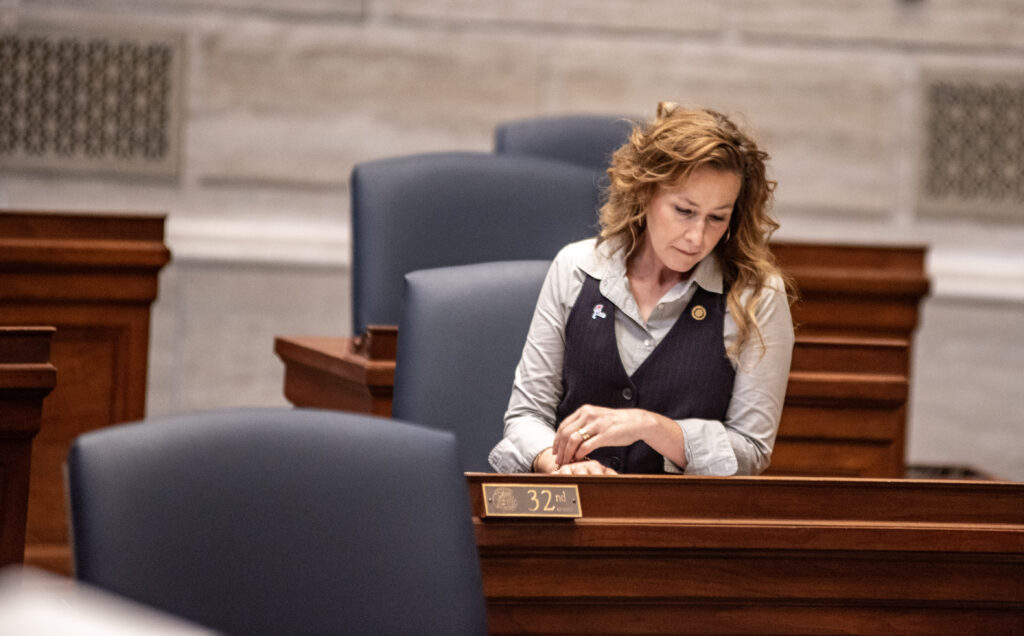
Sen. Jill Carter, a Republican from Granby, studies the day’s business on the first day of the 2024 legislative session (Annelise Hanshaw/Missouri Independent).
Missouri voters narrowly approved Amendment 8 on Tuesday, giving county sheriffs constitutional protection and restricting who can seek their removal from office.
The measure, which garnered 51% of the vote, writes into the Missouri Constitution the existing requirement that counties elect a sheriff every four years, along with certain duties already established in state law.
The change means lawmakers can no longer eliminate the office of sheriff or change those constitutional duties without voter approval.
It also gives the state attorney general exclusive authority to initiate legal proceedings to remove a sheriff from office, a provision that drew opposition from some Republican and Democratic lawmakers.
Under current law, a county prosecutor or the attorney general can initiate a legal action known as quo warranto seeking a sheriff’s removal. Amendment 8 reserves that authority to the attorney general, with a court ultimately deciding whether a sheriff should be removed.
The amendment does not apply to St. Louis city, St. Louis County or St. Charles County.
Amendment 8 follows a four-year push by Republican lawmakers, led by state Sen. Jill Carter of Granby, to give sheriffs constitutional status.
Carter had the backing of the Missouri Sheriffs’ Association, led by Osage County Sheriff Michael Bonham.
Bonham told The Independent in October that more than 30 states already enshrine the sheriff’s authority in their constitutions and argued that Missouri should do the same.
“It is a pure motive to be able to protect the legitimate office of the sheriff in the state of Missouri,” he said, “that legislators can’t come in and [say] ‘We’re mad at the sheriffs’ and that’s it. We’re going to make a state police.”
The legislation lawmakers passed in May was narrower than earlier versions, which sought to give sheriffs authority to oversee federal and state investigations.
Those provisions were removed, but the debate surrounding Amendment 8 continued to reflect a broader political movement that sees county sheriffs as a check on government overreach.
The final version does not give sheriffs new authority to oversee federal or state investigations. Instead, it places several existing responsibilities into the Constitution, making them more difficult for future legislatures to change.
Opponents questioned some of those duties, particularly language requiring sheriffs to “apprehend and commit to jail all felons and traitors.”
The provision already exists in Missouri statute, but putting it in the Constitution means lawmakers can no longer change it without voter approval.
During House debate in May, several Democrats raised concerns about the wording, particularly the reference to “traitors.”
Democratic state Rep. Aaron Crossley of Independence noted that the word “traitor” is not defined in state statute.
“Is a traitor a protester?” he said. “Is it a political dissenter? Is it someone who disagrees with whoever is in power? I’m already uncomfortable with it being a statute, but putting it in our constitution where it can never be changed – or it can be but with a lot of hassle – I think that we’re really treading down a dangerous, dangerous road.”
Supporters maintained that the amendment was about preserving the elected office of sheriff, not expanding its authority.
Its passage now places that office and its constitutional duties beyond the reach of ordinary legislation, while concentrating the authority to seek a sheriff’s removal in the hands of one statewide elected official.
This article was originally published by Missouri Independent and is republished by MetroSTL under a Creative Commons license. The reporting is the outlet’s; please support them.