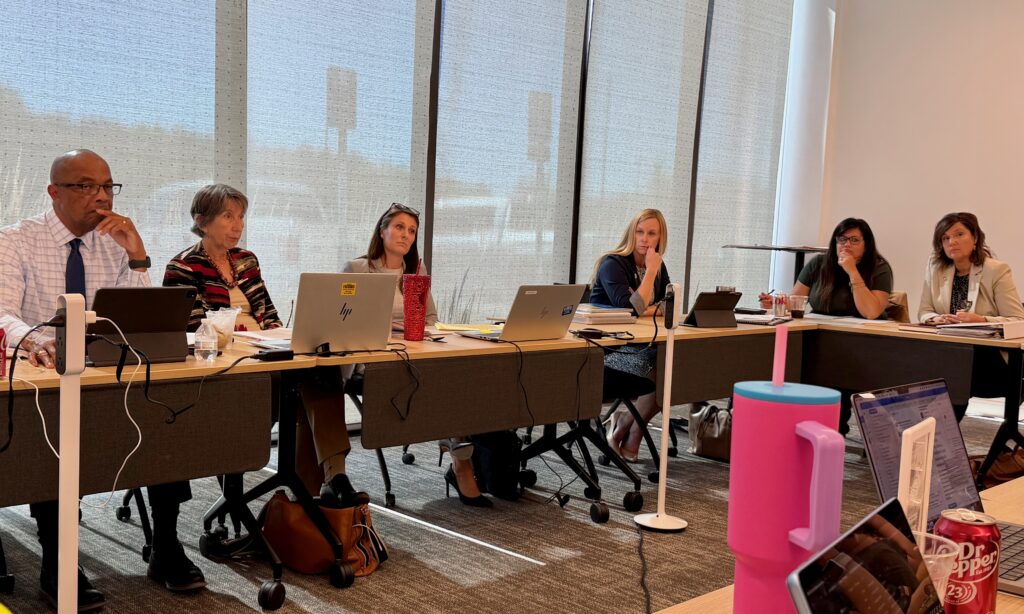
Members of the Missouri Child Welfare Task Force discuss child safety standards in Jefferson City, Missouri, on Oct. 5. Pictured from left are St. Louis County Chief Juvenile Officer Rick Gaines, Missouri State Courts Administrator Kathy Lloyd, Christian County Circuit Judge Jessica Kruse, Audrain County Associate Circuit Judge Melissa Buckman Young, Children’s Division Director Sara Smith and State Rep. Melissa Schmidt (Steph Quinn/Missouri Independent).
The growing attention being given to Missouri’s child welfare system offers a critical opportunity to address not only the challenges with the system, but the circumstances that bring families to a point of crisis — and into contact with the system in the first place.
Children’s Division Director Sara Smith has made significant strides within her department to reduce the backlog of child abuse hotline investigations, stem the extraordinary rates of frontline staff turnover, and address gaps in the state’s foster care system.
Gov. Mike Kehoe also recently signed an executive order creating the Missouri Child Welfare Task Force, a panel charged with issuing recommendations for the Legislature ahead of the 2027 legislative Session.
These improvements are important steps forward, and the progress being made should be recognized.
But while improving the systems that support children and families is necessary, lasting change requires us to look upstream at the systemic conditions that contribute to family stress and instability.
Problems at Children’s Division are a direct reflection of the struggles that families in poverty and in crisis face.
The scale and scope of child abuse, neglect, and state intervention we currently see in our state is itself preventable—a problem entirely within our ability to understand and to solve.
Successfully tackling many of the longstanding challenges within the Children’s Division will require us to acknowledge some inconvenient truths:
- Children’s Division and DSS frontline staff handling the emotional and mental burden of child abuse and neglect investigations need — and deserve — vastly improved or restructured pay and compensation;
- As a state and as a society, we must invest in the basic supports that help children thrive- and keep them out of the system in the first place: healthcare, food security, stable housing, consistent access to diapers, formula, clothing, and child care from trusted providers;
- Finally, and possibly the most important and most difficult truth of them all: we have to muster the political will to tackle the root causes of the child welfare problem and the willingness to rebuild the system from the middle out, at the community level.
As the newly-constituted Child Welfare Task Force begins its work to understand the full scope of what children, families, and frontline professionals are experiencing, we have to push to ensure that the most cost-effective and proven method for reducing and eliminating child abuse and neglect is not left out of the discussion altogether: prevention.
Why is prevention widely recognized as an effective, efficient, and attractive approach?
Preventing child abuse and neglect means meeting parents exactly where they are while also putting the health and safety of children first. Prevention makes keeping children and families together—safely—the top priority in any child welfare system.
There is a common misconception that child welfare intervention is primarily about the most extreme and heartbreaking cases that make headlines. Those cases do require immediate action. But the reality is that many families who come to the attention of child welfare—and drive up unmanageable caseload numbers—are facing challenges that could have been addressed much earlier with the right supports in place: a parent overwhelmed by circumstances, a family without enough food, a child who needs medical care, or a caregiver without anyone to call for help.
The Saint Louis Crisis Nursery has served Missouri families for over 40 years, keeping nearly 150,000 children safe and healthy since 1986. Through our work, we have witnessed a simple but powerful truth: when families do not have the support they need, children are more likely to experience crises that can bring them into contact with the child welfare system.
But we have also witnessed the opposite: when families receive timely support—safe child care during moments of crisis, access to basic necessities, connection to resources, and ongoing community-based support—the outcome changes drastically. Families stabilize. Parents gain confidence and tools. Children remain safely connected to the people who love them and the child welfare system has no reason to get involved.
When a caseworker arrives at a family’s door and finds a child whose needs are not being met because a family is struggling, what should we want our system to do? We should want it to connect that family with food, health care, safe child care, and meaningful support. We should want it to strengthen families before a crisis escalates.
Doing so is not a failure to protect children; it is exactly what protecting children looks like.
Missouri children deserve more than they currently are getting from our child welfare system, and we must be willing to examine and change the systems, policies, and practices that stand between children and families and the support they need to thrive.
Now is the time to raise our voices together and demand better. Now is the time to place prevention — and compassion — at the very heart of our approach to child welfare.
This article was originally published by Missouri Independent and is republished by MetroSTL under a Creative Commons license. The reporting is the outlet’s; please support them.