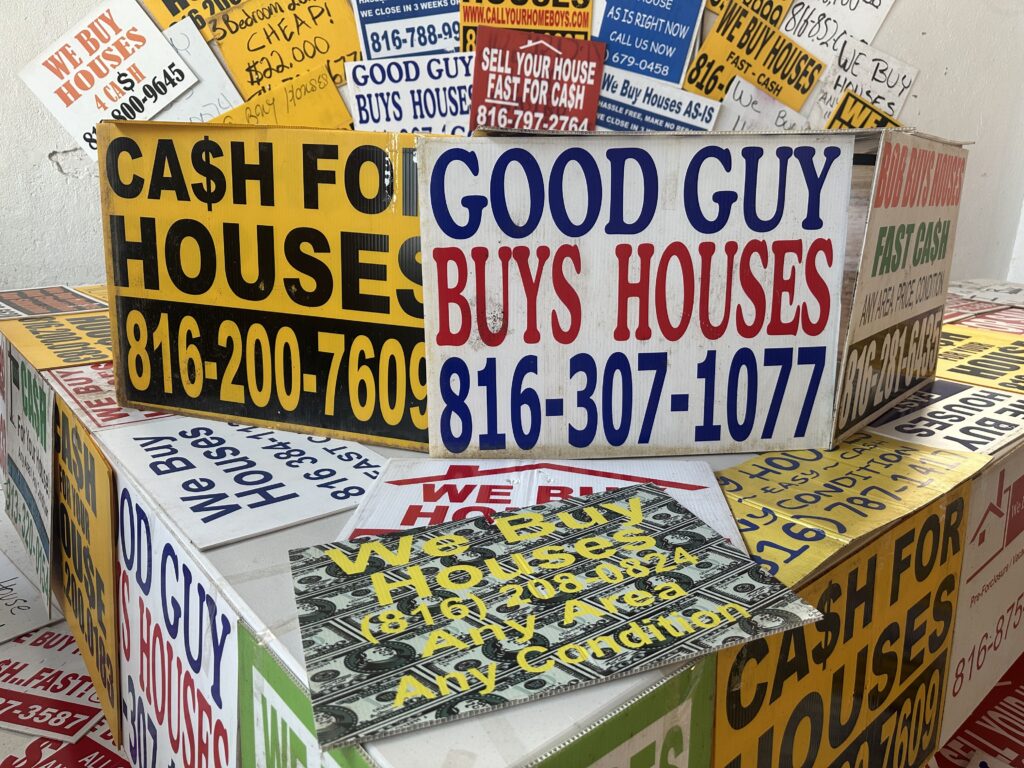
A collection of signs advertising cash for homes is shown earlier this month at an event in Kansas City, Missouri, celebrating a new state law regulating real estate wholesalers. Critics say these businesses can be predatory, especially for poor, minority and older homeowners. (Photo by Kevin Hardy/Stateline)
WE BUY HOUSES. CASH 4 HOMES. FA$T CA$H.
The signs, text messages and mailers promise cash, quick sales and a seamless means of unloading unwanted homes.
But advocates say the business of buying homes for cash can confuse vulnerable homeowners and rob them of home equity. And now, many states are cracking down.
Wholesalers often solicit directly, calling or door knocking looking for sales. But they’re best known by the signs lining curbs and utility poles.
Real estate wholesaling operates distinctly from the traditional real estate market of listings, showings and agents. Wholesalers look to get unlisted homes under contract at a discount and then sell or assign that contract to another speculator before finalizing the property transfer — acting as a middleman and pocketing a profit along the way. The end buyer may flip the house for a profit or hold it as a rental property, but critics say the process can deprive owners of realizing the full value of their homes.
A growing number of state lawmakers worry that buyers don’t fully understand the wholesaling process or even who will end up owning their home at the end of the sale. Lawmakers and regulators, backed by organized real estate trade groups and consumer advocacy organizations, are pushing for more limits on the practice. At least 15 states have recently approved new regulations of wholesalers.
Those include Missouri, where Republican state Rep. Chris Brown sponsored the House version of a law enacted earlier this year requiring wholesalers to give sellers a written disclosure at least 14 days before closing, the final step in the property transaction. The disclosure informs homeowners that the wholesaler may offer below market value and reassign the contract to another buyer. It also encourages sellers to contact an attorney before finalizing a deal.
Brown, who holds an inactive real estate license and is married to an active agent, said the law doesn’t ban wholesaling altogether.

“We’re just trying to make sure that there’s transparency there, and that the seller of the property is in fact educated and fully informed as to what the wholesaler plans to do with the property,” Brown told Stateline. “That’s all it is.”
He said wholesalers often target people facing financial problems or who own homes with major issues.
“And they’re just looking to unload it, and they don’t really at times understand the value of the property,” he said. “So unfortunately, some of these wholesalers become a little bit predatory in nature and then people just lose a lot of equity in their house.”
Critics argue that wholesalers target minority, low-income and older homeowners who may not appreciate the full value of their home. Terrell Walls, president of the Greater Kansas City Association of Real Estate Brokers, a group representing Black real estate professionals, in a statement called predatory wholesaling the “modern-day cousin” of redlining and other practices that historically denied Black families homeownership and wealth.
No state has outright banned wholesaling. But new regulations in Maryland, Ohio, Oklahoma and Texas require disclosure from wholesalers to sellers. Other states, including Illinois, South Carolina and Rhode Island, have required many wholesalers to hold real estate licenses — bringing them under the watch of state regulators.
“Legislators are responding maybe a little too aggressively, but not by much,” said Jeff Watson, general counsel for the National Real Estate Investors Association, which represents 43,000 house flippers and landlords.
‘Stop trying to hide’
Watson said many wholesalers are effectively acting as real estate agents without the same licensing and consumer protection rules. Many wholesalers solicit homeowners directly and then market the home to other investors or buyers once they’ve secured a contract.
“There is a small percentage of wholesalers, in my opinion, that do the business correctly,” Watson said. “They are honest, ethical capitalists. They can buy houses that real estate agents refuse to look at let alone list … Unfortunately, they’re not the majority.”
He said wholesalers can play an important role by helping to find buyers for some of the most distressed homes.
For instance, out-of-state heirs or relatives may want to unload a home quickly after a relative dies or ages out of a house. When those homes are unkempt, have animal infestations or major maintenance needs, owners can secure a quick sale without going through the traditional real estate market.
“Ethical wholesalers can do tremendous things for them,” he said.
Wholesalers have publicly acknowledged that their industry is changing.
Drive for more housing sparks rare bipartisanship in statehouses
Following the enactment of an Oklahoma law last year requiring new disclosures, real estate investor Jerry Norton said wholesalers would have to start doing a better job explaining wholesaling and the value it can provide to owners of distressed homes.
Norton, who could not be reached for comment, says he has made millions flipping and wholesaling homes. He offers paid real estate investment education and runs the popular YouTube channel Flipping Mastery TV. On his show last year, he recounted how he was working to tell sellers how wholesaling works and how they make money off the transactions.
“This is the new way to wholesale. Stop trying to hide what you’re doing,” he said. “Address the elephant in the room. Remember, at the end of the day, the seller wants to work with someone they trust. Honesty is the pinnacle of trust. Be honest and you’ll actually do more business, not less business.”
Consumer confusion
The AARP has pushed model legislation across several states addressing real estate wholesaling. It would require wholesaler licensing, appraisals, cancellation rights and limits on aggressive marketing tactics.
Jenn Jones, AARP’s vice president for retirement security and livable communities, said the organization’s aim is twofold: it wants to ensure older adults can safely age at home and it wants to protect the wealth of homeowners.
“For a lot of older adults, their retirement security, their financial security is in that house,” she said. “That was supposed to be the American dream: You become a homeowner and that asset builds equity, and that is the thing that gives you some comfort in your later years. It’s also the thing that you have that you can pass on to your kids.”
Jones said sellers should know that wholesalers may not be the end buyer of their property, should have the time for an independent home valuation and should be allowed to cancel a contract if they change their minds.
She pointed to the Oklahoma neighborhood where her mother lives. Jones’ mother told her about neighbors quickly selling their homes for $20,000 or less in cash — despite actual property values that are much higher. Her mother, who is in her late seventies, often receives calls and unsolicited visits from people looking to buy her house.
“We could probably all point to a story that we’ve heard or an experience that we’ve had,” Jones said. “This is about making sure that people understand fully the decision that they’re making, and they don’t end up in a situation where they are potentially jeopardizing either their own financial security or that of their kids because they were pressured to sell.”
Experts and lawmakers said recent measures targeting wholesalers have proved largely bipartisan and faced little pushback from the industry.
To promote more housing, cities and states target parking minimums
Rhode Island state Sen. Robert Britto, a Democrat, said a new law he sponsored this year faced “literally no opposition.” It requires wholesalers to possess a state-issued real estate license, which he hopes will put legitimate businesses under state supervision and push bad actors out of the industry.
“I’d think there would be more opposition, but I guess those actors didn’t want to really and truly expose themselves,” he said. “It was a catch-22 for them … Do I complain about it, but if I complain about it, am I showing my true colors?”
That measure was pushed by the Rhode Island Association of Realtors, which represents nearly 6,000 members across the state.
“Real estate professionals are licensed for a really good reason and sometimes the consumers would assume they were talking to a real estate professional,” said Rebekah Wagoner, associate counsel for the trade group.
Wagoner said wholesaling isn’t inherently unlawful or predatory and can play a role in selling distressed properties.
“Our issue is the transparency,” she said. “It’s that a lot of the consumers didn’t understand the transaction.”
Without state licensing, she said wholesalers face no accountability if consumers feel wronged.
“We want them to have a regulatory framework that means that if something happens, the consumer is protected,” she said.
Stateline reporter Kevin Hardy can be reached at khardy@stateline.org.
This article was originally published by Stateline and is republished by MetroSTL under a Creative Commons license. The reporting is the outlet’s; please support them.