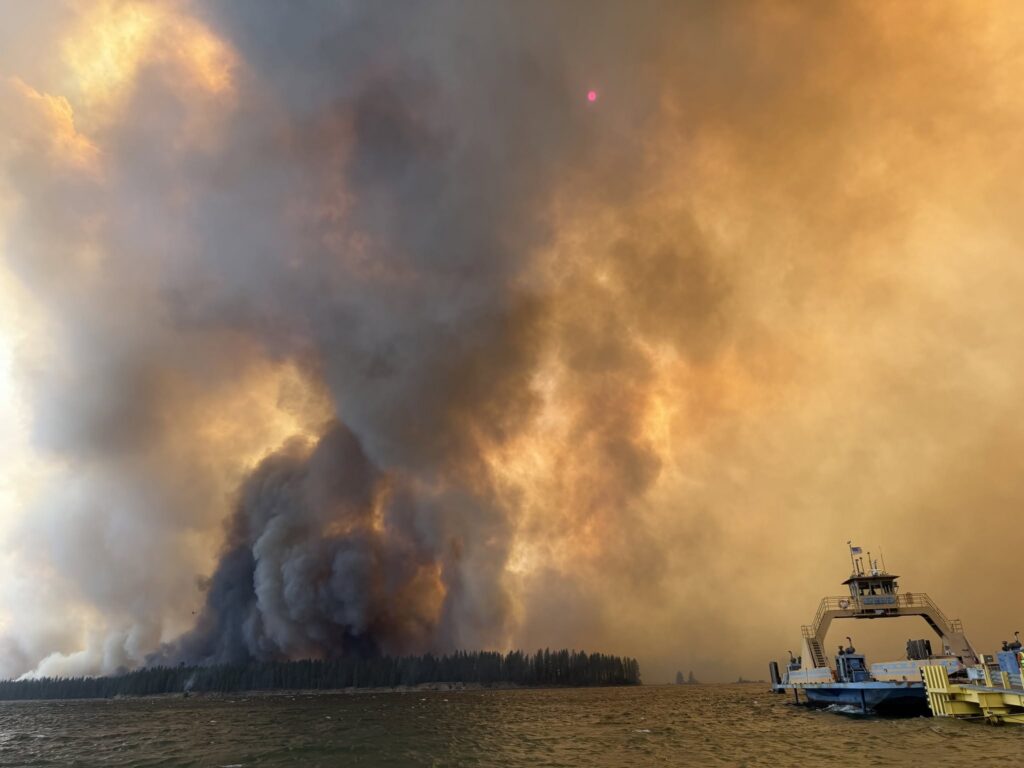
The Columbia Princess Ferry stays on the Gifford side of the Columbia River as the Modrite Fire exhibits extreme fire behavior just south of Inchelium, Washington. Fires in the state hit tribes particularly hard this year. (Photo courtesy of Colville Tribal Broadcasts, News and Information)
Neighbors across the Colville Tribes communities in Washington state knew Matilda Bob’s log home as the “rainbow house,” for its brightly painted exterior.
Now it’s gone.
Sparked by a lightning strike in mid-July, the Kaiser Canyon Fire destroyed Bob’s home and 42 other houses on the Colville Reservation, along with 100 outbuildings such as sheds and barns, tribal leaders said.
“I couldn’t believe that it had happened,” said Bob. “It went so fast.”
Tribal leaders across Washington and Oregon told Stateline that this year’s record-breaking wildfires burned timber that they rely on for income, threatened food sources and waterways, and harmed the health of their communities. Power outages left families without food they’ve hunted or gathered and frozen.
Hotter, drier conditions driven by climate change already have made wildfires nationwide more frequent and intense, a trend that is expected to accelerate. Substandard housing and higher rates of acute and chronic underlying health conditions, including respiratory illnesses, make tribal communities more vulnerable during and after the fires.
“What typically used to be like a two-month fire season for us when I first started fighting fire about 25 years ago — now that’s at least three months and sometimes longer, depending on the year,” said Cody Desautel, executive director of the Colville Tribes, who is also a forester and wildland fire expert.
An especially warm winter also left Washington state with about half its usual snowpack, raising drought concerns and wildfire risks.

This year saw particularly devastating fires in eastern Washington, including arson-instigated fires that destroyed over 700 homes in Spokane. The conditions prompted Washington state Democratic Gov. Bob Ferguson to declare a statewide state of emergency on Aug. 1, citing an “unprecedented” red flag alert of extreme fire danger from the National Weather Service.
The Colville Reservation includes the southern portion of Ferry County, which has the second-lowest median household income of all counties in the state. The tribe lost a significant amount of timber, a main source of income, during the fires.
Many residents didn’t have home insurance because the housing didn’t qualify or they couldn’t afford it, said Cindy Marchand, chairwoman of the Confederated Tribes of the Colville Reservation, adding that about half of homes destroyed in the fires weren’t insured. Other residents couldn’t afford to upgrade to more fire-resistant material, she said.
“The rates are just astronomical in the sense that a lot of people in our area are not able to afford this,” Marchand said. “We have elders living on a single income, they’re on a fixed income, and so they’re having a hard time making it as it is.”
By mid-September, the total acres burned across the state reached roughly 900,000 acres, the worst since 2015.
Since July, about 200,000 acres burned across the Colville Reservation alone, with the Kaiser Canyon Fire scorching over 138,000 acres and the Modrite fire burning more than 57,000 acres.
In Oregon, over 60,000 acres burned across the reservation of the Confederated Tribes of Warm Springs, where at least six homes were destroyed.
The Wrights Spring Fire in Oregon burned through 55,000 acres across Klamath County, national forest and tribal lands.
Health effects
Faith Zacherle-Tonasket has seen how the wildfires have affected perinatal health. Founder of xa?xa? Indigenous Birth Justice, which offers perinatal and doula support across the Colville Reservation, Zacherle-Tonasket said three of her clients went into early labor during this year’s fires. She and her team believe stress amid displacement due to evacuations contributed to the early labor. Emerging research is also showing how wildfire smoke is a primary pollutant affecting pregnancy.
Wildfire smoke is now the primary pollutant affecting pregnancy, study shows
Zacherle-Tonasket also helps lead the River Warrior Society, a nonprofit offering wildfire relief for tribal and non-tribal members. The group has been coordinating shelter placements for elders, donations and food assistance.
“This is one of the biggest fires our reservation has had,” she said. “The biggest need we have on our reservation is air purifiers.”
Respiratory health has been a major concern post-wildfires amid smoke and poor air quality. American Indian and Alaska Native people disproportionately have chronic respiratory health conditions exacerbated by wildfire smoke, including asthma and chronic obstructive pulmonary disease (COPD). Matilda Bob’s father, a veteran who is now displaced with her, has COPD.
Along with respiratory distress, there’s been “tremendous stress, anxiety, grief, trauma — and we expect and know that those behavioral health needs are going to continue beyond this current emergency. Post-fire recovery creates additional health concerns,” said Dayna Seymour, the Colville Tribes’ health and human services chair. “Our members are going in now to clean up the ash and debris, and aren’t really always sure what’s in that ash and debris, whether there’s hazardous materials, heavy metals, asbestos or other contaminants.”
Seymour added that community members helped deliver medications to their displaced neighbors and helped each other dig fire lines.
Research shows disproportionate smoke exposure among tribes in California, noted University of Kansas Assistant Professor Melinda Adams, a cultural fire practitioner and scholar who teaches in the Department of Earth, Energy, and Environment.
“Because wildfire is increasing in frequency and intensity,” said Adams, a member of the N’dee San Carlos Apache Tribe of Arizona, “we must look at cumulative effects and identify patterns in human and environmental health while investing in climate and wildfire mitigation strategies that include Indigenous knowledge.”
Prescribed burns, carefully controlled fires to reduce brush that could fuel megablazes, are crucial tools in preventing dangerous wildfires and preserving ecosystem health. But regulatory barriers have made implementing traditional Indigenous burn practices difficult, Desautel and Adams said.
This week, the U.S. Senate Environment and Public Works Committee advanced legislation that would streamline approval of prescribed burns, while the EPA issued guidance last year.
Funding and staffing limitations are also a barrier, Desautel added. The Indian Forest Management Assessment Team found that Indian trust forest lands are funded at about a third per acre of comparable federal forests.
Waterway pollution, cultural art lost
Seymour added that traditional foods including huckleberries and herbs and roots, such as bitterroot and camas, that the tribes rely on were scorched across the land.
“Those are things that we utilize to help us in ceremony, that we utilize to eat for subsistence. So that was a huge loss for our people,” Seymour said.
In Oregon, while no homes were lost on the Klamath Tribes’ lands, leaders still have concerns and uncertainty around environmental aftereffects, particularly on traditional food systems the tribes were finally in the process of regenerating.
The tribes had just started restoring their ancestral salmon after removal of four dams two years ago. Last year, the tribes documented the first adult Chinook salmon in the Williamson River, and earlier this year detected the first salmon hatch in over a century in the tributaries of the Upper Klamath Lake.
“The biggest (wildfire) impact is the effects on hunting and gathering that may be felt in the future. …With this high-intensity, high-severity wildfire, there’s likelihood of sedimentation into the streams that could serve as spawning grounds for that blue salmon,” said Tim Sexton, Wildland Fire Program Manager at the Klamath Tribes. Research is showing how wildfires affect fish habitats.

Klamath Tribes Chairman William Ray Jr., a former firefighter of 40 years, said he’s been advocating for tribal control of the waterways amid pollution that already existed before this year’s wildfires.
“We have ecological collapse going on. Our water quality in our lake and rivers isn’t very good,” he said.
At the Colville Reservation, Zacherle-Tonasket said many of her community members are holding off on traditional hunting and instead her nonprofit has gotten discounts from local butchers to help families.
“We don’t want to hunt this year,” she told Stateline. “It’s just ethically not right to hunt when our own animals are suffering the way we are.”
Bob said that many cultural heirlooms burned — her own traditional beadwork, a 100-year-old berry basket passed down from her great grandmother, and her nephew’s handmade attire worn during special dances at powwows.
But her family will continue to dance as they do “for the people who can’t,” she said, on their ancestral land.
“Every time your foot hits the floor’s a prayer,” she said. “We were raised to respect the land. … We’re still standing in the fact that we’re all OK, that we all made it, that we didn’t lose anybody.”
Stateline reporter Nada Hassanein can be reached at nhassanein@stateline.org.
This article was originally published by Stateline and is republished by MetroSTL under a Creative Commons license. The reporting is the outlet’s; please support them.