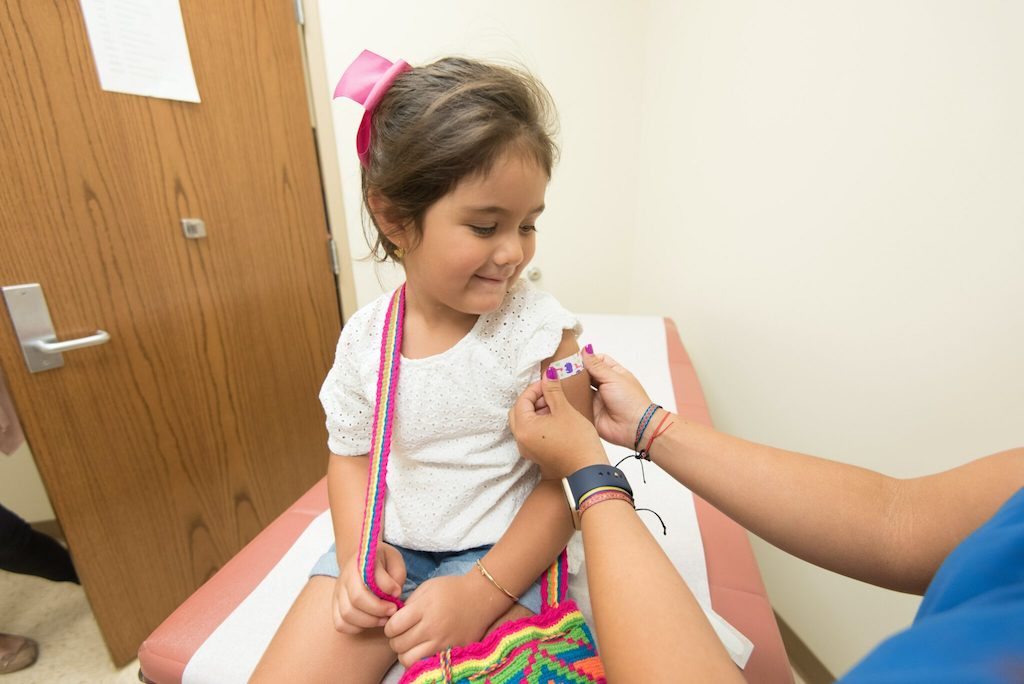
A health care worker places a bandage on a child after giving a vaccination shot (Scott Housley/Centers for Disease Control and Prevention).
A mother carries her 12-month-old into the pediatrician’s office for a routine visit. The doctor recommends the measles, mumps and rubella vaccine- the MMR vaccine- just as pediatricians have for decades.
This time, she pauses.
She heard the President say the MMR vaccine was “sort of like a nuclear weapon.” She heard the head of HHS raise the possibility of a link between vaccines and autism. She loves her child, and is trying to make the best decision she can with the information she has been given.
How can we blame a parent for hesitating when the information landscape has become so confusing?
Her hesitation comes at a critical moment. As of August 13th, the United States has recorded 2,566 confirmed measles cases in 2026, already surpassing the 2,289 total from 2025 and the highest total in more than 35 years.
Measles was considered eliminated from the United States in 2000. As another school year begins, MMR coverage among American kindergarteners has fallen to 92.4%. Exemptions from one or more vaccines rose by ~17% from 3.6% to 4.2% in a single year – meaning ~280,000 kindergarteners are entering school without documented completion of their MMR series. The roughly 95% coverage needed to reliably prevent a measles outbreak is no longer being reached.
Fear travels quickly. Measles can travel with it.
Measles in not simply a childhood rash. It can cause severe pneumonia, hospitalizing one in five unvaccinated persons. Even after apparent recovery, the virus can leave an invisible scar on the immune system. Measles infection can erase 11-73% of children’s pre-existing antibody repertoire a phenomenon called “immune amnesia”- leaving children more vulnerable to infections their immune systems had previously learned to fight.
Years after an apparently complete recovery, a small number can develop subacute sclerosing panencephalitis, SSPE, a degenerate brain disease that is fatal.
Against those risks, we have something remarkably effective: two doses of the MMR vaccine provide ~97% protection against measles.
The question parents are hearing most loudly – does MMR cause autism? – has been asked repeatedly and studied on an enormous scale. Large population studies involving millions of children have found no increased risk of autism after MMR vaccination. Researchers have even looked specifically at children with an older sibling with autism, a group already at higher baseline risk. The result was the same: MMR vaccination was not associated with an increased risk of autism.
This is why the August 10th executive order matters.
The order states that the combined MMR vaccine should be replaced with separate vaccines for measles, mumps and rubella when available and “to the maximum extent feasible” childhood immunizations should be administered at separate medical visits.
There is no published scientific evidence that splitting MMR into three vaccines makes children safer. But it could turn a two-dose series into six injections; each additional visit creating another chance for children to remain incompletely protected.
This is not an abstract inconvenience. About 60% of rural counties do not have a pediatrician. For a parent paid by the hour, getting a child vaccinated may already mean a long drive, lost wages and scare time off. US data show that combination vaccines result in fewer total needles and a higher likelihood of completing the full vaccine series.
Separate measles, mumps and rubella vaccines are not currently licensed or manufactured in the US, and have not been since 2009. Re-establishing manufacturing and attaining regulatory approval would take years and substantial investment, Merck has estimated the process could take roughly a decade.
History should make us cautious about fragmenting vaccine programs. After Japan discontinued MMR in 1993, it later experienced major measles resurgences. Its eventual response included a national catch-up campaign using a combined measles-rubella vaccine and aggressive efforts to restore high coverage.
We do not need to repeat every experiment in public health to learn from it.
None of this means vaccines should be immune from scrutiny. Parents deserve answers to hard questions. Safety signals should be investigated and recommendations should change when better evidence emerges. Our vaccine safety system was built to do exactly that. One example is the rotavirus vaccine: an earlier version was withdrawn after post licensure monitoring detected an increased risk of intussusception.
Earlier this year, the federal childhood vaccine schedule was revised from vaccines routinely recommended against 17 infections to 11 without the traditional evidence -review process. Since ACIP was created in 1964, changes to the federal vaccine schedule have traditionally followed a rigorous process of evidence review, risk benefit analysis and revision when safety monitoring reveals new evidence.
A federal judge subsequently blocked implementation of those changes while litigation proceeds. The August 10 order goes further, urging states to reconsider school vaccination requirements and directing the Attorney General to support certain legal challenges involving exemptions.
The order itself does not rewrite Missouri law. School vaccination requirements remain principally a state responsibility.
This gives Missouri lawmakers both an opportunity and a responsibility.
Missouri legislators should ensure that any change in childhood vaccination policy comes with clear accessible and evidence- guidance for parents. Families should be told what each vaccine prevents, its known risks and benefits, what the evidence does and does not show, and whether a federal announcement actually changes
Missouri law or medical recommendations.
Missouri should also consider safeguards already used elsewhere: requiring parents seeking nonmedical exemptions to receive evidence-based information about vaccination; making school-level vaccination and exemption rates readily available to families; and ensuring that state recommendations are grounded in a transparent scientific review process.
This is not a choice between parental rights and public health. A choice is only truly informed when the information behind it is reliable.
Missouri cannot control every message a parent hears from Washington, a television commentator or an algorithm on a phone. But Missouri can control what happens next.
When that mother sits across from her child’s pediatrician, wondering whom to believe, our state can make sure she has clear evidence rather than more noise – and that a preventable disease does not become the price of preventable confusion.
This article was originally published by Missouri Independent and is republished by MetroSTL under a Creative Commons license. The reporting is the outlet’s; please support them.