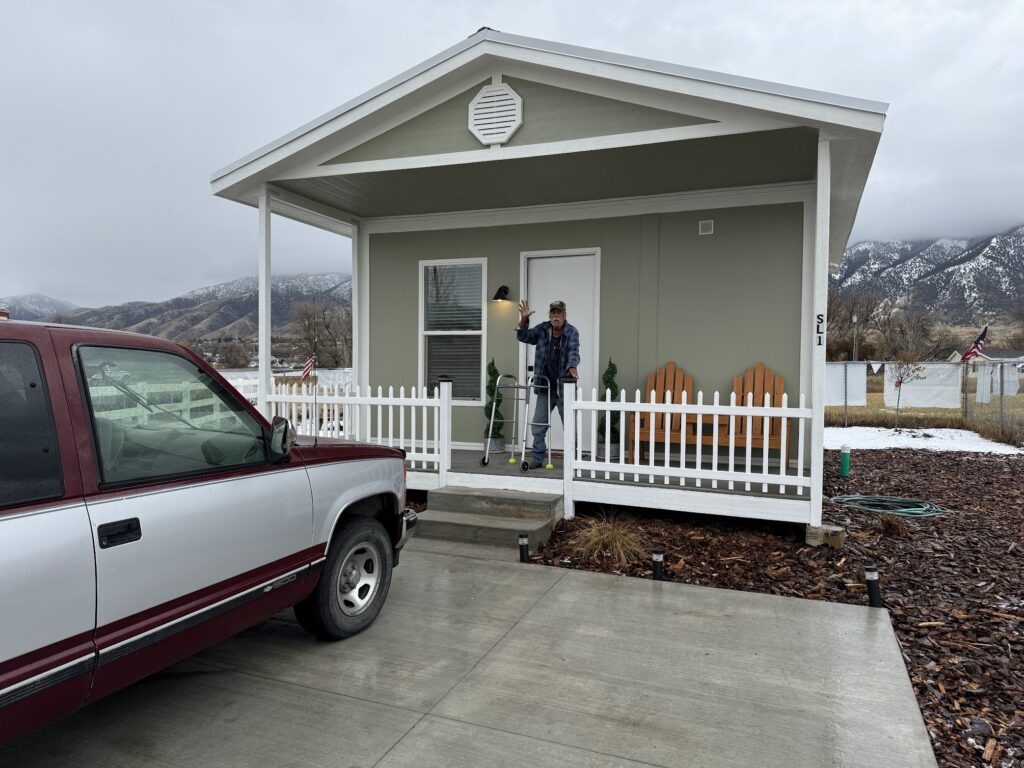
A veteran waves from a housing unit built exclusively for veterans by a Utah-based nonprofit. Despite national veteran homelessness reaching a record-low in 2025, half the states recorded increases during the January 2025 point-in-time count. (Photo Courtesy of USA Project Valor)
Veteran homelessness dipped slightly from 2024 to 2025, according to the latest results from the January 2025 point-in-time count.
The U.S. Department of Housing and Urban Development counted 32,495 veterans experiencing homelessness, 387, or 1.2%, fewer than the previous year. HUD counted 18,877 veterans in shelters, and 13,518 living unsheltered in places not meant for habitation.
Twenty-five states recorded increases in veteran homelessness from 2024 to 2025, and 23 recorded decreases. Just two states — Alaska and Massachusetts — saw no change.
The state with the largest increase, by raw numbers, was Oregon, which saw 228 added veterans, a 16% increase. Pennsylvania saw an increase of 98 veterans, a 14% increase, while New York, with an additional 93 homeless veterans, had a nearly 8% increase.
Mississippi had the largest percentage increase, rising 88%, going from 40 homeless veterans in 2024 to 75 a year later. Utah and Wyoming saw increases of 36% and 30%, respectively.
California recorded the largest numerical decline, with 624 fewer veterans experiencing homelessness, a 7% dip to 8,686. Florida declined by 192, while Indiana and Illinois each recorded 79 fewer homeless veterans. North Dakota’s numbers dropped 36% to 28 homeless veterans.
Since 2010, veteran homelessness has fallen by more than 56%, reaching an all-time low in 2025, and it’s been one of the few sustained decreases in any subset of homelessness during that time span. Details from this past January’s point-in-time count have not been released.
Adam Ruege, principal of policy and evaluation at Community Solutions, a national nonprofit that works with cities, counties and states to reduce homelessness, said the long-term decline resulted from sustained federal investments in housing and mental health services dating back to 2009.
States have taken a bigger role in addressing veteran homelessness, with programs ranging from incentives for landlords, to coordinated services.
“Twenty years ago, being a veteran increased your likelihood of being homeless,” said Ruege, who previously worked for the U.S. Department of Veterans Affairs. “What we’re seeing states do now, is that they are filling the gap between what the federal response isn’t doing and what localities can’t do because of funding constraints.
In July, New Jersey announced that its Bringing Veterans Home initiative saw more veterans finding housing than entering homelessness. According to state officials, since the initiative launched in November 2024, it has permanently housed more than 2,500 veterans, backed by more than $30 million in state and federal money. There’s pending legislation to codify the program.
In March, the Minnesota Department of Veterans Affairs had a statewide by-name registry that allows agencies and service providers to coordinate individual cases instead of making veterans navigate programs independently. The registry, at last update, showed 150 veterans experiencing homelessness, dropping 25% in a year and 41% in two years.
States making efforts to incent or spur landlord participation in voucher and other housing programs, Ruege said, is one of the biggest steps toward getting veterans into permanent housing.
Florida Republican Gov. Ron DeSantis approved a statewide measure in June that created a pilot program getting landlords to participate in a federal voucher program that compensates landlords for holding a vacant unit for up to 45 days while a veteran prepares to move in and reimburse up to $2,000 in qualifying property losses beyond the security deposit.
Maine Democratic Gov. Janet Mills signed a law in April that establishes an incentive program that can give grants to nonprofits for landlord and housing provider incentives, risk-mitigation payments and veterans’ past due rent.
“I think a big factor in their success has been recruitment of landlords,” said Ruege. “It’s just a matter of political and private will, and in some ways, the will of a landlord, to make strides in cutting down homelessness on the local level.”
California announced $109.6 million in July for 278 permanent supportive homes across four communities, including 103 units reserved for veterans.
In March, Pennsylvania awarded about $805,000 from its Veterans’ Trust Fund to county agencies and nonprofits, including programs providing emergency housing assistance, residences, for veterans leaving homelessness and services for veterans exiting homelessness.
Erin Healy, a principal for large-scale change at Community Solutions, said veterans have often been treated differently from other groups experiencing homelessness.
“So, there is a sense of urgency around veteran homelessness, which doesn’t necessarily exist, even though it should, for all homelessness,” Healy said. “But we know these solutions and more empathy can still work for these other groups that are experiencing homelessness.”
Since the U.S. Supreme Court’s 2024 Grants Pass v. Johnson ruling gave governments greater latitude to enforce public camping restrictions, at least 14 states and more than 350 cities have adopted tougher laws targeting camping, sleeping or other activities associated with unsheltered homelessness.
Indiana, for example, enacted a statewide public camping ban that took effect in July, while Georgia and Oklahoma have adopted laws that can hold local governments accountable for failing to enforce restrictions on public camping and related conduct.
Stateline reporter Robbie Sequeira can be reached at rsequeira@stateline.org.
This story was originally produced by Stateline, which is part of States Newsroom, a nonprofit news network which includes Missouri Independent, and is supported by grants and a coalition of donors as a 501c(3) public charity.
This article was originally published by Missouri Independent and is republished by MetroSTL under a Creative Commons license. The reporting is the outlet’s; please support them.