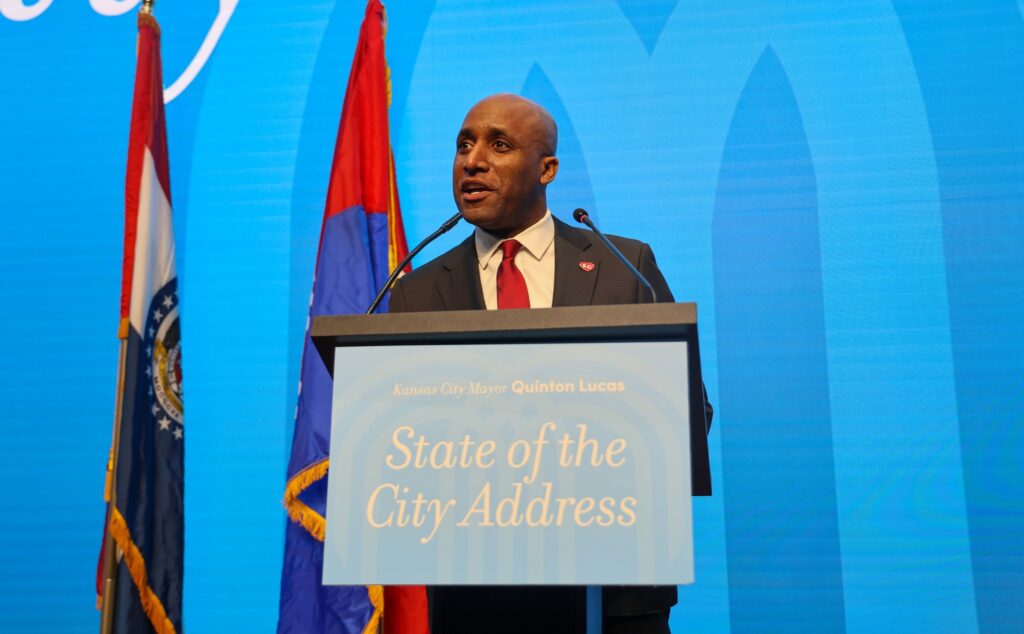
Kansas City Mayor Quinton Lucas delivers his State of the City address in February 2024 (photo courtesy of the City of Kansas City).
On May 14, Kansas City was told in no uncertain terms by its own consultants that its practice of racial and sex-based preferences in city contracting faced serious legal problems.
The Council chose not to end the program.
There was no coverage of the report in local media until my column in The Kansas City Star a month later.
Then, on July 22, Missouri Attorney General Catherine Hanaway filed a lawsuit against the city. That got people’s attention.
The Star finally published a few stories and at least one opinion column from an editorial writer. Others blogged about it. But much of that coverage focused on racial wealth gaps, Hanaway’s politics or the effect of the program on white male contractors.
Those are legitimate subjects for debate. But they largely sidestepped a more immediate question: What did Kansas City do after its own consultants warned that the existing program was legally vulnerable?
Mayor Quinton Lucas did more of the same when we spoke on a local radio program on July 30. While he dismissed the study’s findings, he offered no criticism of the study itself and no competing analysis or data that would challenge its findings. He could not even identify what it would take for him to change his mind on the city’s existing contracting policy.
Later that same day, Councilwoman Melissa Patterson Hazley posted a statement on social media announcing the introduction of several new ordinances, “to begin the process of reimagining Kansas City’s business enterprise programs.” FOX4KC reported on the 31st that Lucas said, “the city had already begun reviewing and revising the program months before the lawsuit was filed.”
Maybe so. But the public record raises questions about how far that work had progressed before Hanaway sued.
While the city did open a 45-day public-comment period on its Minority and Women Business Enterprise (MWBE) program after receiving the consultant’s report, it continued operating under same contracting preferences its consultants had warned could face legal challenges.
The ordinances that Lucas claims were the product of months of deliberation were introduced eight days after the lawsuit. Hazley’s own press release indicates the ordinances were meant “to begin the process” and were the result of the consultant’s report, “and the lawsuit subsequently filed by our own state attorney general’s office.”
Four of the five ordinances are largely overlapping alternatives. Ordinances 260688 and 260689 would suspend different combinations of the city’s MWBE and construction-workforce programs. Ordinances 260690 and 260691 would repeal different combinations of those same programs. These are not five complementary parts of a carefully assembled package; they are competing options for what the council might do.
The fifth, Ordinance 260692, attempts to establish the replacement small-business program. It runs 49 pages — it looks unfinished.
It contains unresolved drafting choices such as “three / five consecutive years.” It refers to “Emergency contracts as defined in Code Section XXXX Chp 2.” It is inconsistent with capitalization and formatting, uses “13cfr” instead of “13 CFR” and includes obvious grammatical mistakes. One provision refers to work performed with a firm’s own “focus,” apparently where “forces” was intended. Another uses the plural “cities” where it presumably means the possessive “city’s.”
Councilman Johnathan Duncan’s name is misspelled as “Dunca” in the ordinance’s sponsor line.
None of the five measures was accompanied by a substantive docket memorandum explaining its legal, administrative or financial consequences.
Perhaps city officials began discussing changes soon after the May 14 consultant presentation; the public record does not establish when drafting began. And perhaps early versions of city ordinances routinely contain placeholders and typographical errors.
But the known timeline is hard to ignore. The council had the consultant’s findings for more than two months without suspending, repealing or materially changing the program. It then produced five overlapping ordinances eight days after the attorney general filed suit.
The councilwoman promoting the package expressly connected it to that lawsuit. The replacement ordinance contains the sort of placeholders, alternatives and mistakes ordinarily found in an internal working draft — not legislation that appears ready for public consideration.
The urgency became explicit at the council’s Aug. 11 Finance Committee meeting. Without objection, the committee recommended passage of Ordinance 260690, which would repeal the city’s existing MWBE program, and Ordinance 260692, which councilmembers described as a temporary small-business substitute while the city reimagines the program. The committee held the other three alternatives—260688, 260689 and 260691.
Councilmembers and Mayor Lucas repeatedly connected the need to act quickly to Hanaway’s lawsuit and an upcoming court hearing. Whatever work may have begun before the lawsuit, it was plainly the lawsuit—and its immediate legal timetable—that forced the council to choose among its unfinished alternatives.
The city’s own May presentation laid out a sensible process: conduct a gap analysis, identify necessary legislation, develop an implementation plan, determine staffing and budget needs, and train employees. If that work occurred before July 30, the city should show it.
For now, the available evidence supports a much less flattering conclusion: Kansas City paid for a study, received a warning about its program’s legal vulnerability, left that program in place for more than two months and moved publicly toward major changes only after Hanaway sued.
Mayor Lucas has repeatedly complained about the waste of city and state tax dollars on the lawsuit. The Finance Committee has now recommended ending the existing MWBE program and temporarily replacing it with a small-business program. But it should not have taken a lawsuit—and the pressure of an approaching court hearing—to produce that decision.
The council had its consultant’s warning in May. It could have acted before Hanaway sued. Any avoidable cost to state taxpayers for bringing the lawsuit or local taxpayers for defending it rests with a council that waited until litigation forced its hand.
If you don’t want to be sued, don’t wait until after the lawsuit to stop breaking the law.
This article was originally published by Missouri Independent and is republished by MetroSTL under a Creative Commons license. The reporting is the outlet’s; please support them.