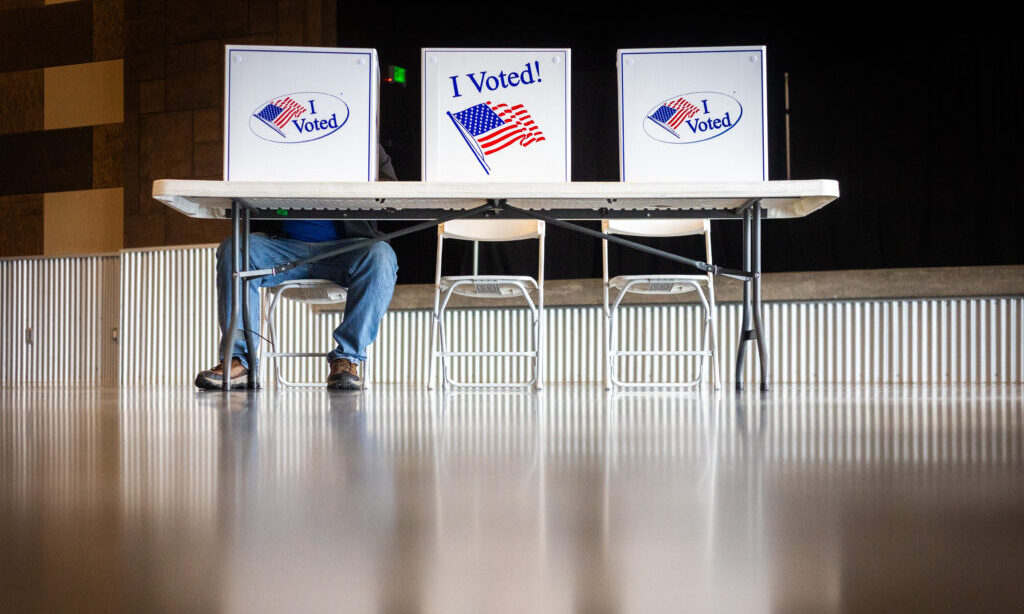
In all, voters settled 11 competitive Senate primaries profiled this summer by The Independent — nine Republican and two Democratic (Pat Sutphin for the Idaho Capital Sun).
Missouri Republicans ousted a sitting state senator and split their verdict among insurgents and establishment-backed candidates in a Tuesday primary that reshaped the likely balance inside a GOP caucus already facing significant turnover.
Springfield elder law attorney Lori Rook defeated state Sen. Curtis Trent 53% to 47% in southwest Missouri’s 20th Senate District, ending Trent’s bid for a second term — and his campaign to become Senate majority floor leader next year.
Elsewhere, House Speaker Jon Patterson easily turned aside a conservative challenger in suburban Kansas City, while state Rep. Greg Sharpe won a three-way race in northeast Missouri despite an organized effort to punish him for opposing a major Republican tax proposal that voters overwhelmingly rejected Tuesday.
In all, voters settled 11 competitive Senate primaries profiled this summer by The Independent — nine Republican and two Democratic.
Rook’s victory was the night’s biggest upset.
Trent entered the race with years of experience representing southwest Missouri, support from much of the Republican establishment and a substantial financial advantage. The 20th District was the most expensive Senate contest of the primary, with candidates and outside groups spending $2.4 million.
The 417 PAC, aligned with Trent, spent $838,000, including more than $500,000 attacking Rook.
Senate Republican primary carries stakes beyond southwest Missouri
But Rook ran against the advantages Trent accumulated in Jefferson City, portraying his campaign for majority leader and support from lobbyists and political action committees as evidence he had become disconnected from the district.
“People outside the echo chamber of this establishment group just want somebody that’s going to go up to Jefferson City and fight for them,” Rook told The Independent during the campaign.
Rook also attacked Trent over his support for a 2025 utility law allowing electric companies to charge customers for power plants while they are under construction and his sponsorship of Amendment 5, the income tax overhaul that lost Tuesday by more than 60 percentage points.
Amendment 5 was an issue in several other Republican primaries, though Tuesday’s results offered no simple verdict on candidates who supported it.
In northeast Missouri’s 18th District, Sharpe won with 47% of the vote, defeating political newcomer Dusty Blue, who received 29%, and state Rep. Ed Lewis, who had 22%.
Sharpe was one of only three House Republicans who opposed Amendment 5 every time it came up for a roll call. The Republican Accountability Project PAC, funded by the group promoting the amendment, spent more than $91,000 opposing him.
Lewis supported Amendment 5 and sponsored Amendment 4, the initiative petition proposal that also lost by nearly 60 points Tuesday. He also had the endorsement of outgoing Senate President Pro Tem Cindy O’Laughlin.
Blue ran as an anti-establishment candidate promising to push the Senate to the right and make Senate debate available by video livestream.
Missouri governor’s tax plan draws skepticism in crowded state Senate GOP primary
In central Missouri’s crowded 6th District, Jake Vogel, president of Jefferson City Coca-Cola Bottling Company, won with 26.6%.
State Rep. Rudy Veit finished close behind with 24.6%, followed by Camden County Presiding Commissioner Ike Skelton with 22.7%. Former Jefferson City Councilman Derrick Spicer received 12.6%, former state Rep. Lisa Thomas had 10.8% and restaurant owner Amber Buckles finished sixth.
Veit was also targeted for opposing Amendment 5, with the Republican Accountability Project spending more than $46,000 against him while backing Vogel.
But skepticism of the tax proposal extended well beyond Veit. Four of the six candidates opposed Amendment 5 or questioned its details during the campaign. Veit and Skelton, who both campaigned against the amendment, together drew 47.3% of the vote.
Vogel, who was endorsed by Gov. Mike Kehoe, supported putting the proposal before voters but was circumspect about its merits during the campaign, telling The Independent: “It is a plan.”
Other prominent Amendment 5 supporters won comfortably.
Patterson defeated former state Rep. Dan Stacy 62% to 37% in the 8th District, which covers Lee’s Summit and Blue Springs.
Patterson helped shepherd Amendment 5 through the House and entered the final stretch of the primary with roughly $2.9 million between his campaign and aligned PAC. Stacy had $43,000 and made the disparity part of his argument that Patterson represented “The Establishment.”
The race also tested Patterson’s occasional breaks with his own party. As speaker, he was the lone House Republican to vote against putting a new abortion ban before voters and had previously opposed Republican efforts to repeal voter-approved minimum wage and paid sick leave requirements.
Stacy ran to Patterson’s right, portraying the speaker’s relationships with major business groups and lobbyists as liabilities. Patterson’s decisive victory keeps one of the House’s most powerful figures on track to move to the Senate next year.
In south-central Missouri’s 16th District, state Rep. Bill Hardwick won with 43%, followed by former state Rep. Hannah Kelly with 30% and state Rep. Don Mayhew with 22%.
Hardwick was one of Amendment 5’s strongest legislative supporters, but gambling drew much of the outside money in his race.
J&J Ventures, an Illinois gambling company seeking to legalize video lottery terminals in Missouri, gave $422,000 to Legio XIII PAC, a committee with no other donor that financed radio ads attacking Kelly. The company separately gave $95,000 to a PAC aligned with Hardwick, the House sponsor of legislation that would legalize the machines, and the maximum $4,000 to his campaign.
Gambling company bankrolls attacks in Missouri Senate District 16 GOP primary
Kelly and Mayhew both opposed legalizing video lottery terminals. Kelly also opposed Amendment 5, while Mayhew voted to put it on the ballot before later souring on the proposal.
In the 28th District, emergency room physician and farmer Sam Alexander defeated state Rep. Brad Pollitt, winning 54% to Pollitt’s 28%.
Alexander ran as an outsider against Pollitt’s argument that eight years in the House and relationships in Jefferson City made him more effective.
The race turned bitter when a PAC aligned with Pollitt sent mailers attacking Alexander over a decades-old trespassing case. The negative campaign sparked a backlash among some people who had originally agreed to help organize the PAC.
Alexander opposed Amendment 5. Pollitt repeatedly voted to put it on the ballot but declined during the campaign to say how he planned to vote Tuesday.
Data center development dominated much of the contest in the 10th District, where Missouri Cattlemen’s Association executive Mike Deering defeated state Rep. Tricia Byrnes 56% to 44%.
Amazon and Google are building enormous data centers along Interstate 70 in the district, and Byrnes tried to make opposition to the developments a defining issue, accusing Deering of being too closely aligned with politicians and business interests that had welcomed the projects.
Deering rejected Byrnes’ portrayal of him as a data center ally, telling The Independent that large projects need “massive, massive guardrails” protecting natural resources and preventing utility customers from absorbing additional costs.
The campaign’s closing weeks were dominated by attacks on Byrnes over her 2025 test of Missouri’s 988 suicide and crisis lifeline. A PAC aligned with Deering accused her of falsely claiming to be suicidal, while Byrnes argued the episode was used by political opponents to distract from problems she identified with the hotline.
In southwest Missouri’s 32nd District, incumbent state Sen. Jill Carter easily turned aside a challenge from neurosurgeon Ellen Nichols, winning 70% to 30%.
Carter survived almost $90,000 in spending by AFC Victory Fund, a national school-choice group that attacked her for missing the final vote on a sweeping 2024 education bill.
The group also spent nearly $150,000 opposing Hardwick and $36,000 opposing Rook. All three won Tuesday.
Family ties create tag-team rematch in Missouri’s 32nd District state Senate primary
The 32nd District race was also a rematch by proxy. Carter won the seat four years ago by defeating incumbent Sen. Bill White, the only Republican Senate incumbent to lose a primary that year. Nichols is White’s wife.
In northwest Missouri’s 34th District, state Rep. Mike Jones defeated fellow state Rep. Sean Pouche 62% to 28%. St. Joseph restaurant and pub owner Ryan Gerster finished third.
Jones and Pouche voted alike more than 80% of the time during this year’s legislative session but offered different arguments about how they would serve in the Senate.
Pouche emphasized deliberation and his experience working through the legislative process. Jones ran with a harder conservative edge, touting his support for President Donald Trump and arguing he would take a more aggressive approach in Jefferson City.
Democrats also decided two competitive Senate primaries.
Former state Rep. Gina Mitten defeated state Rep. Steve Butz 66% to 33% in the St. Louis-area 4th District, where no Republican filed.
Mitten said Butz’s record on abortion rights prompted her to enter the race. Butz, who personally opposes abortion but supports exceptions, emphasized public safety and his support for returning control of the St. Louis Metropolitan Police Department to a state-appointed board.
Mitten opposed the police takeover and argued the overwhelmingly abortion-rights district needed a senator voters could depend on to consistently support reproductive rights.
In north St. Louis County’s heavily Democratic 14th District, state Rep. Raychel Proudie won a four-way primary with 43%.
St. Louis County NAACP President John Bowman finished second with 27%, followed by former federal health official Joe Palm with 16%. Nonprofit founder and political consultant Shante Duncan was also on the ballot.
Proudie, who is leaving the House because of term limits, ran on her legislative record and argued the district needed a senator willing to use a more aggressive style to deliver results for St. Louis County.
Many of Tuesday’s winners will be heavily favored in November, meaning the primaries effectively selected the next senator in much of the state.
This article was originally published by Missouri Independent and is republished by MetroSTL under a Creative Commons license. The reporting is the outlet’s; please support them.