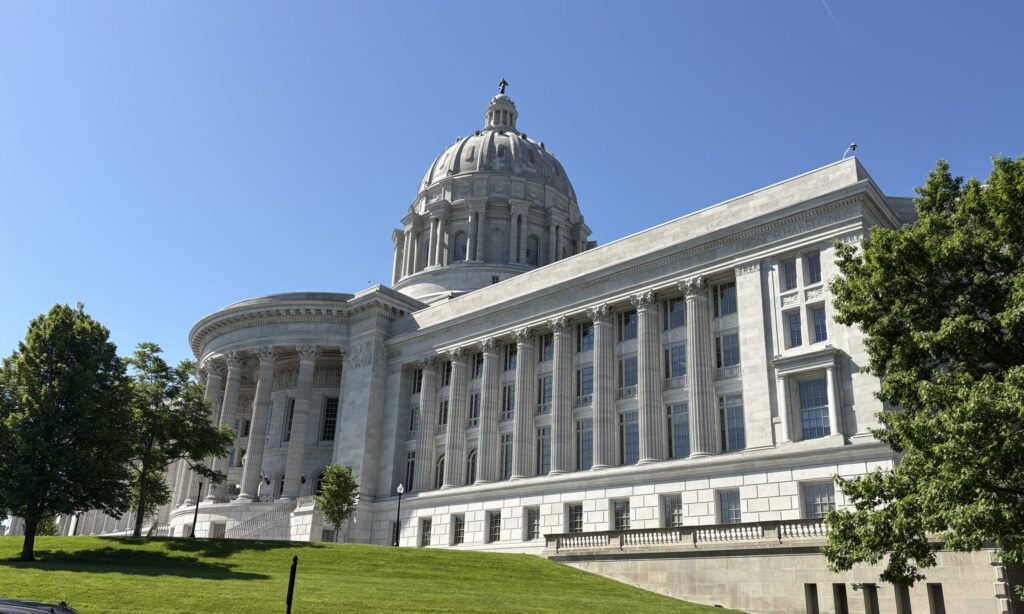
The Missouri Capitol Building in Jefferson City on May 12 (Jason Hancock/Missouri Independent).
Missourians went to the polls Tuesday, and the results resist a single storyline. Here’s what’s worth noticing.
Amendment 5 is the clearest verdict of the night. It lost 83-16. Not close, not regional — a rout. The governor’s top priority, backed by $17.2 million from donors who never had to identify themselves and it couldn’t even clear 20%.
Watch what that did downballot. State Rep. Greg Sharpe voted against it every time it came up, drew more than $91,000 in attack spending for it, and won going away. In the 6th District, the two candidates who ran hardest against it — Rudy Veit and Ike Skelton — together drew 47.3% of the vote, nearly twice the winner’s share. Jake Vogel won that race with 26.6% while offering the least enthusiastic endorsement in Missouri politics: “It is a plan.”
The theory in June was that Amendment 5 would be a loyalty test with consequences. It turned out to be a liability most Republicans had already sensed and run from. Gov. Mike Kehoe says the work isn’t over. The arithmetic suggests otherwise, at least in this form.
The anti-establishment wave didn’t arrive. Dusty Blue lost in northeast Missouri, finishing 18 points behind Sharpe. Dan Stacy lost by 25 in Lee’s Summit to House Speaker Jon Patterson, who helped shepherd Amendment 5 through the legislature. Tricia Byrnes, who built her campaign on data centers in a district where Amazon and Google are actually building them, lost by 12.
Running against Jefferson City was not, by itself, enough. Several candidates spent the summer promising to go to the Capitol and blow things up, and voters mostly declined the offer.
Except in the 20th District.
Lori Rook did exactly that — ran against Jefferson City, its lobbyists and its power structure — and knocked off state Sen. Curtis Trent.
That one matters beyond southwest Missouri. Trent wasn’t just an incumbent. He was running to become Senate majority floor leader, the person who controls what legislation reaches the floor. He had the backing of much of the Republican establishment and an allied PAC that spent $838,000, more than $500,000 of it attacking Rook.
She won anyway.
Which brings us to money.
A national school-choice group spent nearly $90,000 trying to defeat state Sen. Jill Carter, almost $150,000 opposing Bill Hardwick and $36,000 against Rook. It went 0-for-3.
But Patterson’s roughly $2.9 million war chest certainly didn’t hurt him against Stacy, who had $43,000. And Hardwick won after an Illinois gambling company seeking to legalize video lottery terminals poured $422,000 into a PAC attacking Hannah Kelly while giving another $95,000 to a PAC aligned with him.
So Tuesday wasn’t a rejection of money any more than it was a rejection of the establishment.
Maybe the better way to understand the results is that Republican voters were selective about what they were angry about — and whom they blamed.
They overwhelmingly rejected the tax plan Jefferson City handed them. They punished Trent, who had accumulated power in the Capitol, but rewarded Patterson, who had accumulated far more. They chose Sharpe over the candidate endorsed by the outgoing Senate president. But they rejected insurgents elsewhere who made essentially the same argument about a broken political system.
Tuesday didn’t produce a revolution.
It produced something potentially more interesting: a Republican Senate with no obvious mandate about what voters want it to become.
This article was originally published by Missouri Independent and is republished by MetroSTL under a Creative Commons license. The reporting is the outlet’s; please support them.