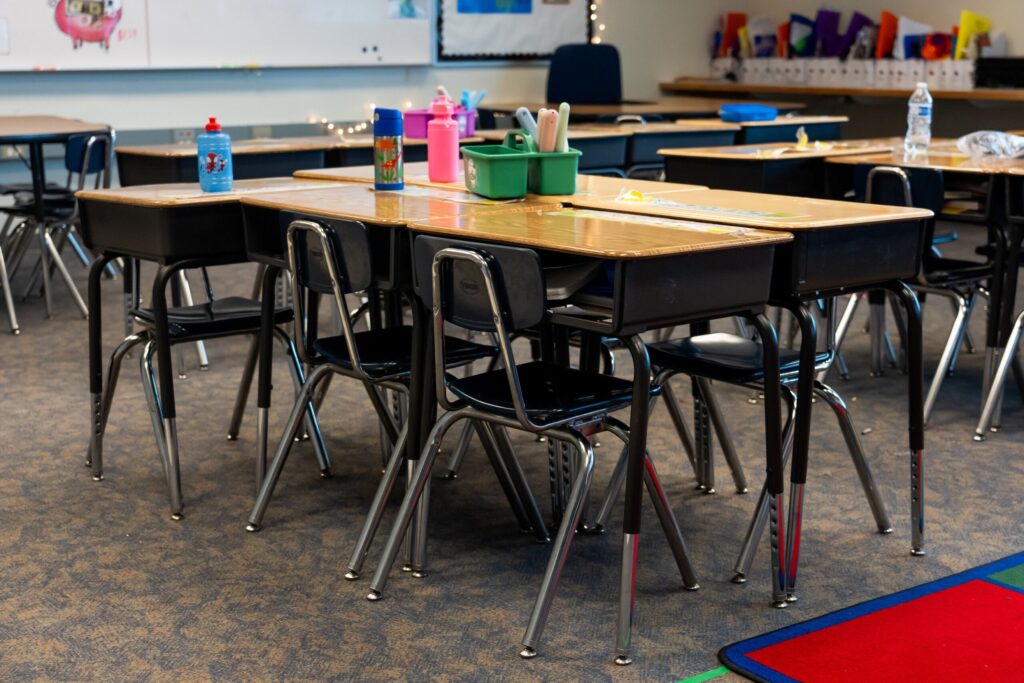
(Spenser Heaps/Utah News Dispatch)
Next month, a child waiting for the bus in a rural district may stand beside a two-lane road, looking across land that has been in one family for generations.
But more and more, that will not be the case.
Rural land that once supported family farms and community life is being absorbed into something larger and less personal. On the ride to school, he may pass where decades ago a locally owned grocery store, hardware store, diner, feed store, or physician’s office once stood — places where people knew not only your name, but your grandparents’ names too.
Now, he is more likely to pass a Walmart, a corporate feed store, empty storefronts, and farmland whose future may be decided by people who will never call that community home. If his community is lucky, the hospital is still there. If not, the nearest emergency room may be an hour away.
That child did not make any of those decisions.
He did not decide manufacturing jobs would leave, the family farm would be sold, or consolidated, main streets would hollow out, hospitals would close, or outside investors would look at rural land and see only acreage, not history.
But through all that change, one institution has remained.
The local public school.
It is where a child can still learn close to home, be known, be challenged, and have the same claim on the future as any child in Missouri.
In many rural communities, the school is not just another public building. It is the last anchor. It is where children learn, where families gather on Friday nights, and where the community turns in crisis — as southeast Missouri did during recent flooding, when schools became response posts.
The school is where a community tells its children: you belong here, and you have a future here.
We have become consumed by grade-level performance, statewide rankings, and figures that fit neatly into narratives. Yet in rural Missouri where almost every other indicator is flashing red — population, jobs, healthcare, income — rural schools are still doing their job. They are educating children in communities asked to absorb decades of economic disruption and preparing students for college, careers, military service, skilled trades, agriculture, health care, and public service.
A state report can measure proficiency, attendance, graduation. Those things matter. But it cannot fully measure whether the school is the last institution keeping a community intact.
Behind every spreadsheet is a larger question: Ten years from now, will every Missouri child still have a strong local public school? And will communities still decide what that school looks like?
That question should concern every Missourian. It is why the future of public education in Missouri is also a rural survival issue.
Because when a rural school weakens, the whole community feels it.
Families who have stayed, worked, worshiped, coached, volunteered, farmed, opened businesses, and raised children there depend on the school as proof that their community still has a future. So do employers, churches, fire departments, and civic groups that rely on people believing the town is worth investing in.
If the school closes, the decision is no longer just about education. It becomes a signal that the community itself is being asked to fade away.
And once that happens, it is very hard to come back.
Missouri is more than its largest cities and suburbs. Our state’s identity was shaped along river towns on the Missouri and Mississippi rivers, on family farms, and in small communities that built schools before almost anything else.
These places are not relics. They are not sentimental backdrops for America’s 250th birthday or the campaign trail. They are living communities, part of the character, economy, and history that made Missouri great.
As we reflect on America’s 250th birthday this year, we should be honest about what kind of Missouri we are preparing to hand to the next generation.
Will we be a state where only larger, wealthier, fast-growing communities can maintain strong schools? Will we tell children in smaller towns that opportunity requires leaving home? Will we accept a future where rural Missouri’s remaining institutions disappear until there is no town left to preserve?
Or will we decide that some things are worth protecting?
Rural Missourians know how to adapt. They have done it for generations. They do not ask for special treatment. They do not expect every challenge to be solved for them. But they do expect the people making decisions in Jefferson City to understand what is at stake.
A school is not merely a building that can be merged, moved, or consolidated without consequence. In many communities, it is the heartbeat.
If that heartbeat stops, something more than a school is lost.
This is a moment when rural Missouri must say enough: enough to the idea that decline is inevitable, enough to policies that make it harder for communities to sustain themselves, and enough to decisions that erase the places that made Missouri what it is.
Rural leaders have stood apart before to defend the people and places they represent. We need them to do it again.
The fight ahead is not about protecting a system for the sake of a system. It is about protecting children, families, local control, and the communities that have held this state together for over two centuries.
That child waiting for the bus is thinking about his first day of school, about his teacher, his friends, his teammates, and whether lunch will be pizza.
He believes the school will always be there.
The adults owe him more than nostalgia. We owe him a future.
And for much of rural Missouri, that future begins with whether the local public school survives.
This article was originally published by Missouri Independent and is republished by MetroSTL under a Creative Commons license. The reporting is the outlet’s; please support them.