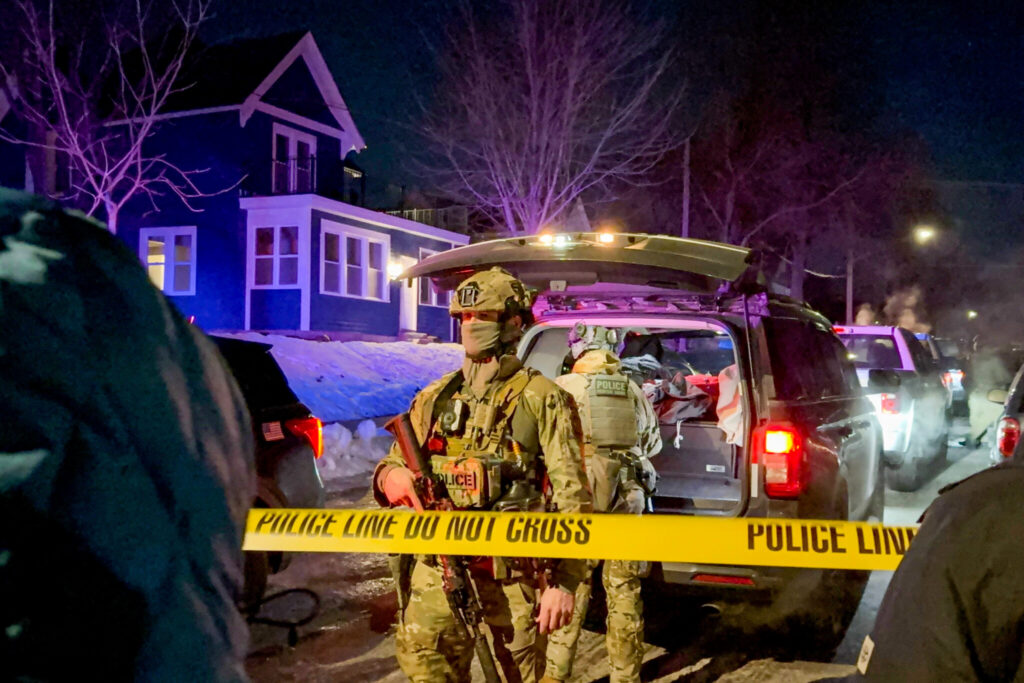
Federal immigration officers in Minneapolis at the beginning of this year. States and cities that have placed restrictions on U.S. Immigration and Customs Enforcement agents or limited state and local cooperation with federal authorities have faced a barrage of lawsuits from the U.S. Department of Justice. (Photo by Max Nesterak/MInnesota Reformer)
As the Trump administration continues its crackdown on illegal immigration, states and cities that have pushed back with so-called sanctuary policies have faced a barrage of lawsuits from the U.S. Department of Justice.
The administration has filed a total of 27 lawsuits against more than 20 cities, counties and states with such policies since Trump returned to the White House in January 2025, according to the Justice Department. In just the past three months, the administration has sued at least a half dozen jurisdictions, including Connecticut, Maryland, New Jersey, New York, a county in Michigan, and the city of Philadelphia, for seeking to place limits on the activities of U.S. Immigration and Customs Enforcement agents.
These policies tend to focus on restricting immigration enforcement in public spaces, limiting how local law enforcement can cooperate with federal immigration authorities, and barring both local and federal immigration agents from wearing masks or otherwise concealing their identity while on duty.
“These sanctuary policies are most times created to help make communities safer. They promote a greater level of trust and cooperation between communities and public institutions of all kinds,” said Cassandra Charles, senior staff attorney at the National Immigration Law Center, an advocacy group.
Some cities have had sanctuary policies since the 1980s, but Charles said many states and cities are creating new protections as the Trump administration has ramped up its deportation campaign. She described the current swell of litigation as “unprecedented.”
Charles said the administration is misinterpreting the Supremacy Clause of the U.S. Constitution, which states that federal law trumps state law. That clause, she argued, does not allow the federal government to dictate what laws states can pass, nor does it “create a duty for the states to help the federal government enforce federal law.”
But the Justice Department argues that sanctuary laws violate longstanding constitutional precedent and prevent the federal government from conducting lawful enforcement activities.
“As explained in DOJ’s briefs in these cases, states and localities do not have a right to obstruct federal law enforcement, to regulate the federal government, or to discriminate against the federal government,” Kiersten Pels, an agency spokesperson wrote in an email. “These and other cases simply seek to vindicate that fundamental aspect of our constitutional structure.”
Our state taxpayer dollars should not go towards having local law enforcement enforce federal immigration law.
– Maryland Democratic state Sen. Clarence Lam
The lawsuits have yielded mixed results.
In May 2025, the Justice Department sued four New Jersey cities (Hoboken, Jersey City, Newark and Paterson) to challenge their policies curtailing local cooperation with federal immigration agents. The next month, a U.S. district judge in New Jersey, appointed by President Joe Biden, tossed out the suit, arguing the cities’ policies didn’t impede ICE activities because of the state’s existing sanctuary laws.
But earlier this month, a U.S. district judge in Pennsylvania sided with the administration in a lawsuit challenging a new Philadelphia policy.
Last month, the administration sued to stop the city of Philadelphia from implementing a new policy barring immigration agents from wearing masks, concealing their badges, or using unmarked vehicles while on the job. Last week, the judge—a Trump appointee—cited the Supremacy Clause in siding with the administration, issuing a preliminary injunction blocking the city from moving forward.
When the Philadelphia City Council approved the policy, the judge ruled, “it attempted to sidestep the Constitution’s clear mandate and disregarded this fundamental principle of law that has informed American jurisprudence for over 200 years.”
The new policy barring officers from concealing their identities was part of a package of seven ICE-related bills the council approved in April. Rue Landau, the city council member who sponsored the package, noted that the other measures have taken effect.
“If the federal government won’t protect their residents, local leaders have the obligation to step up to the plate, and that’s exactly what we did here in Philadelphia,” Landau said. “Great news for Philadelphia: We’ve got six laws on the books, and right now we are working on ensuring that the city of Philadelphia clearly spells out how we’re implementing these laws.”
In late April, the administration filed a similar lawsuit against the state of New Jersey to challenge a law, enacted in March, that prohibits immigration agents from shielding their identity while on duty.
Maryland is the latest state to face a DOJ lawsuit.
Its new law, in effect since May 31, prohibits state and local correctional officers and law enforcement agents from inquiring about or investigating a person’s immigration status. It also bars them from detaining or transferring a person to federal authorities for a suspected immigration violation without a warrant or court order.
Last week, the Justice Department sued Maryland to stop the law, arguing that its “purpose and effect is to obstruct federal law enforcement.”
“Such blatant disregard for federal laws that have been on the books for decades is not merely a political disagreement or passive abstention; it is deliberate, disruptive action that jeopardizes the public safety for all Americans,” the lawsuit states.
In May, local sheriffs from 17 counties in Maryland also sued the state to halt the new law. Their complaint argues that the law puts them in “an impossible and unconstitutional position.”
“If Plaintiffs follow the Act, they are effectively forced to shield removable aliens from federal custody,” the lawsuit states, while “if they continue cooperating with ICE as they have for years, they risk state penalties and lawsuits.”
In some sections, the sheriffs’ lawsuit and the DOJ lawsuit against Maryland employ identical language.
Chris Hajec, head of litigation at the Federation for American Immigration Reform, which favors stricter immigration enforcement and filed the lawsuit on behalf of the sheriffs, said the Maryland law “puts (the sheriffs) in a dilemma.”
“Either they’re violating the state law and they’re going to get sued by their attorney general, or they’re violating the federal criminal law and they could be prosecuted,” Hajec said.
Democrats, Republicans alike focus on states’ rights as a way out of America’s political woes
But Maryland Democratic state Sen. Clarence Lam, the Senate sponsor of the new law, dismissed that argument. Lam said the law only limits what state officers can do, without obstructing ICE from carrying out its duties.
“We think that these efforts to block the implementation are bogus,” Lam told Stateline. “We as a state are wholly within our right and jurisdiction to be able to place limitations on what state and local law enforcement agencies can do. There’s nothing that prevents us from doing so, and that’s all this does.”
“Our state taxpayer dollars should not go towards having local law enforcement enforce federal immigration law.”
Stateline reporter Shalina Chatlani can be reached at schatlani@stateline.org.
This article was originally published by Stateline and is republished by MetroSTL under a Creative Commons license. The reporting is the outlet’s; please support them.