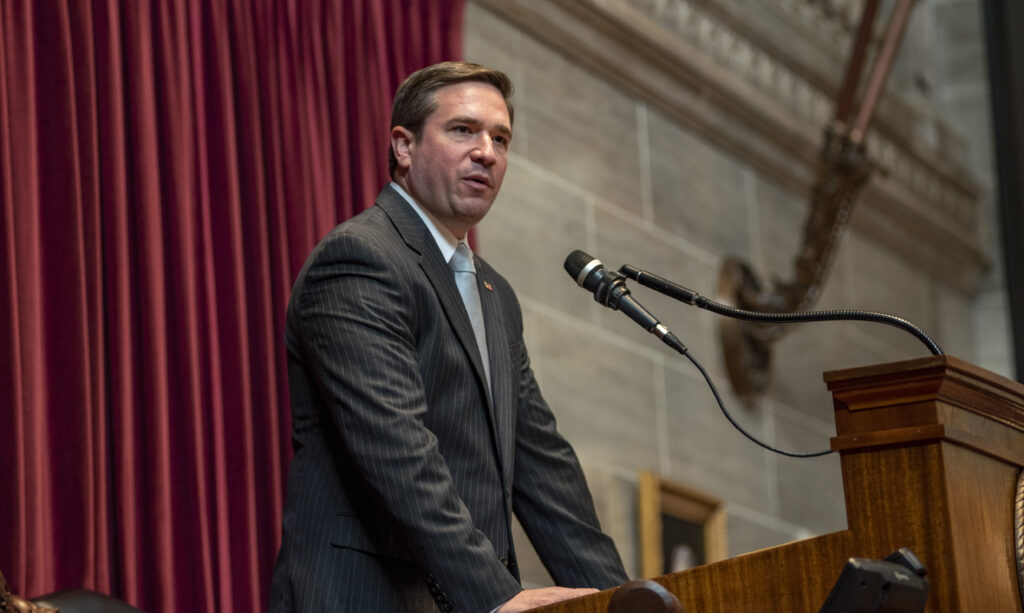
Missouri Attorney General Catherine Hanaway speaks Nov. 16 during a news conference announcing an agreement with Torch Electronics to remove its games from most Missouri locations. Hanaway appeared with Greene County Sheriff Jason Johnson, back left, and Prosecutor Dan Patterson. (Rudi Keller/Missouri Independent)
Two years before Missouri’s attorney general struck a deal allowing a gambling company to temporarily keep its slot machines in nonprofits, her predecessor’s office offered a broad interpretation of state law that could complicate efforts to shut them down.
In a 2024 letter, then-Attorney General Andrew Bailey’s chief of staff wrote that electronic raffle machines were legal when operated for charitable purposes by religious and charitable organizations.
Attorney General Catherine Hanaway’s office wouldn’t say Tuesday what role, if any, the letter played in recent negotiations with Torch Electronics. But a spokeswoman said the letter “does not apply to Torch machines.”
In the non-prosecution agreement announced Nov. 16, Hanaway agreed to allow Torch to operate its slot machine games at nonprofit locations until the end of May as long as they are in place by Jan. 1.
Missouri AG agrees to let Torch Electronics keep slot machines in veterans, fraternal halls
The St. Louis Post-Dispatch reported that the next day, Torch machines were being delivered to a for-profit business location in Franklin County where the owner has a newly registered nonprofit.
In a social media post, Hanaway said Torch “may have already breached the agreement. The operation of illegal machines in for-profit bars or convenience stores is in no way compliant with the agreement and is unacceptable.”
Torch’s attorney, Scott Rosenblum, did not respond to an email seeking comment.
But whether machines deemed illegal in convenience stores and bars can legally operate in nonprofits remains an unsettled question rooted in Missouri’s constitutional exemption for charitable raffles.
The Missouri Constitution says organizations “recognized as charitable or religious pursuant to federal law” can hold raffles and sweepstakes.
Lawmakers have never defined what constitutes a raffle. Criminal gambling statutes do not apply to “constitutionally authorized activities.”
In the 2024 letter, Jay Atkins, who signed it as first assistant attorney general, wrote that a raffle is the exchange of something of value for a chance to win a prize, whether it is conducted online, uses paper tickets or takes the form of an electronic game.
“We believe the use of e-raffle machines for a charitable purpose is lawful for religious and charitable organizations,” Atkins wrote.
During a news conference Nov. 16 in Springfield, Hanaway said her top goal in the agreement was to stop Torch from operating in most locations. Allowing the machines to remain temporarily in nonprofits, she said, would give those organizations time to find other ways to fund their programs.
“It’s tough to negotiate an agreement like this,” Hanaway said.
Atkins’ 2024 letter was addressed to attorneys representing a company that offered machines designated as e-raffle games. He wrote it about four months after a judge dismissed a lawsuit seeking protection from criminal prosecution.
In that ruling, the judge wrote a jury would have to decide whether the Constitution shielded the games from criminal laws. The games were not like traditional raffles, the judge wrote, because each raffle had only one customer and the machine vendor received a share of the winnings.
Granting the exception for nonprofit locations is a prudent step, said Ben Trachtenberg, professor of law at the University of Missouri-Columbia. Giving them a date when the activity must end is also sensible, he said.
The letter from Atkins isn’t binding on the attorney general’s office, he said, but it provides a possible defense for any organization that relied on it.
“The fact that you say something on Tuesday doesn’t mean on Thursday you definitely have to believe the same thing,” Trachtenberg said. “If you punish someone on Thursday for doing on Wednesday what you told them on Tuesday was okay, that might seem unfair. But it’s very different to say: ‘Let it be known that going forward our position on this has changed.’”
Hanaway’s spokeswoman, Stephanie Whitaker, declined to offer any details of the talks with Torch.
“The office does not share the nuances of confidential settlement discussions,” she wrote.
The agreement
Hanaway began pressuring Torch in February, after a federal jury ruled the company had improperly interfered with the business of a competitor that offered arcade games. A federal judge subsequently issued an opinion that Torch machines “meet the statutory definition of ‘gambling device’ and are therefore illegal…” and Torch agreed to turn off its machines in retail locations under threat of prosecution.
To avoid state charges, Torch will, under the agreement, pay the state $13.5 million over two years.
Asked on Nov. 16 about the exception for nonprofits, Hanaway said those locations accounted for less than 1% of Torch’s business.
Torch would “suspend, remove, or destroy all the gaming machines that they have in businesses,” she said.
The exception, the agreement states, covers “non-profit organizations, fraternal organizations, or any other similar types of entities or locations.”
Hanaway defined it this way: “They need to be existing not for profits. We have heard some rumors that people are sort of starting new not-for-profits or taping off areas in C-stores. None of that is in compliance with this agreement.”
State Rep. Betsy Fogle, a Springfield Democrat elected to the state Senate earlier this month, said in an interview with The Independent that she is puzzled by the exception.
“The attorney general has on record and repeatedly said that she views these machines to be illegal, and that her office is taking action against them,” Fogle said. “From the outside, it seems she has now created a golden ticket or a monopoly for Torch to operate their machines in nonprofits across the state.”
Fogle said she has asked the secretary of state’s office for a list of nonprofit organizations created in recent months. To qualify for the Constitution’s exemption, an organization needs to obtain tax-exempt status from the IRS. Registering as a nonprofit with the state does not automatically confer that status.
“I would be surprised if the attorney general wasn’t aware that this settlement between her office and Torch was going to create an environment where businesses were going to open up a nonprofit arm to try to take advantage of the fact that the attorney general has now provided a framework of which that would be allowable,” Fogle said.
Trachtenberg said the agreement can probably be enforced based on Hanaway’s interpretation of its terms.
“It looks like some people are maneuvering through that gap to do what sort of looks like an ordinary gambling parlor,” Trachtenberg said. “It seems unlikely that this subterfuge will last forever.”
In a statement to The Independent, Hanaway said her office would investigate whether nonprofits are being created to undermine the agreement.
“The operation of gambling machines in for-profit bars, convenience stores, or similar establishments is illegal and not in any way compliant with our agreement with Torch,” Hanaway said. “If our review confirms these allegations, we will act swiftly to hold Torch accountable.”
The politics
The pressure on Torch this year marked the company’s most substantial legal jeopardy since 2022, when a change in Linn County prosecutors following that year’s election led to the dismissal of the only felony charges ever filed against Torch.
Neither Bailey, nor his predecessor, Eric Schmitt, took any direct action against Torch or any other game vendor.
Lawmakers gave Schmitt $150,000 in the fiscal 2021 budget to spur action on the machines. In 2022, when he was running for the U.S. Senate, a rival accused him of “turning a blind eye” to the gambling.
Bailey, appointed to replace Schmitt, removed himself in 2023 from the defense of the Missouri State Highway Patrol in a lawsuit by Torch. His campaign committee and PAC took more than $40,000 in donations from PACs controlled by the lobbyist for Torch, which has the largest number of slot machine games in retail locations.
Gambling companies pour campaign money into fight over Missouri video lottery bill
The May 31 deadline for nonprofits to remove Torch machines gives lawmakers time to intervene. Among the possibilities contemplated in the agreement are legislation legalizing Torch’s machines or authorizing a state-regulated video lottery system.
Fogle opposes legalizing video lottery terminals. J&J Ventures of Effingham, Illinois, a company pushing lawmakers to authorize licensed video lottery terminals, spent almost $240,000 opposing her election.
Fogle said Springfield, which has an ordinance banning games that offer cash prizes, doesn’t want electronic gambling whether it is in nonprofits or convenience stores.
“People in Springfield don’t want predatory machines in our neighborhoods, in our gas stations, in our communities, profiting off of the backs of working families and people who are struggling to pay their bills,” Fogle said.
Andy Arnold, a lobbyist for J&J, said the agreement puts more pressure on lawmakers to pass video lottery.
“We applaud anything that provides more money for education,” he said. “However, we are a little puzzled on whether allowing them to operate in not-for-profits through May 2027 makes the devices into raffle machines, or are the devices still considered an illegal gambling device.”
Fraternal organizations and veterans groups are groups no one wants to oppose, he said.
At her news conference, Hanaway said protecting those organizations was a priority in negotiating the exception.
“I didn’t want to hurt veterans,” she said. “I didn’t want to hurt these community organizations.”
This article was originally published by Missouri Independent and is republished by MetroSTL under a Creative Commons license. The reporting is the outlet’s; please support them.