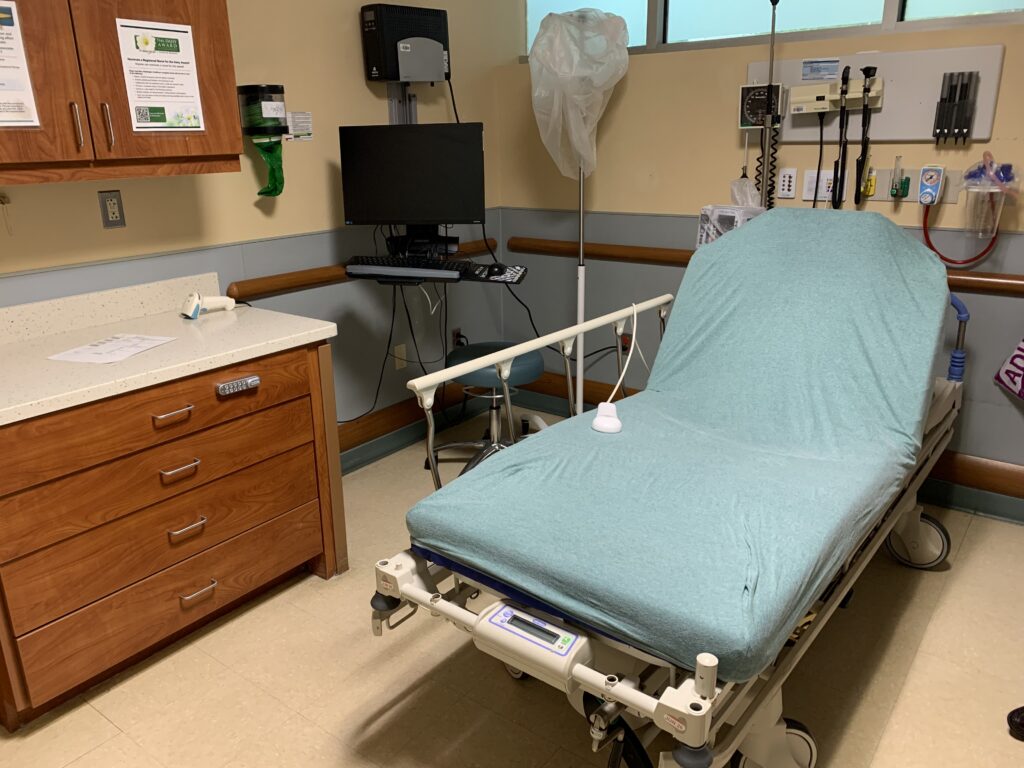
A change to billing codes for pregnancy-related care beginning Jan. 1 will change the insurance process from one lump-sum payment billed at the end of a full pregnancy to separate services for the first time in 30 years. Providers say it won’t change much for patients, but will have many upsides for the overall provision of maternal care. (Photo by Noelle Straub/Stateline)
For decades, pregnancy has been approached by insurance companies as a singular event, with one payment at the end given to one provider, no matter how many prenatal visits occurred over the months or how straightforward or complex the pregnancy was along the way.
Beginning Jan. 1, that approach will change, with the unbundling of the codes providers use to bill insurance and receive payment for their services. The five-digit codes are used to describe the type of care a patient received, including specific procedures and testing.
While it isn’t expected to change much for patients, providers say it will make it easier to transfer care among clinics and hospitals, ease revenue burdens and perhaps most importantly, provide a more detailed and data-driven picture of maternity care nationwide that is opaque under the current system — though it remains somewhat unclear how private health insurance companies and Medicaid programs will respond to the change.
Black mothers around US say pregnancy, postpartum needs are often unmet
The American College of Obstetricians and Gynecologists, known as ACOG, worked with the American Medical Association to develop the new codes, which are then communicated to health insurers, including Medicaid. Pregnancies that began in the 2026 calendar year will likely still be billed under the global code, but those that have their first visit after Jan. 1 will use the new system.
Lisa Satterfield, vice president of practice, sustainability and workforce initiatives for ACOG, said the group started working on this change in 2022, after feedback from providers that the system was outdated.
“The way they were designed was for one provider to get billed from the very first prenatal visit to the very last postpartum visit,” Satterfield said. “It was not practical anymore.”
In the vast majority of cases, nothing should change about how much patients are paying for care, Satterfield said, because maternity visits are considered preventative care under the federal Affordable Care Act and not subject to cost sharing. Patients may just see more statements in the mail with an explanation of their benefits.
With the current global payment, no services are billed after the confirmation of a pregnancy until the last postpartum visit, Satterfield said, which leads to a long delay in the revenue from each visit in between. On average, Satterfield said, the global payment from health insurers to OB-GYNs or midwives was about $3,500 for an entire pregnancy, regardless of whether it was a patient with relatively few or no complications along the way, including delivery, or someone who needed many more interventions and had a long, complicated delivery.
“It didn’t matter, they got paid the same, regardless of the services that were being provided,” Satterfield said.
If patients switch among providers or clinics for various reasons, sometimes a provider isn’t even aware that the patient had seen someone else until the claim is denied, leaving that provider to try to negotiate with the insurer or ask the other provider to share their payment. Many times, it just results in lost revenue for the health providers, she said.
The current bundled code also has allowed some insurers to try to lump other services into that same payment, she said, such as the insertion of a birth control implant, which some women opt to do after delivering a baby, that otherwise could be charged separately.
Study shows sharp increases in maternal deaths over two decades
Dr. Barbra Fisher, a maternal-fetal medicine specialist in central California, said there is a separation of billing if someone is referred to the specialist clinic for various reasons in pregnancy, such as a fetal anomaly or high-risk conditions like gestational diabetes or hypertension. Some specialist clinics use the global code for their services as well, she said, but they also have the option to bill separately for services. The biggest changes will come for standard OB care rather than specialists, she said.
But she added there are some concerns among obstetrics providers about how insurers will adjust to the changes, particularly private health insurance.
“I think practices are worried because they just don’t know what the reaction is going to be,” Fisher said. “We don’t know what state Medicaid payers and private insurance will do.”
Dr. Mark Simon, chief medical officer of the national OB Hospitalist Group, said the insurance providers he spoke with earlier in the fall didn’t have set plans yet on how they would respond to the changes, so there are still unknowns. But he said he sees many upsides to the changes, including how closely researchers can track the details of obstetrical care and its variations by patient.
Maternal mortality rates in the United States remain stubbornly high compared with peer countries. In 2024, the federal Centers for Disease Control and Prevention reported 17.9 maternal deaths per 100,000 live births, compared with 8.4 per 100,000 in Canada and 5.5 in the United Kingdom. That rate in the U.S. also varies significantly by state and race, with a much higher rate of 44.8 deaths per 100,000 births among Black women.
Simon said the global payment made it difficult to know how to improve those rates when there was little information about how many times a patient was seen during pregnancy and afterward, what kind of delivery and labor management they had, and what types of providers they saw.
“You lose a lot of quality data that you need to help systems improve,” he said. “We’re trying to improve the healthcare system with one hand tied behind our back, because we don’t have full information on what’s actually happening.”
The new data will lag behind until 2026 pregnancies are out of the global billing system, he said, but once full data is returned starting late in 2027 and into 2028, Simon thinks there will be many opportunities to make more informed decisions about maternity care.
“I’m very hopeful that with this kind of information, we’ll be able to direct efforts to areas where we identify weaknesses, as it were, that were leaving patients behind,” he said.
Fisher said she’s looking forward to the change as well.
“This has been a long time in the making, and I think it will be much more equitable. I think it will be good for the patients and good for the practices,” she said.
Stateline reporter Kelcie Moseley-Morris can be reached at kmoseley@stateline.org.
This article was originally published by Stateline and is republished by MetroSTL under a Creative Commons license. The reporting is the outlet’s; please support them.