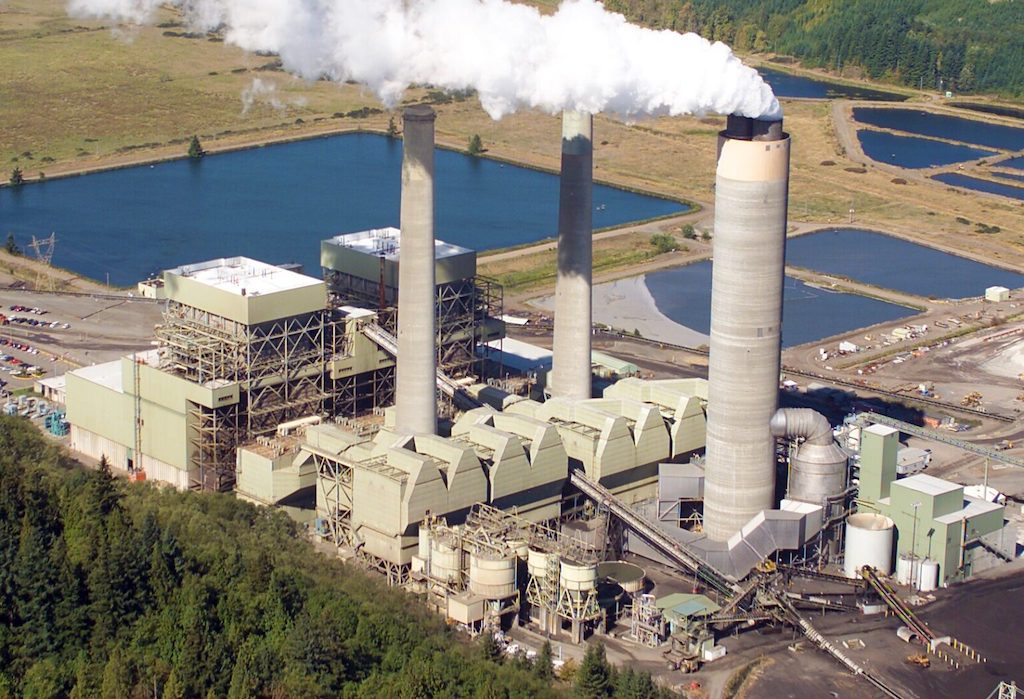
A coal-fired power plant operates in Centralia, Washington. States are divided over the Trump administration’s proposal to repeal remaining greenhouse gas power plant standards. (Photo by the Washington Department of Ecology via Washington State Standard)
States are divided over the Trump administration’s proposal to repeal remaining greenhouse gas standards for power plants, while medical groups warn of public health dangers.
The U.S. Environmental Protection Agency released a proposal that contends it doesn’t have the authority to regulate power plant greenhouse gas emissions to address global climate change concerns. This would rescind the agency’s own findings in 2015 that it had the authority to do so under a section of the Clean Air Act.
If finalized and upheld by courts, the move would repeal remaining power plant greenhouse-gas emissions regulations for fossil fuel-fired electric generating units. The agency said it aims to maintain affordability and reliability of energy supplies.
It follows a final EPA rule that went into effect Monday that partially repeals 2024 emissions standards for fossil fuel-fired power plants as well as requirements that states develop related plans.
The proposed rule would go even further. A comment period for that measure closed earlier this month, generating over 165,000 comments, including from states, health and environmental groups, and private citizens. States, public health and environmental groups have also filed legal challenges to the EPA’s rollbacks.
Some states said the EPA’s regulatory authority over fossil fuel emissions is overreach and would harm their economies, while others said such federal regulations are needed as states, tribes and local governments grapple with the health and costs of air pollution and climate change.
Trump is forcing coal plants to stay open. It could cost customers billions.
In a joint comment submitted last week, the attorneys general of 22 mostly Democratic-leaning states plus Washington, D.C., and officials from New York City, Denver, Chicago and California’s Bay Area wrote that climate change is costly to state and local governments and imposes public health dangers.
In the over-160-page letter, the states pointed to a consensus study report from the National Academies of Science, Engineering, and Medicine last year that concluded that human activity-initiated greenhouse gas emissions will lead to more climate change, “with the severity of expected change increasing with every ton of greenhouse gases emitted.”
The attorneys general wrote that EPA is pushing its proposal despite such “unequivocal evidence, and the increasingly devastating climate harms” that state and local governments experience. They added that the proposal “has no basis in fact or law, would result in large-scale emission increases that will harm the States and Local Governments, and is an unlawful abdication of EPA’s responsibility under the Clean Air Act to protect public health and welfare.”
But the attorneys general of West Virginia and 24 other largely Republican-leaning states contended that the proposal “properly reverses course on past EPA attempts to reshape the Nation’s electricity-generating sector.”
It would “allow States to secure affordable, reliable, and environmentally responsible energy for their residents,” they added.
North Dakota, which signed on to that letter, also submitted its own comment saying it strongly supports the supplemental proposal. The state noted that it has a specific interest in the issue, since it collects a coal conversion tax when power is generated from coal within the state, which then helps pay for school districts and other government services.
Supreme Court takes up climate case testing local lawsuits against oil companies
The National Tribal Air Association, an organization of 162 tribes focused on air quality management policies and programs for American Indian and Alaska Native tribes, groups that have been disproportionately affected by emissions, submitted a comment opposing EPA’s actions.
“Many fossil fuel-fired electric generating units are located on or near American Indian and Alaska Native communities, and Tribes and Tribal members may disproportionately bear the public health and environmental consequences of the increased greenhouse gas and other emissions that this proposal would permit,” the association wrote.
Carrie Jenks, executive director of the Environmental & Energy Law Program at Harvard Law School, noted that some ongoing court cases may affect the EPA rules. Jenks also said that states that support EPA’s authority to regulate greenhouse gases are typically the ones that also support their own authority to regulate them within their own programs.
“Then there are groups of states that want EPA’s authority to be limited, if not eliminated,” adding that others argue that states can’t regulate their own sources of greenhouse gases.
Over 70 medical and public health organizations also submitted comments in opposition to the rollbacks. The groups included the American Medical Association, the American Lung Association, and several state American Academy of Pediatrics chapters, who argued the changes would harm the health of children and other vulnerable groups.
“Children, older adults, people who work outside, individuals with preexisting health conditions or who are pregnant, low-wealth communities and communities of color often experience disproportionate health harms stemming from climate change and extreme weather events,” the groups wrote.
Stateline reporter Nada Hassanein can be reached at nhassanein@stateline.org.
This article was originally published by Stateline and is republished by MetroSTL under a Creative Commons license. The reporting is the outlet’s; please support them.