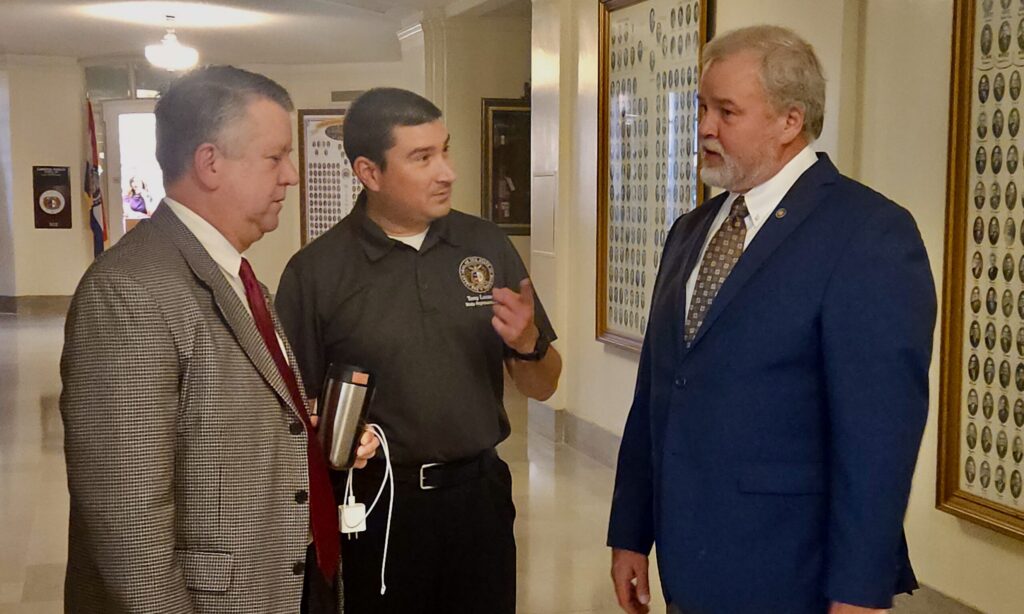
State Rep. Darin Chappell of Rogersville, right, speaks Wednesday with state Rep. John Simmons of Washington and state Rep-elect Tony Lovasco of Wentzville after being selected House Majority Leader (Rudi Keller/Missouri Independent).
After losing 16 Missouri House seats Tuesday in their worst election since Watergate, Republicans are questioning whether their own legislative agenda helped drive voters away.
Some blamed national political headwinds and low Republican turnout. Others pointed directly to a string of unpopular proposals pursued by their own party.
“We need to focus on the business of the people, and quit pursuing what I would call just personal pet projects of individual legislators, and do what people want done,” said House Speaker Pro Tem Chad Perkins of Bowling Green.
In the 99 seats contested by both parties this year and in 2024, Democrats gained more than 12 percentage points. In the seats they flipped, the margin shifted an average of 21 points in favor of the Democratic candidate.
Democrats defeated 10 incumbent Republicans on Tuesday, bringing the total of new members of both parties to 64 and ending 14 years of GOP supermajorities in the House.
On Wednesday, the diminished caucus selected state Rep. Darin Chappell of Rogersville as House majority leader for the coming session. Chappell, who has been an outspoken advocate of cutting state spending, is the uncle of popular singer Chappell Roan.
Chappell was re-elected Tuesday with 70% of the vote in the 137th District in Greene County. The margin narrowed by 15 percentage points from his 2024 election.
Chappell will lead House Republicans as they try to recapture districts lost this year and defend others — 17 Republicans won by fewer than 10 percentage points.
“We’re in a total reassessment,” Chappell said in an interview with The Independent.
House Republicans will pursue policies enhancing liberty, security and prosperity, Chappell said.
“If we need to change course on specific issues, we will,” he said. “We absolutely will.”
In the 1974 election, just a few months after the resignation of President Richard Nixon, Republicans lost 17 seats in the Missouri House. That year, as in this, Democrats benefited from a political backlash against Republicans.
But some lawmakers say Missouri Republicans added to their burdens by pushing an unpopular agenda. Every major policy initiative put before voters by Republicans since Gov. Mike Kehoe was sworn in last year has gone down to defeat.
Constitutional amendments to replace the income tax with sales tax and make it harder to pass constitutional amendments by initiative lost by historic margins in August. A proposal to ban almost all abortions failed Tuesday despite the personal involvement of Kehoe’s wife, Claudia. and voters rejected a Republican-backed congressional redistricting plan.
The income tax amendment was dead the day lawmakers voted to put it on the ballot, Perkins said.
“We all knew how doomed it was before it ever got started,” he said. “We’ve got to stop doing that. We have to stop doing stuff like that.”
Democrats mainly won new seats in suburban areas adjacent to districts they already hold. But they also won seats they were not expected to take in Jefferson City and Cass County.
The election “was a disaster,” said state Rep. Jeff Vernetti of Camdenton.
“The voters have spoken, and we’ve got to listen to our districts and move forward as one,” Vernetti said. “Obviously, the messaging of the last several years ended up costing us 16 seats.”
The losses left Republicans without the two-thirds majority needed to override a veto or enact legislation that takes effect immediately without Democratic support.
Republicans will hold 95 seats, their lowest total since 2008. Republicans have held the House majority since 2002.
State Rep. Tim Taylor of Bunceton, who won re-election in the 48th District with 65% of the vote, said the unpopular income tax proposal hurt Republicans. Taylor has worked for the past two years to overhaul property taxes.
Voters can understand how they would benefit from a focus on property taxes,Taylor said. Republicans would have won favor with the public by addressing the issues of rapidly rising tax assessments, he said.
“That particular subject covers everybody, regardless of political affiliation, whether you’re a voter or not a voter,” Taylor said.
Secretary of State Denny Hoskins, who visited with Republicans as they gathered, said voters are souring on the GOP.
“This is a wake up call for us as Republicans,” Hoskins said. “There’s plenty of blame to go around.”
Hoskins was one of the most vocal defenders of the plan to redraw congressional districts to favor Republicans. The issue of redistricting is not dead, he said, because of a U.S. Supreme Court decision changing the interpretation of the 1965 Voting Rights Act.
“It may be forced on their hands because right now the 2022 map, according to the U.S. Supreme Court, is unconstitutional because it includes a majority-minority district,” Hoskins said. “These new state reps may not have a choice.”
The U.S. Supreme Court did not rule Missouri’s 2022 congressional map unconstitutional. Its April ruling struck down a Louisiana congressional district drawn predominantly on the basis of race, while a separate September ruling allowed Missouri to use its 2022 map in Tuesday’s election.
Israel Baeza of Sedalia, who was elected to the House with 63% of the vote in the 52nd District, said the election returns sent a clear message. His 28% margin was down from the 49% victory for Republicans in 2024.
Democrats flip 16 Missouri House seats, ending Republican supermajority
“This is a good reminder that people send us here to get things done,” Baeza said. “People have been speaking loud and clear that they want us to focus on issues that affect their pocketbooks.”
Matt Sergent of Knob Noster won the 57th District with 73%. His margin of 46% was down from a 62% margin in the district in 2024.
He said a data center in Benton County is a major issue in his district.
Voters are generally angry at the government, Sergent said.
“They’re upset with Washington for sure, and that trickles down to the state level,” he said. “They think that we’re doing something because Washington’s doing it. It’s happening up there, so it must be happening here.”
Alex Riley, the Republican from Springfield who will be House Speaker next year, said the national trend to Democrats was the dominant factor on Tuesday.
“It was a blue tsunami that impacted the entire country, so it’s hard to point fingers and say it’s because Missouri Republicans worked on a particular issue or passed a particular issue,” Riley said.
For some Republicans, the defeats on Tuesday were more about who didn’t vote than who did.
“Republicans didn’t show up yesterday,” Perkins said.
There is no one factor that accounted for the defeats, Perkins said.
“If yesterday taught us something, it’s that there’s enough blame to go around,” he said.
Republicans had a huge cash advantage, outraising Democrats by $10 million for House races. At the beginning of 2024, House Republicans chose Axiom Strategies to guide its campaign efforts, dropping the consultant who had engineered the supermajority. That change is not the reason Republicans had a bad night, Vernetti said.
“It’s on every single thing top to bottom,” he said. “You can’t blame the consultants. You can’t blame the governor or Trump. You can’t. We’ve got to look in the mirror.”
Taylor said he won’t alter his views or change his approach because of the election. And, he said, it might make the caucus more cohesive.
“People do better in smaller groups,” he said. “They work better, and they’re more focused on things.”
This article was originally published by Missouri Independent and is republished by MetroSTL under a Creative Commons license. The reporting is the outlet’s; please support them.