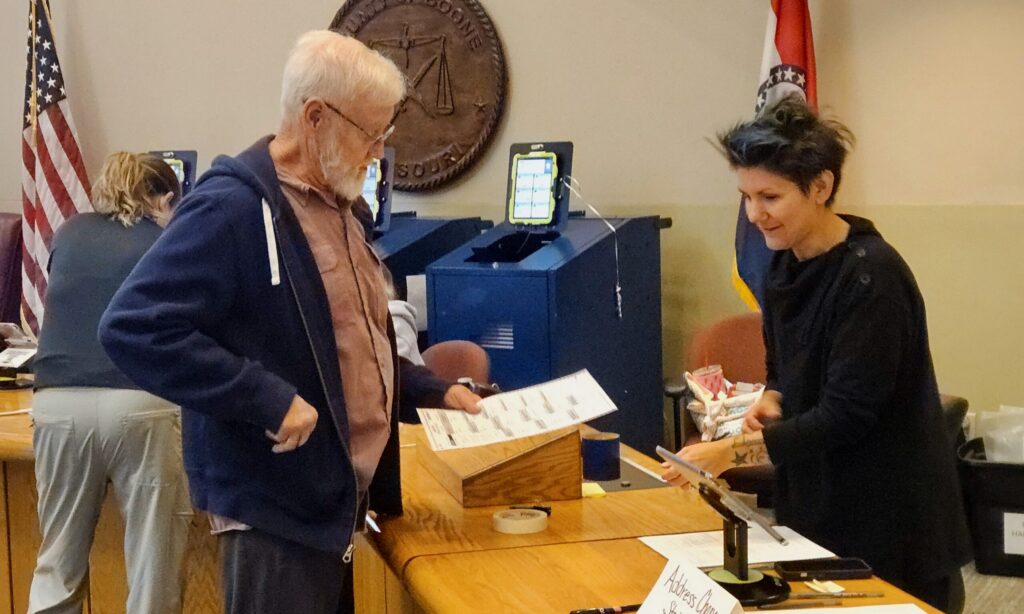
Boone County Clerk Brianna Lennon, right, checks in a voter Oct. 23 at the Boone County Government Center in Columbia (Rudi Keller/Missouri Independent).
Missouri election officials say brisk early voting could push Tuesday’s turnout close to — or beyond — the state record for a nonpresidential election.
The benchmark is 2018, when 2,442,306 Missourians cast ballots. Secretary of State Denny Hoskins expects about 55% of the state’s 4.4 million registered voters to participate, spokeswoman Anne Marie Moy said in a text to The Independent.
That would mean about 2.42 million ballots, just short of the 2018 total. A slightly higher turnout rate could set a new record.
With no hotly contested statewide candidate race, local election officials say voters are being drawn to the polls by the three controversial statewide ballot questions and, in some areas, expensive legislative races.
No-excuse absentee voting began Oct. 20 and concluded when local election authorities closed their offices Monday afternoon. Polls open at 6 a.m. Tuesday and close at 7 p.m. Anyone in line by 7 p.m. will be allowed to vote.
Platte County has averaged 1,000 voters a day since early voting began, said Chris Hershey, director of elections for the Platte County Board of Elections. Hershey estimated that 72% of Platte County’s more than 80,000 voters will cast ballots.
There is a targeted Missouri House race in Platte County and the state Senate race in the 34th District has become unexpectedly competitive.
“Folks have shown they are motivated to vote,” Hershey said. “We’ve stayed consistently busy.”
Turnout in previous nonpresidential elections this century has ranged from 35% in 2014, when Democrats did not contest the state auditor’s race, to 58% in 2018. That year, a U.S. Senate race costing more than $100 million combined with controversial ballot measures on legislative redistricting and medical marijuana to motivate turnout.
Presidential elections typically draw about 3 million Missouri voters.
Spending on this year’s ballot measures — Amendment 3, to ban most abortions, Amendment 6, to limit the power of lawmakers to change measures passed by initiative and Proposition A, the referendum on redistricting — totaled $55 million through Friday.
Of that, almost $17 million has been spent on broadcast advertising, according to tracking by The Independent.
St. Louis County, which has the most registered voters, keeps a tally of absentee ballots received available online. When early voting stopped Monday, 173,484 people — more than one-fourth of the county’s voters — had cast ballots.
The Independent contacted election officials from both parties across the state, who reported strong interest in early voting and projected substantial Election Day turnout.
The 35,000 ballots received in St. Charles County are double the number cast early in 2022 — the first year it was available — and about half the number who voted early in 2024, elections director Kurt Bahr said.
There are three Missouri House races targeted by both parties in St. Charles.
“This shows both that the midterm turnout will be lower than the presidential year and that the two weeks of no excuse voting is becoming more popular,” Bahr said.
In Jackson County, where spending in the 8th District state Senate race is approaching $6 million, there have been 21,049 ballots been cast through Friday morning.
“Turnout is great,” said Tyler Spencer, Republican director of the Jackson County Election Board. “We love when people get out and vote.”
The other multimillion-dollar state Senate race is in Greene County. The candidates and their supporters have also combined to spend $6 million in the 30th District. There are also three Missouri House districts targeted by both parties.
Almost 2,300 votes were cast Saturday and almost 21,000 ballots have been received, Greene County Clerk Shane Schoeller said. He expects turnout between 58% and 59%.
That would almost match the 2018 turnout of 60.7%. In 2014, turnout in Greene County was 33.2%
“This election is unusual, as you know, because state auditor is the only statewide race on the ballot,” Schoeller said. “The issues on this ballot are drawing more interest than those in 2014, and we have a competitive state Senate race in Greene County that wasn’t on the 2014 ballot.”
In Franklin County, a reliably Republican county without competitive legislative races targeted by either party, about 4,500 people had cast ballots by Friday morning, Clerk Tim Baker said.
There is no comparison data for 2022 “because it wasn’t used that much,” Baker said. This year so far is about half of the early vote in 2024, he said.
“Turnout is steady and I would say we should be close to the state prediction of 50 to 55%,” Baker said.
In Boone County in central Missouri, a Democratic-leaning county, Clerk Brianna Lennon said her office had received about 10,500 ballots by the end of the day Thursday, about half the number cast by this point in the 2024 election.
She expects about 57% of voters to cast ballots, she said, which would be comparable to 2018.
“I expect we’ll land at double the amount of November 2022 and half the amount of November 2024,” Lennon said. “A healthy splitting of the middle.”
This article was originally published by Missouri Independent and is republished by MetroSTL under a Creative Commons license. The reporting is the outlet’s; please support them.