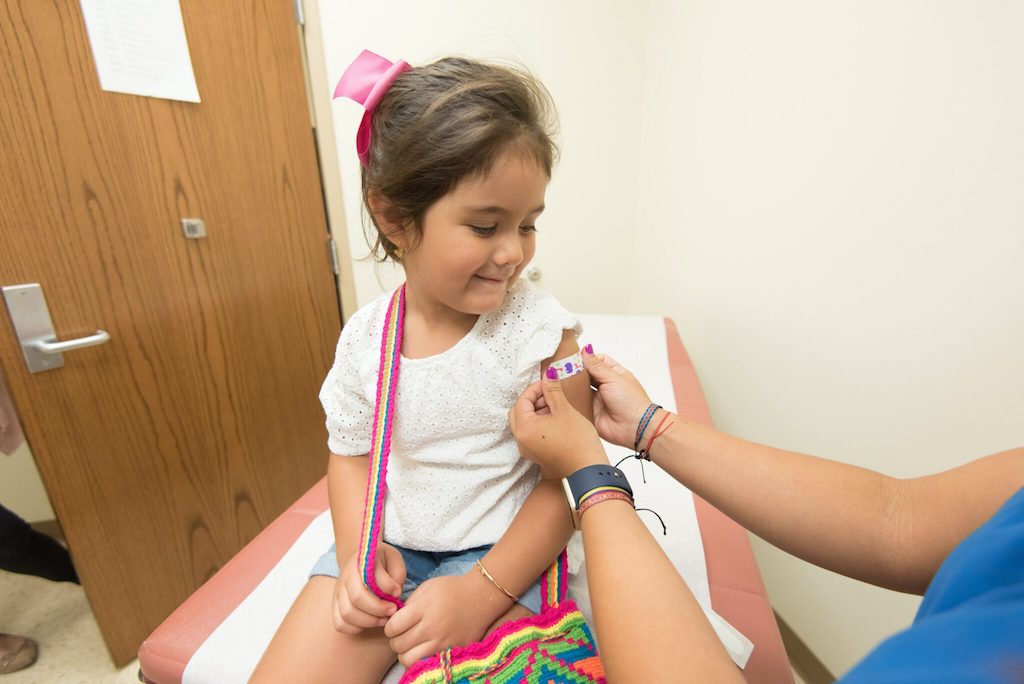
A healthcare worker places a bandage on a child after giving a vaccination shot (Scott Housley/Centers for Disease Control and Prevention).
When I considered practicing in Missouri in late 2020, I expected the licensing process to evaluate my education, training, experience and professional credentials. What I did not expect was to be asked to reconstruct more than three decades of my personal preprofessional history.
After six months of unemployment due to the COVID-19 pandemic, I was offered a job and needed a Missouri physician assistant/associate (PA) license. Having practiced in other states, I assumed the process would focus on the qualifications most relevant to patient care: accredited education, national certification, clinical experience and any disciplinary record.
Instead, Missouri requires applicants to submit a complete curriculum vitae covering every year from high school graduation through the application date, including the names and addresses of all employers and supervisors, employment dates, job titles and all professional and nonprofessional activities.
I was 59 years old when I applied to practice in Missouri, more than 40 years after graduating from high school. In essence, the application process required me to document every employer, supervisor and activity dating back more than three decades before I became a certified PA at 49. It was time-consuming, frustrating and daunting. A 25-year-old PA applicant, only eight years removed from high school, likely wouldn’t find this extraordinary. But reconstructing eight years of work history is vastly different from reconstructing 30 years.
More importantly, I struggled to understand how this requirement improved patient safety or measured clinical competence. Missouri can verify meaningful indicators of readiness to practice through accredited education, national certification, professional references, clinical employment history and disciplinary records maintained by licensing authorities.
These safeguards protect the public while providing a meaningful assessment of a clinician’s qualifications. They are also the most relevant factors for determining whether a PA is prepared to care for patients.
In my case, the requirement nearly discouraged me from pursuing licensure in Missouri. After months of unemployment, I had little choice but to complete the process. But if I had been offered a comparable position in a state with a less cumbersome process, I might have chosen to practice there instead. That raises an important question: How many qualified healthcare professionals have chosen to practice elsewhere because of unnecessary licensing requirements?
Even a small loss of clinicians can have significant consequences in a state already facing workforce shortages. I was just one licensing applicant, but my experience may reflect that of an unknown number of PAs who have faced a similar experience.
No one is suggesting Missouri abandon its rigorous licensing standards. Patients deserve confidence that healthcare professionals are competent, ethical and qualified to practice. Thorough background checks, verification of education and certification and review of disciplinary history are the safeguards most relevant to evaluating a clinician’s fitness to practice, not unrelated employment from decades before entering the profession.
Healthcare delivery has changed dramatically over the past several decades. Clinicians today are educated to nationally accredited standards, maintain certification, complete continuing medical education and practice under extensive regulatory oversight. Licensing boards now have faster, more reliable ways to verify qualifications and disciplinary histories. Requirements focused on irrelevant preprofessional employment do not contribute to patient care.
Notably, Missouri licensing requirements for physicians do not include such demands, and nurse practitioners (NPs) are governed by the Board of Nursing, which has no similar requirement. This discrepancy raises a fundamental question: Why are PAs uniquely burdened with requirements that neither physicians nor NPs must meet?
The Missouri Board of Healing Arts, in collaboration with Missouri lawmakers, should streamline licensing requirements by eliminating the requirement to document preprofessional work history unrelated to healthcare when applying for initial PA licensure.
Passing the PA Licensure Compact was an important step toward improving interstate mobility for qualified PAs, but it does not change initial licensure requirements for PAs.
Missouri is seeking clinicians. Communities need providers. Patients need timely access to care. The question is whether the state wants experienced healthcare professionals to invest their time caring for patients or reconstructing employment records that play no role in patient care. The path forward is clear: reform PA licensing requirements and remove obligations that serve no public purpose.
This article was originally published by Missouri Independent and is republished by MetroSTL under a Creative Commons license. The reporting is the outlet’s; please support them.