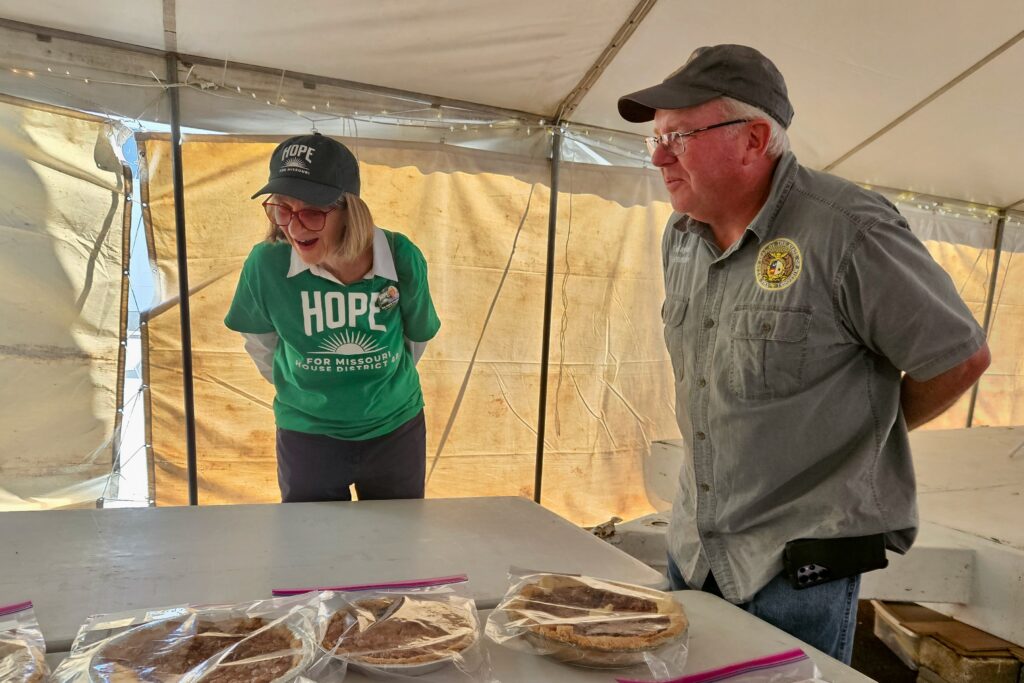
Dr. Hope Tinker, left, Democratic candidate in the 48th Missouri House District, and state Rep. Tim Taylor, the Republican incumbent, on Oct. 3 look over pies entered in the Brunswick Pecan Festival pecan pie contest before they are auctioned (Rudi Keller/Missouri Independent).
Over five consecutive elections from 1974 through 1982, Missouri Democrats elected supermajorities — more than two-thirds of the 163 members — to the Missouri House.
The party drew its strength from rural voters, union households and Black-majority urban districts.
The supermajority ended as rural voters, who had developed a habit of voting Republican in national races, turned from Democrats in local contests. By the mid-1990s Democrats held only 87 seats – five more than a majority — and have been in the minority in Jefferson City since 2003.
Republicans are on a streak of their own, winning a supermajority in seven consecutive elections. But with Democrats needing to gain just three seats to break that streak, Republicans are playing defense in nearly every legislative race attracting significant attention and money.
House Majority Leader Alex Riley of Springfield, slated to become speaker, isn’t sure about extending the streak.
“I expect to be the Republican speaker with a very strong majority,” Riley said. “As far as what that looks like, I don’t know.”
House Minority Leader Ashley Aune of Kansas City said Democrats will win at least 55 seats for the first time since 2010.
“People ask me all the time how many seats we’re gonna flip, and I always tell them we’re gonna break the supermajority and then some,” Aune said.
The national Democratic Legislative Campaign Committee is targeting 12 districts, including 11 held by Republicans.
The House Republican Campaign Committee is focused on defending 13 seats, including 10 on the Democrats’ list, while targeting a single Democrat for defeat.
Republicans entered the fall campaign with $3 million on hand at the HRCC.
The House Democratic Action Fund has less than one-tenth of those resources.
Overall, Democrats are contesting 158 seats while Republicans have candidates in 134 districts. Republicans start with five seats in unopposed districts while Democrats can count 29.
The Independent rated the remaining districts based on past results and identified 39 districts that are potentially in play. The challenge for Democrats is to break out of their current strongholds. No Democrat has won a predominantly rural district since 2010.
The Independent visited three districts — one in the Kansas City region, one in central Missouri and one in St. Louis County — where the results will test assumptions about where the parties are competitive and where they are not.
12th District
The 12th District, which sits along the Missouri River in southern Platte County, is the only district Republicans took from Democrats in 2024, prevailing by 179 votes.
The seat is open because incumbent Republican state Rep. Mike Jones is the GOP nominee in the 34th District state Senate race.
Tracey Steele, a commercial real estate attorney, is the Democratic nominee against Jerry Hickey, owner of an employment placement firm. Both object to the attack ads flooding the district.
To back Steele, the union-funded Will of the People political action committee is attacking Hickey for accepting a Paycheck Protection Program loan in 2020 and later purchasing a new home.
The loans were eligible for forgiveness if recipients met federal requirements. In a social media post, Hickey said the home was purchased a year after the loan was forgiven.
To back Hickey, two recently formed committees funded by the HRCC are attempting to tie Steele to New York City Mayor Zohran Mamdani and U.S. Rep. Alexandria Ocasio-Cortez of New York.
“I’m a socialist because AOC and Mamdani are alive, apparently,” Steele said in an interview with The Independent.
In a video posted to social media, Hickey said he wants the outside groups — Republican and Democrat — to stay out of the race. He didn’t approve the attacks on Steele and he doesn’t think Steele is responsible for the attacks on him, he said.
“I frickin’ can’t stand it,” Hickey said on social media.
Hickey was not available for an interview for this article. His campaign website offers few specifics about his positions. On education, he says he backs school choice “when needed” and that he would address both economic and healthcare issues by “cutting red tape.”
Steele said education funding is a vital issue for the district. Property taxes for the Park Hill School District are among the highest in the Kansas City metro area and state support provides 22% of the budget.
This year’s state budget underfunds the school foundation formula by $190 million.
Steele, like many Democrats, opposes Amendment 3, which would reinstate a near-total ban on abortion. He will also vote no on Proposition A, a referendum on the 2025 Republican gerrymandered redistricting plan. He supports Amendment 6, which would limit lawmakers’ power to alter measures enacted through the initiative process.
On a recent Saturday, Steele went door-to-door in the Thousand Oaks neighborhood.
Sonja Mosier told Steele she is upset with Republicans because they have tried so hard to block laws enacted by voters. .
“We don’t want to teach our kids that voting doesn’t matter, and that kind of teaches them that voting doesn’t matter,” Mosier said.
Voters spoke loudly in August when they rejected, by historic margins, two Republican priorities. Amendment 4 would have made it harder to pass constitutional amendments by initiative and Amendment 5 would have allowed lawmakers to replace the income tax with increased sales tax.
Eric Munch, another voter in the district, sees those defeats differently. He blames poor campaign planning.
“The opposition to those was very motivated,” he said, “so the marketing on the opposition side was 10 times better.”
Steele, meanwhile, argues voters should judge Republicans on their record in power.
“The Republican Party has had a supermajority in the legislature for 14 years,” Steele said. “If they had any brilliant ideas to fix the problems in the state of Missouri, they would have tried them by now.”
48th District
The 48th District in central Missouri will test the definition of a safe Republican seat.
Incumbent state Rep. Tim Taylor of Bunceton is running for his fourth and final term. He won re-election in 2024 by a 55% margin.
His Democratic opponent, Dr. Hope Tinker of Fayette, was the treasurer for Taylor’s 2024 challenger. For this year’s race, she’s raised twice as much money as Taylor and had 15 times as much money on hand at the end of August.
“It is a different race in that the Democrats are more energized right now than they have been in a long time,” Taylor said in an interview with The Independent. “There’s no question about that.”
Tinker was a family physician in Howard and Chariton counties for 36 years. She’s better known than many first time candidates — while caring for pregnant women, she delivered many of the people now eligible to vote.
And her last name is symbolic nationally as shorthand for the free speech rights of students. Her older brother and sister were the plaintiffs in the landmark Tinker v. Des Moines decision from 1969, that found students could engage in non-disruptive political speech.
Even with a fundraising advantage, the district’s history makes Tinker a long shot. Of the four counties in the district — Cooper and Howard with portions of Randolph and Chariton — Cooper hasn’t supported a Democrat for president since 1964 while none of the counties have been represented by a Democrat since 2015.
“Desperate times call for desperate measures,” Tinker said. “As an individual with values and a commitment to love my neighbors and do the best things I can do with my life to move our society forward, I felt I could do this.”
Campaigning in the 48th District is not really a question of money. Television time is too expensive, so advertising is mainly in the form of yard signs, direct mail and spending time at community events in the summer and fall.
On a recent weekend it was the Brunswick Pecan Festival, where the big attractions are the auction of contest pies and the Saturday afternoon parade that caps the festival.
Ennis Nieholdt of Brunswick said he will be voting for Taylor as he waited for the parade to start.
“He’s talked to some of the meetings that I’ve been at, and he seems like a real nice guy,” Nieholdt said.
Across the street, Grace Fortner of Keytesville was cooling herself with a Tinker-branded fan. She said she knows people who were patients of Tinker’s. Taylor, she said, seems unable to explain himself despite six years in office.
“He says all these things, and I feel like he doesn’t understand what he’s saying,” Fortner said.
Taylor won election in 2020 after retiring as a Columbia firefighter. His highest-profile legislative work came in 2025, when he led an interim committee through a series of hearings on property taxes across the state. The resulting legislation, which included provisions to control increases in home and business property tax bills by requiring separate tax rates on each type of property, stalled as Gov. Mike Kehoe’s call to repeal the state income tax took over legislative attention.
“At 2:30 in the morning, sometimes, I wake up with it on my brain,” Taylor said. “I think about it when I’m on my mower, just mowing the yard. I think about it when I’m doing farm chores. It has been and remains on my mind.”
He’s confident, he said, that Republican leaders will make the legislation a priority in the coming year.
Tinker sees the failure of the property tax bill as a measure of Taylor’s effectiveness.
“I attribute the chaos and dysfunction and incompetence to the guys in Jeff City, our representatives at the state Capitol,” she said.
The state’s budget outlook is worsening as its surplus dwindles. Taylor opposes diverting money from major construction projects already underway, while Tinker says education should take precedence.
“We should look at all those options, whether that’s feasible or not,” Taylor said. “But I don’t want to cut from these capital projects and not let those that have already started get completed.”
The budget crunch, Tinker said, stems from Republican tax cuts for the wealthy.
“If we need to take dollars out of the highway budget, do it,” Tinker said.
Taylor has been a reliable Republican vote on the big issues in the Capitol Building, rarely bucking the leadership. He voted in favor of measures that became Amendment 3, Amendment 4 and Amendment 5.
The district, like the rest of the state, overwhelmingly defeated Amendments 4 and 5.
“Even though it was a failure, I’m still proud that we have tried,” Taylor said. “I’m proud of the governor for trying to bring about some change.”
Amendments 4 and 5 were examples of misplaced priorities, Tinker said, and show how poorly the Legislature is working.
“They have failed to work collectively, in a bipartisan manner,” Tinker said. “Too many bills that were not well conceived were presented and corporate lobbyists had too much influence.”
At the Brunswick Pecan Festival, the county Republican Party did not have a booth while the Democratic Party did.
That is notable, said Chariton County Democratic Chair Tess Jones Clay.
“The change that I’ve seen is the lack of the presence on the Republican side here compared to previous years,” she said. “The signs aren’t up here like they used to be. I don’t know if it’s just that they think they don’t need to be, or if people’s minds are changing a little bit and shifting.”
Nieholdt, the Taylor voter, said this is not a year to punish incumbents.
“It’s a year to come together,” he said. “If not, we’re going to lose our country, I’m afraid.”
100th District
Over the past two elections, the 100th District in western St. Louis County has been one of Missouri Democrats’ most frustrating near-misses.
Incumbent Republican state Rep. Philip Oehlerking won his first term in 2022 by 181 votes. In a rematch two years later, the Democrat narrowed the gap to 143 votes.
This year’s Democratic challenger is Mary Ann Perkins, a first-time candidate who believes Oehlerking’s voting record is increasingly out of step with his constituents.
She points to the district’s support in 2024 for both Kamala Harris and a constitutional amendment protecting abortion rights.
Oehlerking voted with other Republicans to put Amendment 3 on the November ballot to roll back the abortion-rights amendment.
“That’s essentially our district being silenced by a representative who doesn’t know us and doesn’t feel like he needs to vote closely in alignment with what the people here value,” Perkins said in an interview with The Independent.
Oehlerking also supported the 2025 congressional redistricting plan And he voted in favor of the legislation that became Amendments 4 and 5 in August.
But Oehlerking, who did not respond to telephone calls and texts requesting for an interview, has not always sided with his party’s leadership. He broke with Republicans over legislation providing state taxpayer support for new professional sports stadiums.
Before winning office, Oehlerking worked at the Missouri Higher Education Loan Authority. His personal legislative agenda has focused heavily on financial matters.
He won passage in 2025 of a bill to regulate virtual currency ATMs and allow banking customers to designate a “trusted contact” if they are suspected of being victims of suspected financial fraud. This year, Oehlerking sponsored a bill changing the regulation and licensing of paycheck advance and small loan companies.
On a recent Wednesday, Joe and Kay Wiese stopped by her Perkins’ campaign meet-up spot to get a yard sign.
This is the first year they have ever put a campaign sign in their yard, they said.
“I’ve spread my vote around in the past,” Joe Wiese said. “In more recent years, I’m more and more leaning towards the Democratic ticket, and in the last couple of elections, absolutely straight Democratic because what’s going on with the Republican Party is extremely worrisome.”
Perkins has worked at the Brown School of Social Work at Washington University since June 2025. Prior to that, she spent 12 years as editorial consultant for UN Women, evaluating donor reports to the governments and foundations for major projects in Southeast Asia.
As she talks to voters, Perkins emphasizes the need for the state to pay its fair share of education costs. The foundation formula distribution is $190 million short of being fully funded in the current year and the State Board of Education request for the coming year would, if adopted, make the fund $300 million short.
The 100th District is part of the Parkway School District, where the state only provides 5% of the budget. Relatively modest taxes on the high property values pay the majority of costs.
“I try really hard to make the case that we need to make sure every child has a well-funded public education,” Perkins said. “We can’t just be looking only at our district saying we’re fine, then we don’t care. I think that’s ridiculous.”
Not every doorstep offered Perkins an opportunity to win over a voter.
Pat Compton had pro-Amendment 3 signs on her lawn and Perkins tried to persuade her to oppose it, describing her experience with a procedure to remove retained placental tissue after childbirth.
Compton was unmoved. She said she would continue voting Republican.
“There is nothing about the Democratic Party that attracts me,” Compton said in an interview with The Independent.
Republicans, meanwhile, are trying to make the race less about Oehlerking’s legislative record and more about Perkins’ political identity.
A political action committee called Missourians for Justice was organized Sept. 2. On Oct. 1, it received $130,181 from the HRCC A day later, an attack flyer was in voter mailboxes.
It features Perkins, with a mask covering her face, in a photo collage with former U.S. Rep. Cori Bush of Ferguson and Ocasio-Cortez.
“It’s weak sauce,” Perkins said.
The big unknown
For Democrats, the August results showed that Republican voters will reject GOP-backed policies. Whether they will also reject GOP candidates remains uncertain.
The November ballot will include a referendum on Republican efforts to gerrymander the state’s congressional districts, the GOP plan to repeal abortion rights and an initiative to restrict the Legislature’s ability to alter measures passed by initiative.
Through Tuesday, committees for and against those ballot measures had, collectively, raised nearly $52 million and broadcast advertising has cost the committees more than $10 million, tracking by The Independent shows.
In previous elections, Democrats have been on the same side as voter majorities on ballot issues but haven’t seemed to benefit from that association.
Voters have not connected Republicans with the unpopular side of ballot measures, Aune said. But this year, she said, Republicans must wear the brand of everything voters rejected in August and two of the three ballot questions.
“We remind them over and over again that Republicans have been in charge,” Aune said, “and if they’re frustrated, they’re frustrated with Republicans.”
Riley said he doesn’t think voters will reject Republicans over some unpopular ideas.
“Amendments 4 and 5 were just asking voters if they wanted to do something,” Riley said. “The question is, are they going to punish us for asking them their opinion? We’ll find out.”
This article was originally published by Missouri Independent and is republished by MetroSTL under a Creative Commons license. The reporting is the outlet’s; please support them.