MISSOULA, Mont. — Bethany Zulick went back to school in January to become a high school English teacher.
Years ago, she taught English as a second language overseas and loved it.
“It’s so exciting to me to watch someone learn a new word or have that spark of understanding,” she said.
Zulick knew she could earn enough money as a substitute teacher to make going back to school financially viable — except for the cost of health insurance. She didn’t want to risk being unable to see her doctor for her allergies, or for preventative care.
The health insurance offered through Montana State University was too expensive, Zulick said, almost as much as her tuition. But then she found a solution that allowed her to make the leap: Medicaid. She wouldn’t have to pay any monthly premiums.
It worked well for a few months, as Zulick taught by day and took online classes at night.
But in June, the state sent a letter that she said left her “completely confused.” She knew Montana was rolling out a system for work requirements over the summer, but she thought she wouldn’t have to prove she met the requirements until next year, when her Medicaid enrollment came up for renewal.
Yet the letter from the Montana Department of Public Health and Human Services outlining the new requirements gave conflicting information on when Zulick would have to prove she was meeting them. First it said at her next renewal, which would be sometime next spring. Lower down it told her she would have to submit paperwork to prove compliance much earlier — “within 30 days” of the date on the letter, June 26. She wondered: Was it a boilerplate mass-mailing letter she could ignore, or was her insurance on the line?
All states must implement the new work requirements by Jan. 1, but three states — Montana, Nebraska, and Arkansas — have already gotten started. Medicaid advocates worry that the expedited timeline in those states will lead to thousands of people losing coverage because they’re confused about the new rules, even if they are eligible for the program — and that Montana may offer a troubling preview of what will happen nationwide next year.
State health department officials maintain they are well prepared and told state lawmakers they plan to process roughly 5,000 enrollees monthly.
Growing Confusion, Dwindling Help
Rep. SJ Howell of the Montana House has gotten dozens of calls from confused constituents, specifically about letters like the one Zulick received.
“The notices coming from the department are very, very confusing, and it’s very hard to find help figuring out what’s going on,” said the Democratic legislator, who asked health department leaders about those letters at a hearing in early September. Letters being sent to enrollees have been updated to be clearer, state health officials told lawmakers at the hearing.
In Montana, nearly 71,000 people are subject to the new rules. Medicaid costs are split between the federal and state governments, and states are responsible for administering the program, which provides health insurance for people with low incomes or disabilities.
Under the new work requirements, enrollees must document that they’re working, volunteering, or studying 80 hours per month — or they must show that they qualify for one of a range of exemptions, such as being “medically frail” or being the primary caretaker for a family member.
Montana began with a soft launch of the work requirements in July and gave enrollees until Oct. 1 to comply.
Critics contend that isn’t enough time, because the state hasn’t finished setting up new computer systems or hiring the staff it said it would need. Of the 59 positions, only about 20 were filled, state health department officials told state lawmakers during the Sept. 9 hearing, adding that numbers had fluctuated amid staff turnover.
State health officials have said they’ll eventually be able to automatically verify that students are enrolled in public universities. However, that computer system isn’t expected to be up and running until next year, leaving students like Zulick to track down and submit the correct paperwork to prove their college enrollment.
However, there are fewer outside resources to help residents with these bureaucratic tasks.
For example, Cover Montana, a nonprofit that helps Montanans fill out such paperwork, lost federal funding last year, going from a staff of 18 to two part-time employees working a phone line.
The state does operate a helpline, but federal data shows that Montanans stay on hold much longer than the national average and that many callers hang up before they connect with a state employee.
“We were worried about chaos that could be generated by the state rushing,” said Aaron Wernham, CEO of the Montana Healthcare Foundation, a nonprofit aimed at improving health in the state. “Given how little information the state has provided about what they are doing, I’m much more worried about chaos.”
Wernham pointed to a similar upheaval in 2023, when states undertook a massive process to redetermine the eligibility of all Medicaid enrollees, after regular eligibility checks were paused during the pandemic.
Many Montanans who were financially eligible lost Medicaid coverage for technical reasons, such as incorrectly filling out paperwork — roughly 87,000, according to state data from two years ago.
Even vulnerable Montanans who didn’t need to file paperwork, because their coverage should have been automatically renewed, were dropped from the Medicaid rolls, including people who were homeless.
Long-Sought Requirements in State
The Montana Legislature passed a measure in 2019 expressing its desire to add work requirements to Medicaid, but the state didn’t have permission from the federal government to move forward until now.
Having work requirements creates accountability for people who rely on the social safety net, said Montana Senate President Matt Regier, a Republican.
“In an economy like this, if you’re an able-bodied adult that’s able to work, you really do need to step up,” he said.
Asked about confusion among enrollees about the rules, Regier responded that the Oct. 1 deadline offered more than enough time to work out the kinks in the new system.
In the end, Zulick learned she didn’t need to worry about that deadline, because she got married in July and no longer qualified for Medicaid, although she didn’t know that would be the case when she got the June letter.
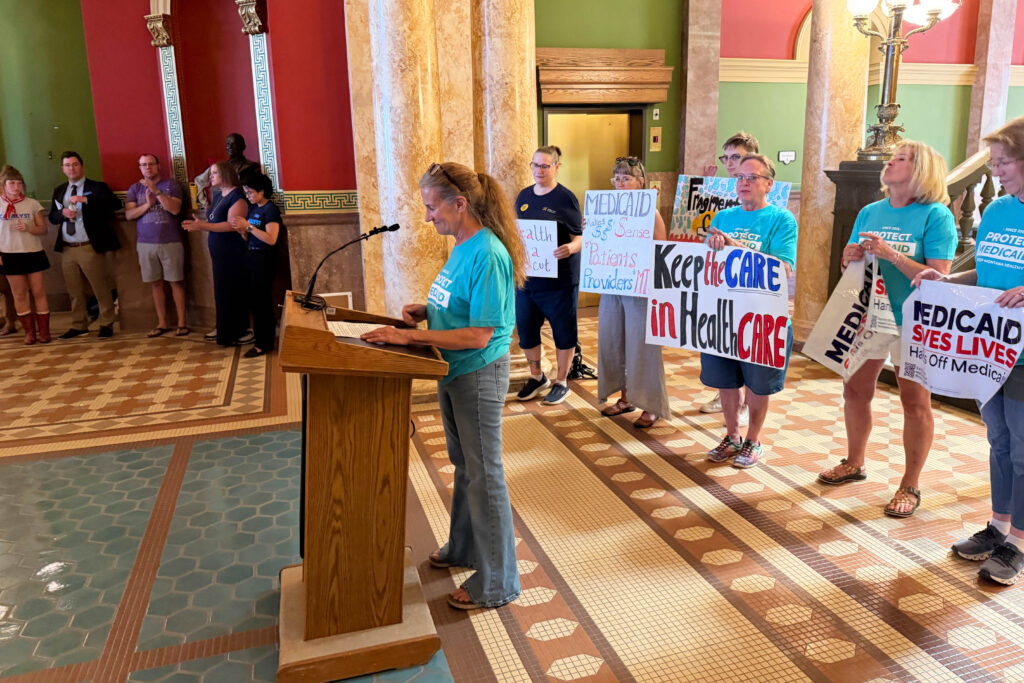
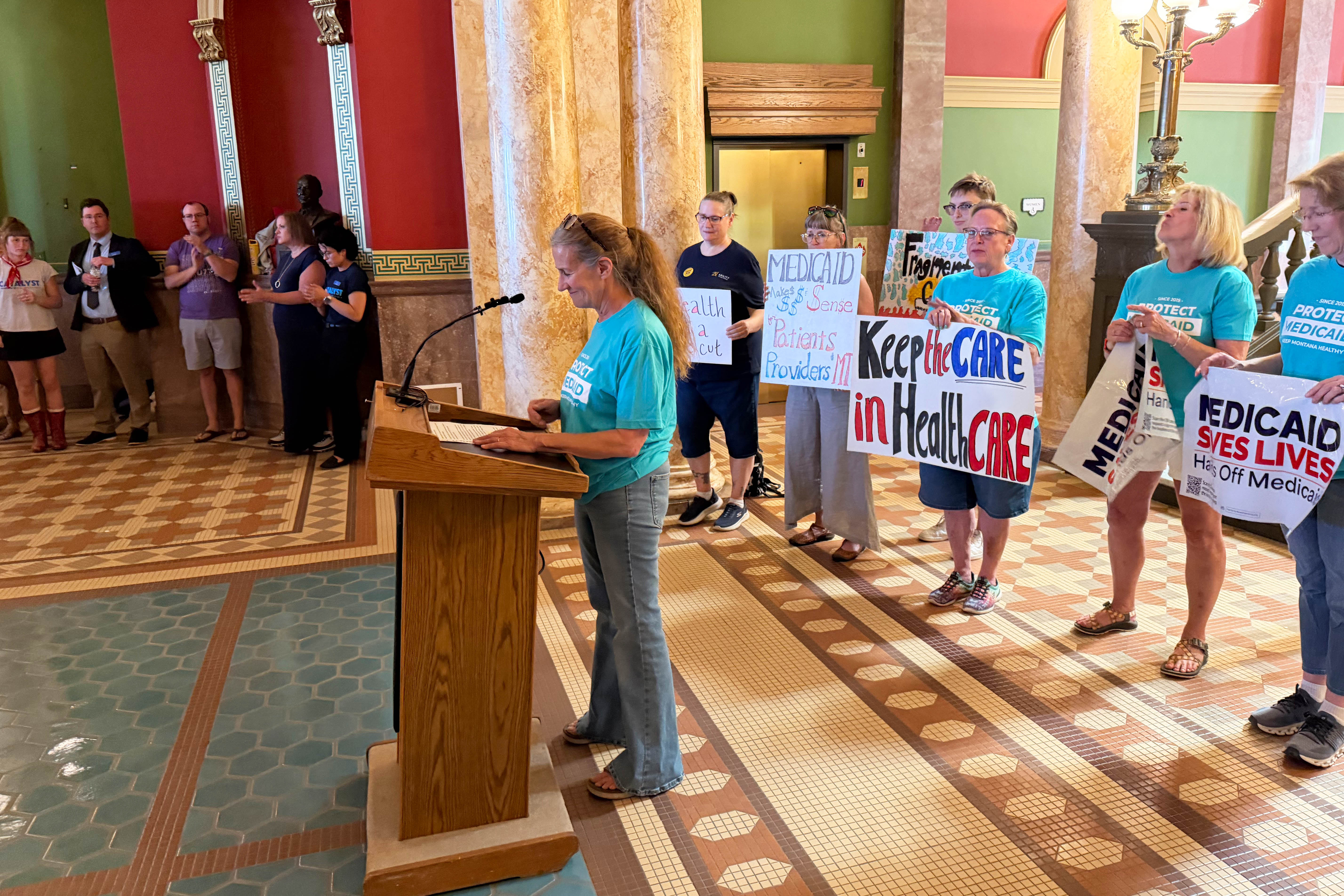
But others remain scared about losing coverage, including Heather Reel, who attended a rally at the state capitol in July to push back against Montana’s early rollout.
Reel relies on Medicaid for its mental health coverage. Without it, she said, she would struggle to care for her teenage son, who has autism and is nonverbal. Between her shifts at a fast food restaurant and caring for her son, she’s scared she’ll be too busy to figure out how to report her work hours.
Montana’s Rollout a Potential Preview
The handful of states that are implementing the Medicaid work requirements early are building the plane as they’re taking off, said Akeiisa Coleman, who provides Medicaid analysis for The Commonwealth Fund, a nonprofit focused on making healthcare more equitable.
“Montana is going to be an example for what we might see nationally as things roll out,” she said.
Although most other states are sticking to the Jan. 1 deadline to build and test their Medicaid systems, they still might not have all the components in place, she said.
If states can’t automatically renew or deny coverage based on the new rules, state workers will have to do so manually, on a case-by-case basis. That could create backlogs and more disruption, leading more people to lose coverage, Coleman said.
Jon Ebelt, a spokesperson for the state’s health department, said in a statement that Montana’s Medicaid office is ready for the change on Oct. 1.
“We are committed to ensuring eligible Montanans maintain coverage while meeting requirements, and we will continue to monitor implementation closely,” Ebelt said.
Democratic state lawmakers have repeatedly asked state health officials to extend the Oct. 1 deadline for enrollees to comply with the new rules, but they’ve said they have no plans to do so.
This article is from a partnership that includes Montana Public Radio, NPR, and KFF Health News.
KFF Health News is a national newsroom that produces in-depth journalism about health issues and is one of the core operating programs at KFF—an independent source of health policy research, polling, and journalism. Learn more about KFF.
This article first appeared on KFF Health News and is republished here under a Creative Commons Attribution-NonCommercial-NoDerivatives 4.0 International License.
This article was originally published by KFF Health News and is republished by MetroSTL under a Creative Commons license. The reporting is the outlet’s; please support them.