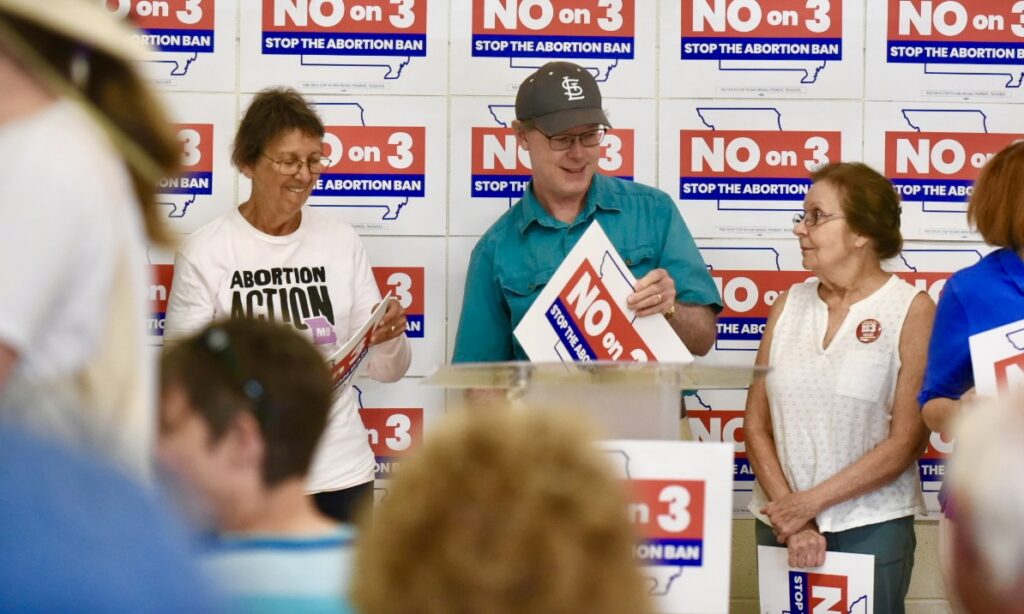
Abortion rights advocates gather for a canvassing kick-off event on Aug. 29 in St. Louis County (Anna Spoerre/Missouri Independent).
Since 2017, a D.C.-based nonprofit called the Fairness Project has poured more than $13 million into Missouri campaigns.
Every campaign it backed that has reached Missouri voters has won. And now it is making its biggest investment yet in the state.
In 2024, The Fairness Project gave more than $4.5 million to a citizen-led ballot effort to overturn the state’s abortion ban. This year, it has donated $5.3 million to Stop the Ban, making it the largest donor to the campaign seeking to defeat Amendment 3.
The amendment, placed on the Nov. 3 ballot by Republican lawmakers, would repeal the abortion-rights measure Missouri voters approved two years ago and replace it with an abortion ban with limited exceptions. It would also place a constitutional ban on gender-affirming care for minors, which is currently banned in state statute.
The Fairness Project’s prominent financial role — and the fact that, as a federally registered 501c4 nonprofit, it is not legally required to publicly disclose its donors — has also made it one of the main targets of conservative and anti-abortion leaders who argue that out-of-state interests wield too much influence over Missouri elections.
James Lawson, campaign manager with Her Health, Her Future, the group supporting Amendment 3, said he finds the influence of out-of-state funders on the abortion-rights campaign “deeply troubling.” Lawson is on a leave of absence from the Missouri Attorney General’s Office where he worked in communications through early November so he can help manage the campaign.
“They don’t have a dog in this fight here in the state of Missouri, except to push a radical agenda,” he said, accusing the Fairness Project of trying to make Missouri “a battleground” for progressive movements.
The latest SLU/YouGov poll found Missouri voters almost evenly divided: 43% supported Amendment 3, 44% opposed it and 13% remained unsure. In 2024, the abortion-rights measure won with 51.6% of the vote. Their polling over the past several years has continuously shown the majority of Missourians remain in favor of abortion access with gestational limits.
The Fairness Project, which backs progressive ballot measures across the country, declined a request for an interview or written comment. But the nonprofit’s leadership has been vocal in the past about its partnerships in Missouri.
In September 2024, Kelly Hall, then executive director of the Fairness Project, spoke with The Independent about that year’s reproductive rights campaign. Hall recently stepped down as executive director.
While money is a necessary ingredient to a successful campaign, Hall said, “it is only possible to do anything at all if we are supporting the work that is being driven by grassroots organizations, grassroots donors, regular people speaking to their neighbors and an electorate that is enthusiastic about the issue that these advocates have put forward.”
The coalition behind the reproductive rights campaign, called Missourians for Constitutional Freedom in 2024 and Stop the Ban this year, also includes the ACLU of Missouri, Abortion Action Missouri, Action St. Louis, Planned Parenthood Great Plains Votes, Planned Parenthood Great Rivers Action, PROMO and Beacon Reproductive Health Network.
Stop the Ban did not provide a comment for this story.
Chris Melody Fields Figueredo, executive director of the Ballot Initiative Strategy Center, which partners with the abortion rights campaign, said as ballot campaigns get more expensive, funders become more critical.
“There is a partnership that is critically important between state and national organizations,” she said, “to ensure that Missourians have the freedoms that are so fundamental to what the people of Missouri want.”
The Fairness Project
The Fairness Project was started by SEIU-United Healthcare Workers West leaders in 2015 after the group’s president, Dave Regan, hoped to support ballot efforts to raise minimum wages and expand healthcare access beyond the west coast.
“ … The Fairness Project has made it possible for regular people across the country to create meaningful economic and healthcare improvements in their lives, when their state governments have refused to do so,” a 2020 resolution signed by the SEIU-UHW executive board reads. “In short, the Fairness Project provides hope.”
The nonprofit’s revenue has grown substantially in recent years. In 2021, the Fairness Project brought in $4.1 million in revenue. In 2024, as its reach expanded across the country, it brought in $33.3 million, according to ProPublica’s nonprofit tracker.
That year, the Fairness Project injected more than $32 million into 11 campaigns in seven states, including efforts to raise the minimum wage, guarantee paid sick leave and protect reproductive rights, according to its annual impact report. In the 2024 general election, nine of the 11 campaigns they were involved in won at the ballot box.
By November, the nonprofit will have invested in more than 40 ballot campaigns across the country.
SEIU-UHW continues to support the Fairness Project, according to the union’s website. The nonprofit’s board members have included SEIU-UHW leadership, as well as Democratic political strategists and leadership with the ACLU, Planned Parenthood and the Human Rights Campaign.
Missouri labor unions, abortion rights groups turn unlikely alliance into ballot power
Leading up to the November 2024 election, the Fairness Project poured more than $30 million into reproductive rights ballot measures across the country. Nearly $5 million of that went to Missouri’s abortion rights effort, which raised more than $30 million.
“Since the start of our fight to restore abortion access in Missouri, the Fairness Project has been an invaluable partner,” Emily Wales, president and CEO of Planned Parenthood Great Plains, is quoted saying on the Fairness Project website. “They’ve helped guide in-state organizations through an effort that’s unlike any other we’ve undertaken.”
In Missouri, the Fairness Project has also put money behind efforts to expand Medicaid access in 2020, raise the minimum wage in 2024 and protect direct democracy this year. In November, the Fairness Project is backing the effort to overturn a gerrymandered congressional map, known as Proposition A, as well as Amendment 6, which would make it more difficult for lawmakers to alter or repeal measures approved by voters.
“Jefferson City politicians spent months trying to keep this measure off the ballot, showing exactly why Missourians need it,” Hannah Ledford, the new executive director of the Fairness Project, said in a statement earlier this month about Amendment 6, adding that the proposal “will protect voters from misleading ballot language, attempts to block citizen-led campaigns, and efforts to overturn laws they have already passed.”
Since 2017, the Fairness Project has contributed to the following Missouri campaigns, according to campaign finance reports:
- Stop the Ban (2026): $5.3 million
- Respect Missouri Voters (2026): $375,000
- Protect Majority Rule (2026): $1.4 million
- People Not Politicians (2025): $250,000
- Missourians for Constitutional Freedom (2024): $4.7 million
- Protect Majority Rule (2024): $64,021.
- Missourians for Healthy Families and Fair Wages (2024): $322,539
- Missourians for Healthcare (2020): $496,067
- Raise Up Missouri (2018): $285,000
- Give Missourians a Raise (2017): $114,276
Anti-abortion campaign lags 7-1 in fundraising
The campaign to keep Missouri’s abortion rights amendment in place has so far raised more than seven times as much as the campaign to reinstate the ban, according to the latest fundraising data.
As of this week, according to the Missouri Ethics Commission, Stop the Ban had raised about $13 million. Her Health, Her Future, which has the support of many of Missouri’s most powerful Republican officials, had raised more than $1.8 million.
Most of the largest contributions to Her Health, Her Future have come from Missouri donors. Only around $50,000 has come from out of state. The largest donors to the anti-abortion campaign are organizations tied to the Drury family, best known for the Missouri-founded, St. Louis-based hotel chain. Drury has donated more than $741,000 to the campaign effort across three of its businesses.
A spokesperson for Drury could not be reached for comment, but Lawson called Drury “a classic Missouri success story and family that is very committed to their faith and to the values that they hold dear.”
Her Health, Her Future has built a coalition that includes national organizations based outside of Missouri, providing help on the ground, including by sharing expertise, he said. But many aren’t backed by deep pockets.
“You’re gonna see it even on the national level, we see a significant imbalance of funds from progressive billionaires,” he said. “Versus, the pro-life movement is made up primarily of a coalition of faith groups that are much more grassroots oriented.”
Stop the Ban has also received sizable checks from individuals and Missouri organizations. Its local coalition members have contributed nearly $1 million. Philanthropist Lynn Schusterman, who was born in Kansas City and who now lives in Oklahoma, has given $3 million, and Bloomberg donated $1.25 million. Hundreds of Missourians have made smaller donations to the cause.
While the Fairness Project isn’t required to disclose its donors, some of its top contributors can be identified through 990 forms filed to the IRS by nonprofits that have given. Top contributors to the Fairness Project include Global Impact, Hopewell Fund, Our American Future Action and Sixteen Thirty Fund, all of which are based in D.C. Public records do not show whether those grants were earmarked for Stop the Ban or other specific campaigns.
‘Dark money’ flows across ideological lines
Earlier this month, while embroiled in a court battle over Missouri’s congressional map, Missouri Secretary of State Denny Hoskins proclaimed he would “proudly fall on my sword to save this great state from out-of-state special interests and their out-of-state sugar daddies.”
“Missouri will not become another New York City or Los Angeles on my watch,” he said.
Criticism of out-of-state money has become a recurring theme among Missouri Republican leaders as ballot campaigns have increasingly drawn millions of dollars from national organizations and wealthy donors.
Missouri lawmakers last year approved a proposed amendment for the 2026 ballot that sought to raise the threshold for passing citizen-led ballot initiatives. It also would have put a ban on campaigns accepting money from a “foreign national” into the state constitution.
In a video supporting Amendment 4 — which was rejected in August by 80% of Missouri voters — Republican Gov. Mike Kehoe said “our constitution shouldn’t be the victim of out-of-state special interests who spend millions to deceive voters and pass out-of-touch policies.”
But undisclosed money has also played a big role supporting causes backed by Kehoe and other Republicans.
By the August primary election, about $23 million in large donations came from groups that don’t have to disclose their donors. The largest donor — giving more than $6.5 million — was a nonprofit called Missouri Action that was created earlier this year. The campaign also received roughly $2 million from Ohio-based nonprofit American Policy Coalition.
Lawson believes voters are increasingly paying attention to who is funding campaigns.
“Slowly, over time, yeah, I think voters are becoming significantly more sensitive to out-of-state dark money,” he said. “And I would even go as far as to say, we probably saw that a little bit in the primary when we saw a rejection of some of the ballot measures there.”

Hall in 2024 said she doesn’t bother with dark money arguments.
“If they want to focus on this rather than on the issue that Missouri voters care about, which is making sure that everyone in their state has access to life-saving, reproductive healthcare when they need it, then that’s a misread on their part of what Missouri voters care most about,” she said.
The same model is also being used by abortion opponents.
The Love Life Initiative, launched late last year by U.S. Sen. Josh Hawley of Missouri and his wife, Erin Morrow Hawley, says it will invest in anti-abortion and pro-family messaging around the country. The organization does not publicly disclose its donors and has not donated to the Amendment 3 campaign.
Undisclosed political spending is hardly unique to Missouri — or to one side of the political spectrum. The New York Times reported last month that at least $1 billion from anonymous donors has flowed into the 2026 midterm elections through nonprofits, super PACs and other groups.
Craig Holman, a campaign finance expert with the consumer advocacy nonprofit Public Citizen, said “dark money” was born of the 2010 U.S. Supreme Court decision in Citizens United v. Federal Election Commission which opened the door for unlimited spending on elections.
In the 16 years since, total expenditures in politics have increased more than three-fold, he said. The prevalence of campaign funding from groups that don’t have to disclose their donors spans party lines and political ideologies, reaching from statewide races to federal elections, he said.
Ballot measure campaigns in particular remain the “wild west” of campaign finance laws, Holman said, as judges continue to strike down any limits on contributions and spending on behalf of ballot measures.
The prevalence of anonymous campaign cash in Missouri elections continues to give John Hancock, a veteran GOP political consultant, heartburn.
“You’re really, in a sense, taking the ball out of the hands of Missourians by having all of this influence money, and it’s dark influence money — we don’t really know who the donors are — and I think that’s regrettable,” Hancock said. “But that’s what the campaign finance laws allow.”
Editor’s note: The Hopewell Fund served as an incubator for States Newsroom, the parent organization of The Missouri Independent, from 2017-19 and does not fund the nonprofit news organization. States Newsroom lists Global Impact Fund as among its donors. Donors have no role in editorial decisions.
This article was originally published by Missouri Independent and is republished by MetroSTL under a Creative Commons license. The reporting is the outlet’s; please support them.