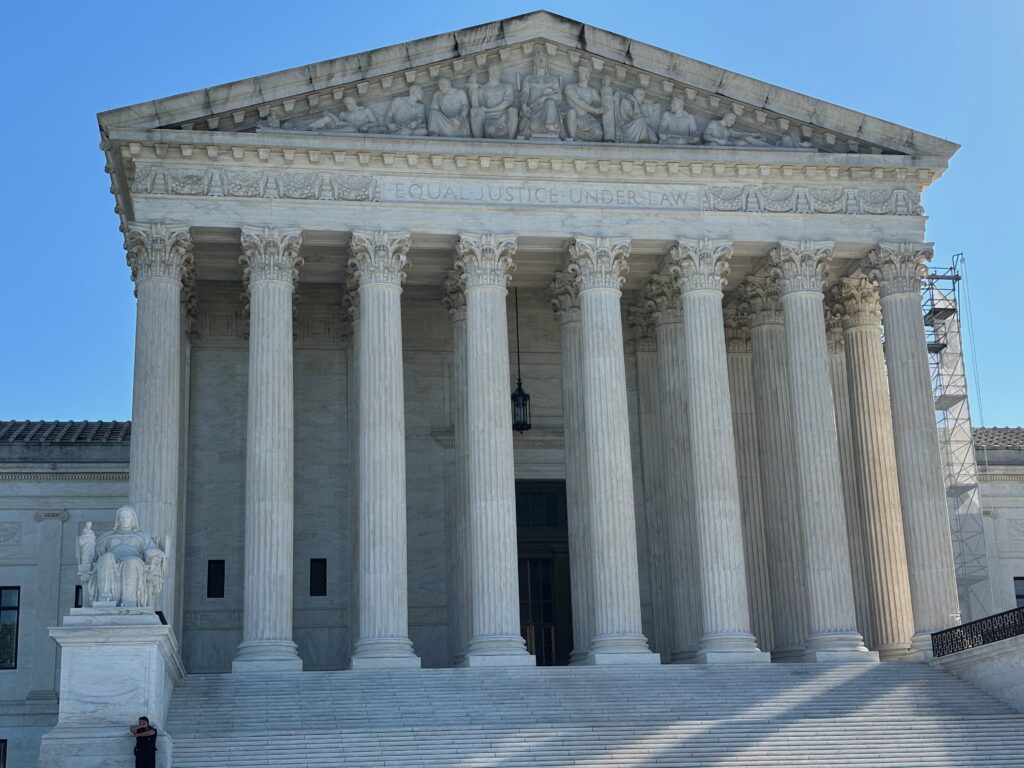
Missouri Republicans want the U.S. Supreme Court to overrule a decision of the Missouri Supreme Court ordering a congressional election in the districts used in 2024 (Jane Norman/States Newsroom).
The U.S. Supreme Court appeal filed late Friday by Missouri Republicans could be the surprise plot twist that results in a GOP triumph or an epilogue to a saga of a goal that stayed tantalizingly out of reach.
In the filing, Republicans surrendered on the question of whether Missourians will see a referendum on the gerrymandered congressional map muscled through a 2025 special session. The filing from Republican Attorney General Catherine Hanaway in the name of Republican Secretary of State Denny Hoskins asks just that the revised map, used to nominate candidates in eight districts on Aug. 4, be the controlling boundaries for the Nov. 3 general election.
“On the one hand, Richard von Glahn — the referendum petition’s proponent — will get his referendum vote on Missouri’s congressional map regardless of what this court does,” wrote Lou Capozzi, the state solicitor general, in the application for an emergency stay. “The only question is whether he (joined by a small minority of the state’s voters) can void a congressional map before he gets his vote. On the other hand, Missouri cannot run a timely, lawful federal election absent a stay.”
The court is being asked to stay the effect of Thursday’s Missouri Supreme Court decision that found People Not Politicians, the political action committee that sponsored the referendum petition, had submitted enough signatures for a constitutional use of the referendum power.
As a result, Judge Ginger Gooch wrote, the new congressional map passed by the General Assembly had not taken effect and the court ordered Hoskins to conduct the general election in the boundaries used for elections in 2022 and 2024.
The redistricting plan passed in 2025 “is not the law and has never been the law,” Gooch wrote in a footnote to the unanimous opinion. “There is only one valid congressional redistricting in effect — the congressional redistricting the General Assembly established in 2022.”
If the Supreme Court does not intervene, the election is expected to result in six Republicans and two Democrats winning. An order to use the 2025 map is expected to give the GOP seven seats because the boundaries of six districts were rearranged.
While the referendum may prevent the map from being used in future elections, the prize is the extra GOP seat in a year where Republicans worry about losing their slim majority.
The application went to Justice Brett Kavanaugh, who is the Supreme Court justice assigned to the Eighth Judicial Circuit. Kavanaugh gave People Not Politicians a deadline of noon Monday to file a response.
Mike Wolff, a former Missouri Supreme Court chief justice and dean emeritus of St. Louis University School of Law, said he expects Kavanaugh to deny the stay.
“There is no authority given to the federal courts to tell a state how to conduct its elections, except the Voting Rights Act, which is pretty much dead, or another constitutional principle,” Wolff said. “Other than that, the federal courts don’t have any business telling the states how to run their elections.”
Michael Smith, an associate professor of law at the University of Oklahoma, said he expects Kavanaugh to consider carefully whether the procedures and deadlines in Missouri’s state election laws have been met.
Smith is the author of a research paper, “Missouri’s Law of Constitutional Interpretation” and he sees the Missouri Supreme Court decision as being firmly supported in the text of the Missouri Constitution and precedent.
“What the Supreme Court is going to do, I would like to hope, is uphold the Missouri Supreme Court ruling, given its compliance with state law,” Smith said.
People Not Politicians issued a statement saying it expects the Supreme Court to rule against Hoskins and Hanaway.
“Anyone with a basic understanding of civics knows the legislature, which in Missouri includes the people via the referendum, is who makes law, not the judiciary,” von Glahn, executive director of People Not Politicians, said in a news release Saturday. “The Attorney General is asking the Supreme Court of the United States to create a law that has never been the law in Missouri.”
In the application for an emergency stay, Capozzi argued that reverting to the districts used in 2022 and 2024 is impossible and violates the rights of voters who participated in the primary.
Behind the drama in Washington, actions are occurring while a state law deadline looms.
U.S. Rep. Bob Onder of Lake St. Louis, who represents the 2nd District, and state Sen. Rick Brattin of Harrisonville, GOP nominee in the 5th District, and two voters, sued Hoskins in federal court for the Eastern District of Missouri asking for an order blocking the Missouri Supreme Court ruling from being implemented.
“The entire state of Missouri has now been plunged into legal and electoral uncertainty over which congressional maps govern Missouri’s 2026 general election and which candidates represent whom,” Republican Party attorney Marc Ellinger wrote in the filing. “This court should issue all appropriate relief without haste to ensure free and fair elections in November.”
Ellinger asked for an expedited consideration.
On Saturday afternoon, Hanaway’s office, instead of defending the Missouri Supreme Court action, said in a filing on behalf of Hoskins that it agreed with Onder and Brattin.
“The Missouri Supreme Court’s order patently violates federal law in several respects,” Capozzi wrote.
Chuck Hatfield, attorney for People Not Politicians, said he believes Kavanaugh will refuse to issue the stay because the only reason the decision is being made now is because of choices Hoskins made to delay.
“A person who has done wrong cannot ask for relief to solve an injury they caused,” Hatfield said.
And he said the Eastern District lawsuit violated basic principles that a true dispute must exist between the parties for the courts to intervene. Hatfield filed a motion to intervene in the case Saturday afternoon, writing there are “serious doubts that a genuine adversarial proceeding exists in this action.”
“Cheech agrees with Chong that pot is groovy,” Hatfield said in an email. “Its what’s known in the law as a collusive lawsuit.”
After Hatfield filed the motion to intervene, Chief District Judge Stephen Clark issued an order giving the parties until noon Monday to file additional arguments on “whether federal abstention doctrines” mean the case should be dismissed as well as the impact of the pending U.S. Supreme Court appeal.
The decisions that delayed legal action on the basic questions surrounding the referendum were discretionary actions by Hoskins.
People Not Politicians submitted more than 300,000 signatures on Dec. 9, two days before the redistricting law was set to take effect. At that point, Hoskins had the option of using a random sample of the lot to determine if it had the required 5% of voters in six districts, or sending pages out for line-by-line verification.
A random sampling procedure would have required Hoskins to deliver his decision on the sufficiency of the petition by early February, weeks before candidate filing began. Instead, by using line-by-line verification, the deadline was pushed to Aug. 4, the date of the primary, and Hoskins won an interim decision that he was allowed to consider the law to be in effect until the referendum was certified for the ballot.
The questions decided Thursday could have been resolved before candidate filing ended in March, Hatfield said.
“He had the opportunity to avoid all of this and he chose not to,” Hatfield said.
The deadline for finalizing the Nov. 3 ballot is Tuesday. One state law prohibits local election authorities from adding or removing candidates or issues after that date and another extends that prohibition to the courts.
Under Missouri law, nothing can be added or removed from general election ballots after Tuesday. Ballots must be printed and ready for delivery to overseas voters by Sept. 19.
The law limiting the timing for court-ordered additions to the ballot was passed after the Missouri Supreme Court in 1996, less than three weeks before the election, struck the fiscal note language from a ballot question and ordered election officials to place an “opaque sticker over the previously printed ballot language…”
The state’s application to the Supreme Court asks Kavanaugh for a decision by Sept. 14. The lawsuit filed by Onder and Brattin asks for quick action without setting a goal for a decision.
The federal courts should respect the Tuesday deadline, Wolff and Smith said.
The legal doctrine of unclean hands could also play a role, Smith said.
A federal judge in December said Hoskins did not have to wait for signature verification to declare his belief that the referendum petition was unconstitutional. That could have resolved the legal questions even earlier than a random sampling.
“To the extent there is a crisis, it is a crisis of the state’s own making,” Smith said. “In asking for a stay in the judgment, there are principles that counsel against giving that extraordinary relief if the parties seeking that relief have contributed to that need for it.”
This article was originally published by Missouri Independent and is republished by MetroSTL under a Creative Commons license. The reporting is the outlet’s; please support them.