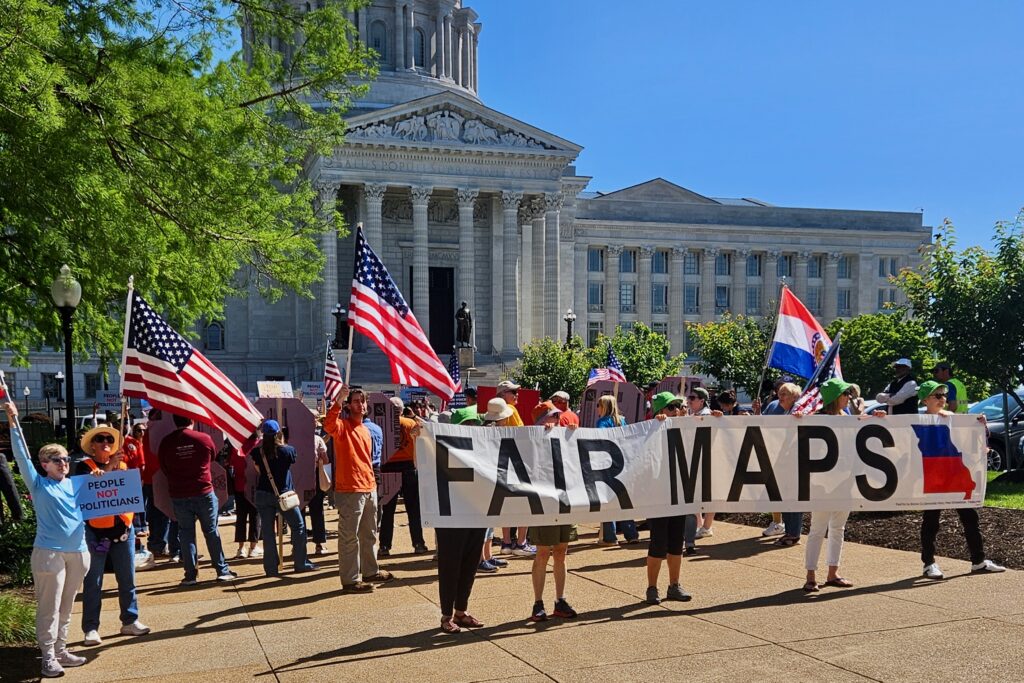
Supporters of a referendum on Missouri’s gerrymandered redistricting map rally at the state Capitol Building Tuesday, May 12 after the Missouri Supreme Court heard arguments on two cases involving the redistricting map (Rudi Keller/Missouri Independent).
While the nation faces various stress tests for the rule of law upon which our country was built, Missouri courts are facing their own stress test in the hot mess of our current congressional redistricting.
Our Legislature redrew our congressional maps in 2025 at the insistence of President Donald Trump. The chief aim was to make the 5th District in the Kansas City area less favorable to incumbent U.S. Rep. Emmanuel Cleaver, a Black Democratic congressman who represents a majority white district.
The 5th District’s boundaries were stretched from the Kansas border to mid-Missouri, which includes a lot of rural voters who, it is presumed, would be less likely to vote for Cleaver than his current constituents. Nevermind that there might have been a racial motive; the U.S. Supreme Court in its dismantling of the federal Voting Rights Act has taught us to look away.
The hot mess is a series of court cases, 12 in all but only a few that ultimately matter, and I include names of decisions if the reader is looking for more. Individually the cases are simple but overall seem complicated. Let me explain as simply as I can.
The road to where we are now started with the Missouri Legislature’s redistricting act passed in a special session in September 2025. Cleaver’s allies challenged the new boundaries for not being “compact” and “contiguous” as the Missouri Constitution requires. While one can see that the boundaries are contiguous, they certainly don’t look compact.
Notwithstanding the “compact” requirement, the Missouri Supreme Court — perhaps reflecting the U.S. Supreme Court’s inability to see anything wrong with partisan gerrymandering — upheld the Legislature’s work which reportedly was handed to them by someone in the District of Columbia. In any event, it was close enough for government work (Wise v. Missouri and Healey v. Missouri et al).
In another case challenging the Legislature’s work, there was a strong argument that the Missouri Constitution does not authorize redistricting except when the state receives its once-a-decade population count and its allocation of congressional seats as computed by federal law based on the U.S Census. Only three of the Missouri Supreme Court judges accepted the arguments, however, while the four-judge majority held that unless explicitly prohibited, the Legislature can do redistricting any time it wishes (Luther v. Hoskins).
That set the stage for the big upcoming court case: What to do with the petition of 300,000+ voters who petitioned to put the 2025 redistricting law on the November ballot?
Months ago, the petitioning organization, People Not Politicians, sued to force Secretary of State Denny Hoskins to acknowledge that there are enough signatures to meet the constitution’s requirement, which currently is about 110,000 valid signatures. No, the Supreme Court said, the secretary’s review was “ongoing”, and the constitutional deadline was Aug. 4, coincidentally the date of the primary election (Maggard v. State).
Though Hoskins had received verified signed petitions from local election authorities months ago, he refused to act until the deadline.
Fair enough, one might say. But the Supreme Court unanimously said if there are enough signatures, the redistricting law goes on hold retroactive to Dec. 9 when the petition was filed — the prior law stays in effect and the new law “shall take effect when approved by a majority of the votes cast thereon, and not otherwise.”
An hour before the deadline to certify voters’ signatures on Aug. 4, Hoskins announced that he refuses to put the measure for the ballot no matter how many signatures there were. That’s because the secretary came late to claim he has the power to disapprove the petition no matter what the Missouri Constitution or the Supreme Court says.
The People Not Politicians lawsuit asks the court to resolve a basic question: Does the Missouri Constitution, which guarantees citizens the right to challenge any “act of the General Assembly” include the act of redistricting?
Hoskins and Attorney General Catherine Hanaway say no, that is not what those words could have meant, even though citizens have done a referendum on congressional redistricting before in 1922.
There are exceptions to the constitutional provision requiring a vote of the people, but redistricting laws are not in the exceptions. The secretary’s reading of the Missouri Constitution evades or ignores its plain language. Hoskins and Hanaway’s theory apparently is also based on a federal constitutional challenge that a federal court already has turned aside.
Court-ordered changes to the ballot must be done by September 8.
The Supreme Court’s prior decision says if the petition has enough signatures and is constitutional, the new map is not in effect until the voters approve it. So, what if the court also finds that using the referendum to challenge a mid-cycle congressional redistricting is also protected by the Constitution’s voter-approval provision?
That would mean that the maps would change back to the earlier maps for the November election. This year’s candidates nominated in most congressional districts would be campaigning in districts that differ from the districts they campaigned in for the primary election.
But if anyone feels aggrieved by the change in maps, their complaint is with Hoskins — it was his decision to wait until the legal deadline, which was months after he received the verified signatures from the local election authorities. He could have raised his legal concerns back in December of last year, but he chose to go ahead and use the new maps that the voters’ signatures should have put on hold.
The old map or the new map? Despite the differences, it would seem useless to re-do the primary election. Close enough for government work. There are primary election victors ready to campaign and stand for election in all eight districts regardless of where the lines are drawn.
If Missouri courts have the fortitude to follow their own Supreme Court precedent as well as the Constitution’s guarantee that the people will have a veto, the rule of law will have survived for another day.
And what if the voters approve the new 2025 map on Nov. 3? The new law will go into effect after the people have voted. If the voters approve, the redistricting law will be in effect for the 2028 election. Unless, of course, the Legislature changes it in the 2027 or 2028 session, as the Supreme Court said it could.
But for the coming term of Congress, Missouri will have representatives elected from lawful districts. And, despite the gamesmanship dictated from the District of Columbia, the winner will be the rule of law.
This article was originally published by Missouri Independent and is republished by MetroSTL under a Creative Commons license. The reporting is the outlet’s; please support them.