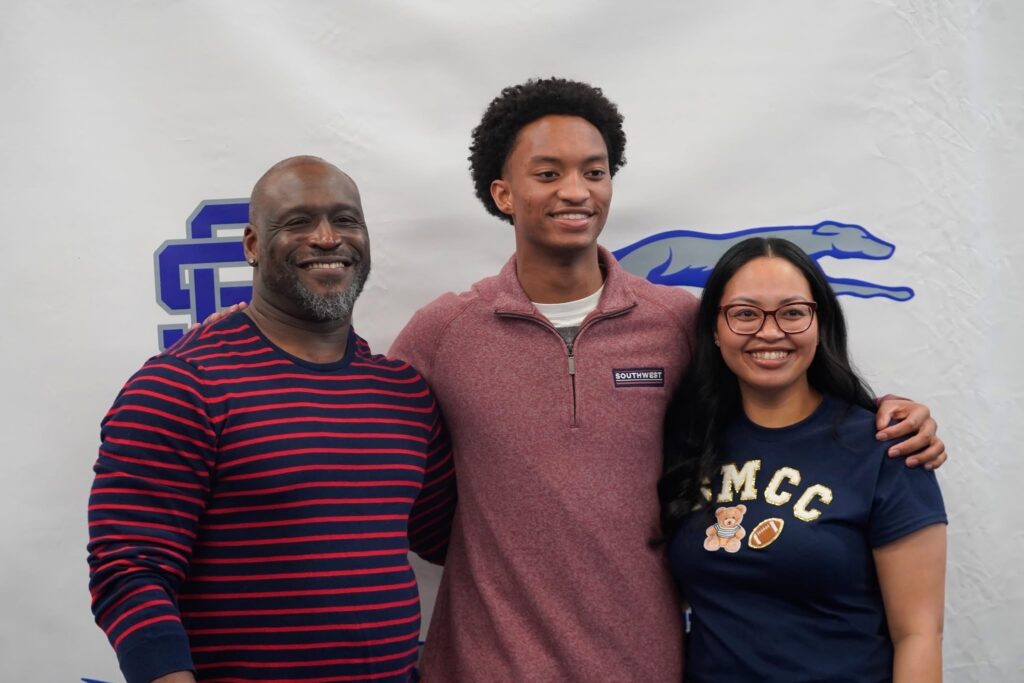
Nolan Xavier Wells, center, with his parents, Christine Wells-Wonsley and Elmore Wonsley. After Nolan’s death in early July during a boat trip with a group of white friends, his parents commissioned an independent investigation with the help of civil rights attorney Ben Crump. (Photo courtesy of Ben Crump Law)
After investigators ruled 31-year-old high school counselor and coach Kelsey Harris’ death a suicide in 2021, her mother, Kellee, said she was not convinced the inquiry had answered the most important questions.
About a week before Kelsey died, police had arrested her boyfriend on a strangulation charge after Kelsey reported he attacked her, according to her mother and police records. After Kelsey was found dead of a gunshot wound to the head, the county medical examiner ruled her death a suicide.
“I just couldn’t even believe that,” Kellee Harris said.
Kellee Harris has since questioned whether investigators fully considered the assault report and other circumstances surrounding her daughter’s death, including the bullet’s entry and exit points and the authenticity of Kelsey’s final text message to loved ones. She has spent years seeking additional information about the case and has joined other Oregon families in advocating for changes to how suspicious deaths are investigated.
Forensic crime labs are buckling as new technology increases demand
“It’s been the most aggravating, challenging thing I’ve ever done in my life, you know, is to try and get to the bottom of what happened,” Harris said. “The system failed us every single step along the way.”
For families who question an official determination about how a loved one died — whether from suicide, an accident, natural causes, during an encounter with law enforcement or while incarcerated or detained — the next step is often unclear. Independent autopsies have become a familiar part of some of the nation’s highest-profile death investigations, most recently with the death of 18-year-old Nolan Xavier Wells, who died in Mississippi in early July.
Independent autopsies have often emerged from a deep distrust of official systems — particularly in cases involving Black victims killed by law enforcement, where families have questioned whether investigators treated their loved ones’ deaths with the scrutiny they deserved. For some, an outside review represents a way to seek answers when they believe the initial investigation overlooked key evidence, moved too quickly or failed to account for their concerns.
But these reviews are not limited to police encounters; families have also sought independent examinations in cases involving domestic violence, disputed evidence and other circumstances where the official explanation remains contested.
Other high-profile cases include the deaths of Kendrick Johnson in 2013, Michael Brown in 2014, Tamla Horsford in 2018, George Floyd in 2020 and Patrick Lyoya in 2022. In some cases, the second autopsies reached conclusions that differed from or expanded on the initial investigation, while in others they provided additional medical evidence that became part of the public record.
Some families hire independent forensic pathologists. Others seek outside investigators, ask prosecutors to reopen cases or turn to advocacy groups for help understanding what happened.
Harris pursued nearly every avenue she could find. She consulted multiple independent experts to review the case, requested investigative records, including crime scene photos and other materials, repeatedly asked local investigators and prosecutors to take another look at the evidence, and ultimately became an advocate for changes to Oregon’s death investigation laws.
Linn County Sheriff Michelle Duncan told Stateline that investigators stand by their determination that Harris died by suicide. Duncan said she and the county district attorney have met with Kellee Harris and outside experts who have questioned the investigation and believe the crime scene was staged, but said those experts did not visit the scene in person.
“All of the evidence points to, unfortunately, a suicide,” Duncan said. “I feel really awful for the mother who is probably wanting to hang on that her daughter would not do that, but there is no evidence of anything but a suicide.”
The United States has no single death investigation system, and the options available to families can vary widely depending on where a death occurs.
A Stateline analysis of state death investigation systems found that 20 states and Washington, D.C., use centralized medical examiner systems, while nine states rely primarily on local coroners. The rest use a mix of state and local officials. In most places, death investigations are handled at the county level, where families may encounter different officials, including sheriffs and justices of the peace, procedures and resources.
A 2025 report from the National Academies of Sciences, Engineering, and Medicine found that the nation’s medicolegal death investigation system is fragmented and lacks the resources, uniform standards and oversight needed to ensure consistent cause- and manner-of-death determinations.
Independent autopsies may provide another expert interpretation of evidence, identify unanswered questions or help families understand how investigators reached a conclusion. But they are not guaranteed to produce a different answer, and they can be expensive or difficult to obtain.
Death investigations, explained
Death investigations in the United States do not follow one national model. States rely on a mix of medical examiner systems, coroner systems and hybrid models that can vary significantly in structure, resources and oversight.
In a medical examiner system, deaths are investigated by physicians, typically forensic pathologists, who are trained to determine a person’s cause and manner of death. Medical examiner offices often employ investigators, forensic technicians and other specialists.
Coroner systems operate differently. Coroners are often elected officials, and the qualifications required for the position vary by state. In some jurisdictions, coroners are physicians with medical training; in others, they may not have a medical background and may rely on forensic pathologists or outside experts to perform autopsies and help determine the cause of death.
“When you have so many systems that are varied across the country, there’s going to be some nuances in those systems,” said Dr. Michelle Jorden, the president of the National Association of Medical Examiners. Jorden also is a practicing chief medical examiner in northern California.
Why ‘clearance rates’ don’t tell the whole story about solving crimes
Those differences can affect everything from who examines a body to what resources are available when families have questions about an official finding.
For families, the system can feel opaque. A death certificate may list a cause and manner of death, but relatives may not understand what evidence was considered, who made the final determination or whether there is a process for requesting another review.
“All you want is answers and information,” said Iva Rody, the chief operating officer at the National Center for Victims of Crime. “The system itself just kind of sets us up for not being able to truly be transparent and communicate well.”
Rody said some of that difficulty stems from the way investigations are structured. Law enforcement agencies often limit what they share while an investigation is ongoing to protect evidence, witnesses and the integrity of the case.
Policing experts say investigations can also take months or years to complete depending on the complexity of the case, available evidence and the need for additional forensic testing or interviews. But those delays can leave families feeling shut out of a process that directly affects them.
“They want answers, and they want them based on the way they’ve been conditioned to expect them. That’s just not consistent with the reality of how investigations roll out,” said Matt Irvine, a retired detective and law enforcement instructor with 29 years of experience.
Irvine said public expectations are often shaped by TV shows and movies that portray forensic results and case resolutions as happening much faster than they do in real life.
For some families, a lack of information or communication with local authorities can become a reason to commission independent investigations.
Second autopsies
Independent investigations, which might include a second autopsy, may confirm the initial findings, identify information that was overlooked or provide families with a better understanding of how investigators reached a conclusion.
But forensic experts caution that a second autopsy is not designed to automatically replace an official investigation or prove that an initial finding was wrong. In many cases, the first examination provides the most complete opportunity to document evidence before it is altered or no longer available.
“The first autopsy is more than likely going to be the most valuable autopsy,” Jorden said. “That’s where the autopsy exam is most complete.”
Black homicide victims’ families most likely to be denied compensation
The goal of an independent investigation or autopsy is not always to produce a different conclusion, but to provide another examination of the evidence. In some cases, that review can still leave families with unanswered questions.
That was the case this summer for Nolan Xavier Wells.
The 18-year-old Mississippi college student’s family’s legal team commissioned an independent forensic review after questioning the circumstances surrounding his death. Wells, who is Black, was found dead two days after he disappeared during a July Fourth boat trip to Horn Island off the coast of Mississippi with a group of mostly white friends.
Roger Mitchell, an independent pathologist and former chief medical examiner for the District of Columbia, conducted a second autopsy and classified the cause and manner of death as “undetermined” pending further investigation.
This means that Mitchell determined there was not enough evidence to confidently classify the death as natural, accidental, a suicide or a homicide.
Mitchell wrote that the most significant limitation of the independent review was the inability to directly examine the airway and lungs for evidence of water or the stomach for gastric contents, in part because internal organs had been “rightfully” removed in the first autopsy and that the trachea was missing. Mitchell wrote that he “cannot rule out injury to the neck as a contributor or a cause of death.” He added, however, that a toxicology report hadn’t come back yet, and that questions remained about the circumstances that led to Wells entering the water.
The Mississippi State Medical Examiner’s Office conducted its own autopsy but has not yet released the results.
“We have more questions than answers at this time,” said civil rights attorney Ben Crump, who is representing Wells’ family, when announcing the results of the independent autopsy. Wells’ family and legal team declined Stateline’s interview requests.
Trust, transparency and accountability
Some researchers who study public trust in institutions say confidence in an official death investigation is shaped not only by outcomes, but also by whether people believe the process was transparent, whether they were treated fairly and whether they had a meaningful opportunity to understand how decisions were made.
Brandon Garrett, a Duke University law professor and leading scholar on forensic evidence reliability, criminal justice outcomes and constitutional rights, said the concerns families raise about death investigations reflect deeper problems in forensic science — not only that many labs are closely tied to law enforcement, but also that some of the judgments medical examiners are asked to make aren’t backed by strong research or clear scientific standards.
“The two biggest needs are for labs to be independent and have scientific oversight, and for the basic scientific research to be done, so that experts can reach more reliable conclusions,” Garrett said.
Jorden, of the National Association of Medical Examiners, echoed that point. She told Stateline that while forensic pathologists often rely on information from law enforcement as part of an autopsy, they must maintain independence when interpreting the evidence and reaching conclusions about a person’s death.
But confidence in those conclusions is also shaped by the history of the institutions making them. In Mississippi, civil rights advocates have long pointed to the state’s history of unsolved killings of Black residents and allegations of inadequate death investigations, contributing to skepticism when official conclusions are announced in more recent cases.
“There’s valid historical reasons for people to distrust the police in this country,” said Irvine, the retired detective. Irvine served in California and Oregon.
That history has resurfaced in public discussions of several recent deaths in the state, including the death last year of 21-year-old Demartravion “Trey” Reed, who was found hanging from a tree on the campus of Delta State University. His death was ruled a suicide, and Crump’s legal team arranged an independent autopsy, though the results have not been publicly released, according to the Mississippi Clarion Ledger.
But some experts and advocates say past failures, or what community members view as failures, can influence how people respond when authorities announce conclusions in new cases.
Misinformation and speculation can further complicate efforts to build trust. Incomplete information, rumors and unverified claims can spread quickly online, as seen in the public discourse surrounding the deaths of Wells and Reed.
“(Families and victims) may not be able to be privy to investigative information, but (investigators) need to stay in touch with them to make sure that they understand that the investigation is really happening,” Garrett said. “And they should receive news first before the public does.”
Stateline reporter Amanda Watford can be reached at awatford@stateline.org.
This article was originally published by Stateline and is republished by MetroSTL under a Creative Commons license. The reporting is the outlet’s; please support them.