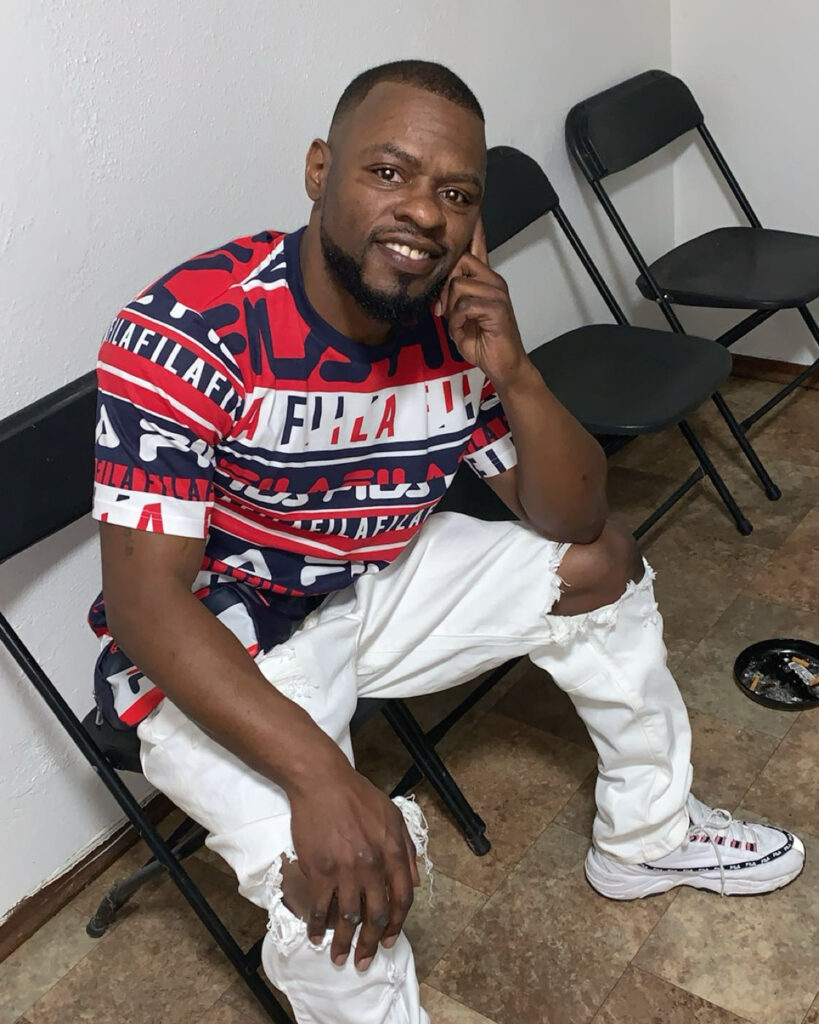
SIKESTON, Mo. — Not everyone at Lloyd Gilmore’s funeral knew him well. One woman, who had ironed her clothes two days in advance, said she just wanted to be there for his family. School-age children, guided by their parents, approached his open casket in the sanctuary of Cornerstone Baptist Church and peeked inside. Other people looked away.
On that rainy Friday afternoon, hundreds of such mourners gathered to honor the man who went to the police department for help and didn’t come back.
“Stay woke. Stay guarded,” his daughter Lania Gilmore told the church full of mourners in this city of fewer than 16,000 with a long, troubled history of racial violence. “Be there for your family and love on one another.”
Her father, a 44-year-old Sikeston resident, died in police custody on June 10. During a quick, physical altercation involving seven Sikeston police officers, he was shocked with a Taser and put into hobble restraints, which allow officers to hogtie a person’s feet and hands, according to a police report obtained by KFF Health News through a public records request. Two autopsies were performed, but they — and Gilmore’s cause of death — had not been released as of mid-July while the result of a toxicology report remained pending.
Gilmore had approached an officer in the parking lot of the police station, according to the report, speaking words the officer said he could not understand. Lania Gilmore said that her dad, who had mental health issues, had asked her to call the police department and that he ran there seeking help.
“I kind of trusted the fact that he was OK because he was at the police station,” she told KFF Health News.
At his funeral, hardly anyone spoke of the police — and, at the family’s request, the funeral home declined to ask police to provide traffic assistance as they usually would. A preacher did his best to comfort Gilmore’s family. “Sometimes we need not talk,” the Rev. Tommy Robinson Jr. told the crowd. “We just need to listen.”
But after years of expressing concerns of racial bias within the city’s police department, some Black Sikeston residents wonder if anyone is listening at all anymore. They want justice even as the national reckoning over police brutality has faded from public view.
“We need the police. We just need them to do their jobs correctly and leave Black people alone,” said Mark Wiggins, president of Sikeston’s NAACP branch. “They know it. We know it. The truth of the matter is there’s a lot of unwarranted cop killings of Black men in America.”
But despite worldwide protests in 2020 in the wake of high-profile police-involved killings of Black people, the public paid little attention when a prestigious group released a report last year about deaths in custody, said Roger Mitchell Jr., a forensic pathologist finishing his term as president of the National Medical Association, which represents African American physicians. The report from the National Academies of Sciences, Engineering, and Medicine urged Congress to require states to collect and report data on all in-custody deaths, a problem that Mitchell said disproportionately affects Black men.
“We are in an anti-diversity environment,” Mitchell said. “We’re in a war.”
Upon returning to the White House last year, President Donald Trump immediately signed an executive order that targeted diversity, equity, and inclusion programs. As a result of that and other measures, funding for racial equity has dwindled, researchers who once studied violence as a public health issue have redirected their work to less politically charged topics, and a growing fear of professional and political retaliation has made it increasingly difficult to sustain the momentum.
Kevin Myles, a civil rights leader based in Georgia who has trained tens of thousands of activists around the country, said he saw a shift in priorities around racial equity before Trump was reelected. Since then, it has escalated, he said, and he has lost at least half his funding for his work on equity, child welfare, and mass incarceration.
“I don’t think we really were prepared. It’s not that we didn’t take it seriously. I don’t think we were psychologically prepared for what this means,” Myles said. “Everything we have done before now was practice. The game has just started.”
Sikeston, located in the rural area of southeastern Missouri known as the Bootheel, has a history of racial violence, including the brutal lynching of a Black man named Cleo Wright in 1942. Another Black man, Undraus Nabors, was found dead in a grain silo months after heading out to pick up his white girlfriend in 1999. In April 2020, less than a month before George Floyd’s murder in Minneapolis, an unarmed Black man, Denzel Taylor, was shot at least 18 times by Sikeston police officers. The city was the subject of the 2024 “Silence in Sikeston” documentary film and podcast by KFF Health News, Retro Report, and WORLD.
Silence in Sikeston
Watch: New Documentary Film Explores a Lynching and a Police Killing 78 Years Apart
The “Silence in Sikeston” documentary film explores how the nation’s first federally investigated lynching and a police killing 78 years apart haunt the same rural Missouri community. The film from KFF Health News and Retro Report explores the lasting impact of such trauma — and what it means to speak out about it.
Larry McClellon, a longtime Sikeston resident who founded a civil rights group called And Justice for All, has expressed concerns about the integrity of his city’s police department for decades. He’s also convinced that being vocal about racism in Sikeston comes with a price.
“It’s a dark side of Sikeston that a lot of people do not know and don’t prefer to know,” McClellon told KFF Health News in 2021 after police fatally shot Denzel Taylor. “But I’ve walked the streets.”
He believes someone burned down the headquarters of And Justice for All in 2019. A report from the city’s public safety department said the fire was “suspicious in nature.” The electricity in his building wasn’t on when flames erupted, he said, so he wasn’t satisfied when an investigator called it an electrical fire. He asked the department to take another look. No one was charged.
James McMillen, the city’s police chief, told KFF Health News in 2021 that he had plans to improve policing before Taylor died. At the time, McMillen, who is white, said he and his department had “a poor relationship” with Black residents in the city. He started some community meetings after Taylor’s death, but he said in 2024 that people had stopped showing up.
“We have tried,” the chief said during a City Council meeting this month. “But, as my daddy would say, a relationship is a two-way street. And so I don’t know what else I can do.”
During the meeting, Lania Gilmore pleaded with the city to release more information about her father’s case. Other residents wanted to know why the officers involved were not placed on administrative leave immediately after Gilmore died.
“It depends on the circumstances. It does,” McMillen told them. “You’re assuming a certain set of details that you don’t know.”
Another resident asked the city about training for officers. McMillen said his officers are trained. Nationwide, many communities have created specialized non-law enforcement teams to assist people in crisis.
“Chief does not want anybody to be mistreated at all. Period,” Sikeston Mayor Greg Turnbow, who is white, said at the meeting. “And I guarantee you, I put my life in his hands. I’d do it today.”
McMillen declined to comment on KFF Health News’ questions about Gilmore’s case and the community’s concerns about the department. The Missouri State Highway Patrol investigated the death and planned to refer the results to the Cape Girardeau County prosecuting attorney, Sgt. Bradley Germann said.
The day Gilmore died, his daughter said, he had been anxious and was looking for a “safe space.” So, she said, he had spent much of the day watching her braid hair at the salon where she works, then he went with her to her eyelash extension appointment. Lania Gilmore said he was still feeling undone, but she needed some space, so he asked her to call the police instead. She said she did, then she watched him run toward the police station.
The rest unfolded within 30 minutes, according to the police report and 911 call logs. The police report said that, amid an ensuing scuffle, Gilmore bit one officer’s hand — “but did not break the skin.”
After the police stunned and restrained Gilmore, a paramedic gave him a sedative, and the emergency medical services took him to a hospital, according to the police report. The report listed five victims — all police — and accused Gilmore of third-degree assault and resisting arrest.
Lania Gilmore said police told her that her father overdosed. But she said she doesn’t understand how that would have been possible, given the short time between when he left her and an ambulance was called.
The city’s police force knew Gilmore had mental health issues, his daughter said. Police officers in a neighboring community “excessively tased” and beat him in 2020, court records show. He received a $65,000 settlement five years later, and she said that experience left a mark.
After Gilmore died, Louis Houston, a longtime Sikeston resident, said he decided to move 30 minutes outside the city to a neighboring community, where he feels safer. He said hearing about other Black Sikeston residents being harassed by the police department had started to affect his mental health.
“I got on away from here,” said Houston, who returned to Sikeston for the funeral.
Houston’s already thinking about the conversations he will have with his young children about how to respond if they ever interact with a police officer. He has a script in mind.
“Be careful,” Houston plans to tell them. “They can help you, but they also can kill you.”
Related Article
No One Wants To Talk About Racial Trauma. Why My Family Broke Our Silence.
Every family has secrets. I spent the past few years reporting about racial violence in Sikeston, Missouri. Interviewing Black families there helped me uncover my family’s traumatic past, too.
KFF Health News is a national newsroom that produces in-depth journalism about health issues and is one of the core operating programs at KFF—an independent source of health policy research, polling, and journalism. Learn more about KFF.
This article first appeared on KFF Health News and is republished here under a Creative Commons Attribution-NonCommercial-NoDerivatives 4.0 International License.
This article was originally published by KFF Health News and is republished by MetroSTL under a Creative Commons license. The reporting is the outlet’s; please support them.