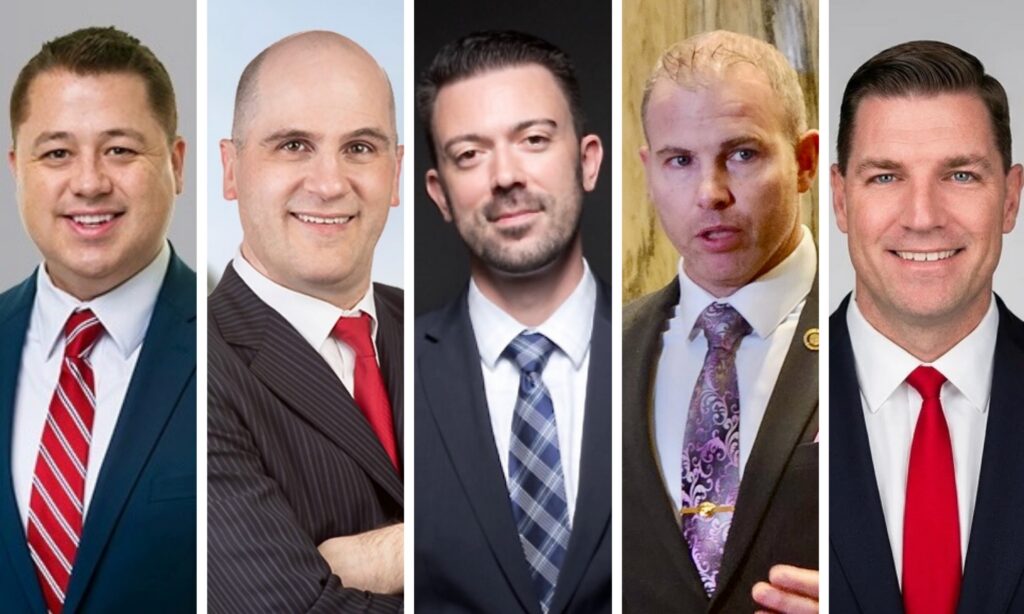
The candidates for the Republican nomination in Missouri’s 5th Congressional District are, from left, Micah Beebe, Brett Hueffmeier, Taylor Burks, Rick Brattin and Brad Patty (Compiled from submitted and staff photos).
The Republican nomination in Missouri’s 5th Congressional District could, in the weeks after the Aug. 4 primary, become a prize not worth having.
Six candidates are competing for the nomination in a district Republican lawmakers redrew last year at President Donald Trump’s urging to give their party an advantage over incumbent Democratic U.S. Rep. Emanuel Cleaver.
But Secretary of State Denny Hoskins is expected to decide on primary day whether a referendum petition challenging the map has enough valid signatures. If he certifies it, the courts could be asked to decide whether the new boundaries were ever legally in effect — and which map must be used for the Nov. 3 general election.
Under the new map, the Republican nominee would compete in a 14-county district stretching from Kansas City through rural areas that reliably support the GOP. Under the previous boundaries, the contest would be decided in Kansas City and portions of Jackson and Clay counties, where Cleaver would be overwhelmingly favored to win a 12th term.
Since winning election in 2004 with 55% of the vote, Cleaver has fallen short of a majority only twice and not since 2014.
The possibility that the district could change after the primary has not discouraged political spending. Outside groups have poured almost $2.8 million into the contest — more than five times what the six candidates combined have reported raising — but all of it has focused on two candidates: Taylor Burks of Boone County and state Sen. Rick Brattin of Cass County.
The concentration of money has left the other four candidates — Micah Beebe, Brett Hueffmeier, Brad Patty and Berton Knox — trying to convince voters that the primary has not already become a two-person race.
“I went into this race realizing that I was running against some people that had done this before, and that they were probably going to get a lot of endorsements,” Hueffmeier said.
Brattin is certain the map used on primary day will be the one electing the next 5th District representative in November, arguing that a referendum on a congressional map violates the federal constitution.
“The sole authority is given only and solely to the legislature and legislature alone,” he said.
“This isn’t a regular statute on which referendum is applicable, and I’ve said that from the onset.”
Burks said that while a referendum may occur, he expects the courts will keep the districts in place for November.
“Both the attorney general and secretary of state have very clearly said that this is the map that governs this cycle,” Burks said. “What happens with the referendum will be decided by voters. If the secretary of state puts it on the ballot.”
A two-candidate advertising war
There is little love lost between the two candidates benefiting from — and enduring — million-dollar advertising campaigns.
For Burks, Brattin is defined by his membership in a disruptive faction of Republicans in the Missouri Senate he believes are more interested in garnering headlines than moving the state forward.
“Senator Brattin has a long track record of being a bomb thrower and a disrupter in the state Legislature,” Burks said. “Club for Growth apparently is seeking that and trying to buy this seat for him, which my campaign is going to do everything we can to stop.”
Club for Growth is the funding source behind more than $1.3 million being spent by Win It Back PAC, airing positive ads painting Brattin as “a MAGA Marine” who will fight for Trump’s agenda.
A negative ad funded by Club for Growth accuses Burks of encouraging “woke” activities at Truman State University, where he serves on the Board of Governors. It cites a campus resource center with clothing available to students who are transitioning their gender.
“I obviously have no control over the legal activities of student groups,” Burks said. “And no university funds were used for that, so it didn’t even come before the board. It is a silly, desperate out-of-state attack ad.”
Conservatives for American Excellence, a super PAC backing Burks, has responded with ads attacking Brattin over votes he cast in the Missouri Senate.
One ad says Brattin helped sex offenders get removed from the state registry because he voted for a 2018 bill that changed how long some offenders must remain registered.
The ad also says he voted against child-abuse prevention funding. That claim is based on Brattin joining other members of the Conservative Caucus in opposing an $853 million supplemental spending bill that included about $519,000 for two child-abuse programs.
“Rick Brattin voted to make it possible for sex offenders to be removed from registries. Brattin also voted against funding for child abuse prevention programs,” the ad states. “If Rick Brattin won’t vote to protect our children, then you can’t vote for him.”
Despite the attacks, Brattin believes the race is trending his way.
He has major endorsements, including Gov. Mike Kehoe and Missouri Right to Life, he noted.
“Plus having the track record, the voting record is resonating with people that are tired of people talking the talk and not walking the walk,” Brattin said.
Burks, a commander in the Naval Reserve and chief executive of commercial landscaping company Rost Inc., has financed much of his campaign himself, lending it $900,000 and raising about $250,000 from donors.
Brattin, a two-term state senator who previously held office as a state representative and Cass County auditor, has raised $312,000.
Hueffmeier, a one-time staff member for U.S. Sens. John Ashcroft and Kit Bond who now works in commercial real estate, loaned his campaign $275,000 and raised about $50,000 more.
Beebe, a commercial real estate investments specialist, raised less than $5,000.
Patty, a retired Army master sergeant currently pursuing a graduate degree in public administration, raised $7,774 through June 30. He said the loans illustrate the corrupting influence of campaign money because candidates who lend their campaigns heavily may later rely on donors to repay them.
“This job pays $174,000. It’s a two-year term,” Patty said. “So, who’s going to pay the extra money back?”
Patty also said Brattin should be disqualified in the minds of voters because he helped create a district he does not live in and is now seeking to represent.
“So you vote for the map as a state senator, and then you run in it, and you don’t live in the district,” Patty said. “Why wouldn’t you run in your own district? Well, it’s because you lost to Mark Alford, and you know you can’t win.”
Voters size up the field
At a recent Lincoln Days event in Saline County, five of the six candidates were on hand but the program didn’t give any of them time for a quick stump speech.
That left them quick one-on-one efforts at campaigning. Many Republicans stopped after they shook hands with candidates on their way to the dinner buffet that they need to know more about the candidates before they make a choice.
“Them showing up here in such a small community says a lot, that they want to make change,” said Kaylee Kipping, whose Saline County home is newly in the 5th District.
She said she’s leaning toward Burks because he’s a “conservative family man.”
Wayne Heuman of Saline County said he knows a little bit about the candidates but not enough to decide. He wants a candidate committed to passing the SAVE Act pushed by President Donald Trump to require voters to provide proof of citizenship to register, photo identification to vote and limit mail-in voting.
“We don’t need illegals coming in and voting and running our country,” Heuman said.
Many did like the idea of gaining another Republican seat in the Missouri delegation.
“It’s a fantastic idea,” said Roger Davenport of Marshall. “It has to reflect the voters of the district, what’s happening across the United States.”
The issues
There is little daylight among the five candidates interviewed by The Independent on the Republican Party’s core issues. All support Trump’s border policies, oppose abortion and support gun rights.
The differences are largely ones of emphasis, experience and temperament.
Burks’ television ads, for example, focus on China.
He wants to stop China from buying up Missouri farmland, he said. To do so, he says in one broadcast ad, China will have to pry the land “from my cold, dead hands.”
Brattin said his stump speech points out the dangers he sees if Democrats regain control of Congress.
“We now have a party that’s literally electing devout communists, outspoken devout communists. Some of these Democrats are even happy 9/11 occurred, and thought we deserved it,” Brattin said. “They want to see it toppled and think America is disgusting and disgraceful. I think we’ve got to have representation of people who love America, will uphold its values, and combat the crazy left that literally wants to see its destruction.”
Beebe places greater emphasis on federal spending and the national debt.
“I’m not so naive to think that I’m going to show up in Congress and all of a sudden the problems are going to be fixed,” he said.
Hueffmeier said he wants to work on solving rural health care needs. Right now, there are heavy restrictions on doctors owning hospitals. If that were changed, he said, there would be more interest from physicians to serve rural areas.
“It’s just kind of an antiquated law that’s there that really doesn’t need to be there anymore,” he said.
Patty said he wants to cut spending and taxes.
“I am all about reducing taxes and putting money, basically not taking too much money from the people, because it was originally in their hands,” he said.
All five candidates interviewed supported Trump’s decision to use military force against Iran, although Hueffmeier criticized the administration’s preparation and public messaging.
“What the president’s been a little guilty of is that the messaging was not organized, or well organized, in order to do it,” he said.
The U.S.-Israeli relationship helped lead Trump to go to war and the Israeli military actions in Lebanon and Gaza have soured some Americans on the Middle East ally.
None of the candidates said they would reduce or curtail support for Israel. Burks, however, added that the U.S. must be ready to hold Israel accountable for how it uses military aid.
“The United States, as an ally, also has a role to work with Israel and say, ‘hey, what’s what’s proportional, what’s in the best interest of this partnership overall,’” Burks said.
The next Congress will consider what, if anything, should be done to regulate development of artificial intelligence.
For Burks, the area to regulate is online interactions with children and national security. For Brattin, the limits should be to protect humans while allowing full and open development for commercial uses.
Hueffmeier said he learned the need for privacy protection when he returned from China after working as a higher education administrator. His devices were hacked, he said.
AI regulation should protect personal information and privacy, he said.
“We tend to just give up our privacy and our freedoms on an increasing basis without really thinking it through, and just thinking everything is going to be okay but what the public doesn’t understand is that once you do that, you know it’s too late,” Hueffmeier said.
AI development needs data centers, and the candidates are hearing from vocal opponents of data center development. While they sympathize, they questioned whether it is a federal issue.
Congress should not be regulating data center site selection, Brattin said. In his state Senate district, he said, there are communities determined to keep them out and communities that will welcome them.
“Nobody wants a nuclear power plant right in their backyard. They don’t want a coal-fired power plant in a residential community,” Brattin said. “In the same way, they don’t want a big hyperscale data center which looks like a maximum security prison in a residential area. We understand it’s just common sense on all sides, from the developers to the counties and to the state, as to where these things are going to be installed.”
Farmers are reeling from the combined effect of low crop prices, high feed and fertilizer costs and tariffs cutting off markets entirely. The system of farm supports known as the Farm Bill, which also includes authorization of nutrition assistance programs, is three years late for renewal.
Hueffmeier said farm programs should prioritize making farms profitable. The current programs, for farmers who are enrolled, put targets for subsidies at past prices and yields regardless of the profitability of those levels.
More stable support is needed, he said.
“Those are not bad ideas, and those things didn’t really ever cost us an enormous amount out of the federal budget,” Hueffmeier said.
Patty said farmers should face market conditions.
“I personally stand on the principle of having the government being less and less involved,” Patty said.
Brattin said less regulation would ease the burden on farmers.
With little public polling, it is uncertain which candidate has the upper hand as early voting begins Tuesday.
The only thing that would alter the outcome, candidates agreed, is if Trump endorses a candidate.
Hueffmeier, who went to Washington looking for support, said he doesn’t expect the president to make a selection.
“Here’s what they told me: They said that he will only endorse someone if it’s right at the end, and we know for sure that that person is going to win,” Hueffmeier said. “Otherwise the only time he gets involved is when he’s upset with somebody who’s an incumbent and he wants somebody to run against them.”
This article was originally published by Missouri Independent and is republished by MetroSTL under a Creative Commons license. The reporting is the outlet’s; please support them.