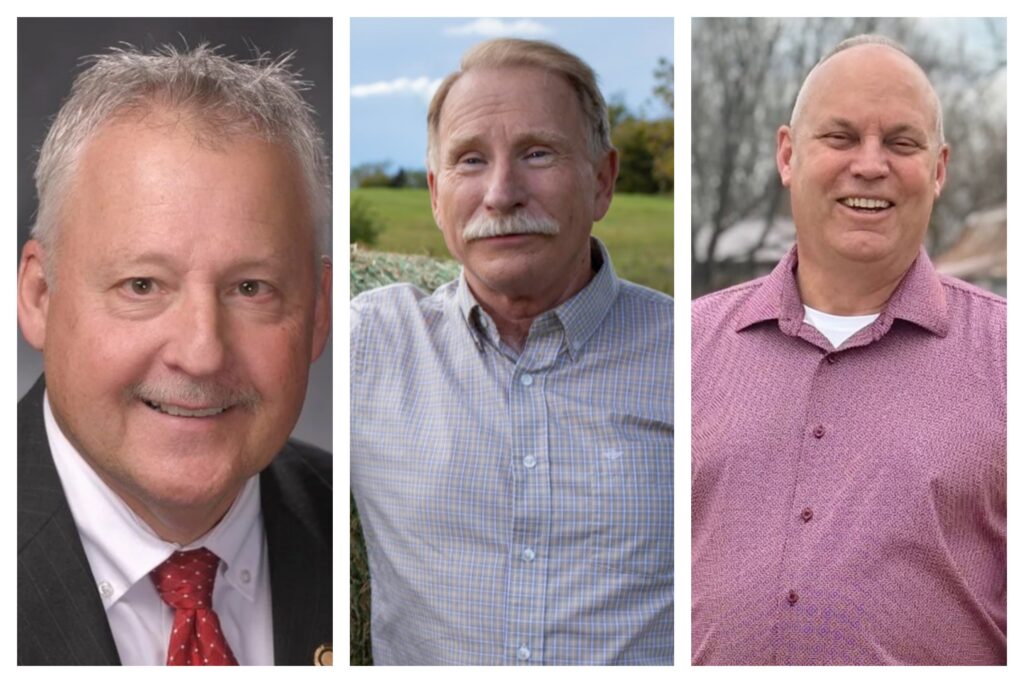
The 28th state Senate District Republican primary candidates are, from left, state Rep. Brad Pollitt, Dr. Sam Alexander and Chuck Lentz. (Submitted photos)
Sam Alexander paints a grim picture of Missouri’s 28th Senate District.
Alexander, an emergency room physician and farmer running for state Senate, said he lays awake at night thinking of the hospitals in financial straits, young people leaving their small towns behind for more work opportunities and senior citizens living month-to-month.
“We’re America. We can do a lot better than we’re doing here in this district,” Alexander said. “… We’re dying out here. We really are.”
Alexander’s chief primary competitor, state Rep. Brad Pollitt of Sedalia, chuckled at the assertion that the district has one foot in the grave.
Pollitt, a cattle farmer and former educator, said during his eight years in the Missouri House representing Pettis County, he’s brought more than $150 million back to constituents, including to State Fair Community College, the Boys and Girls Club, Bothwell Hospital and a couple of major road projects.
“We’ve got a budget shortfall, so a lot of these projects aren’t gonna happen here in the future,” he said. “But I was proud that none of my budget asks were withheld or vetoed. How many representatives can say that?”
But while Alexander sees Pollitt as part of a political system that has failed the district, a political action committee backing Pollitt is asking voters to view Alexander as an irresponsible scofflaw who shouldn’t be elected to office. The negative tone of those direct mail messages from the Rocker P Brand PAC have created a rift with some of his backers who don’t want to be associated with the message.
Pollitt and Alexander are joined by Chuck Lentz, a professor and administrator, who said he was in-part motivated to join the race after hearing from his college students who were feeling defeated over how unattainable homeownership was and how costly starting a family can be.
“We have real poverty in these counties,” Lentz said. “And people don’t address rural poverty, and what’s happening to our rural communities, and our small families.”
The 28th District encompasses nine counties in southwest Missouri and includes the cities of Sedalia, Bolivar and Clinton. Incumbent state Sen. Sandy Crawford must leave office due to term limits. The winner of the primary race will face Democrat Mike McCaffree, a real estate agent from Nevada.
Second-quarter campaign finance reports show Pollitt had raised $372,656 and had nearly $172,000 cash on hand at the end of June. A political action committee working on Pollitt’s behalf, Rocker P Brand PAC, has raised $272,447 since the start of 2025 and had $240,241 on hand at the end of the quarter.
Alexander has raised $249,791, including a $120,000 personal loan to the campaign, with about $170,000 cash on hand.
Lentz, raised $13,757 by July.
As of Thursday, Pollitt had placed about $42,000 in ad buys across three TV stations.
Amendment 5
The median household income of the 28th District is $55,156, and about 17% of the district’s 188,345 constituents live below the poverty line, according to data from the US Census Bureau.
“The 28th District is just filled with really good people who just want the government to provide the bare essentials and let them live their lives,” Pollitt said. “They want God in their lives, they want family, and they want life protected. They want their gun rights protected. It’s a huge agricultural Senate district. There’s a lot of cattle in the 28th District.”
Alexander and Pollitt have many of the same priorities on paper: they support gun rights and anti-abortion laws.
Their views diverge slightly on education and taxation.
Pollitt said many people are voicing concerns around Amendment 5, which would eliminate the state income tax if approved by a simple majority of Missouri voters in August. He said he can see both arguments for and against the amendment, but won’t share how he plans to vote.
Pollitt voted for the Amendment 5 legislation each time it was before the House on a roll call.
“I think it would be disingenuous if I tell them how to vote. I think they need to look at their own situation. I do believe that the statistics say that states without income taxes, that their economies are stronger than Missouri’s, and their population is growing,” he said. “Their concerns that they’ve said back to me is, ‘we don’t know what you all will tax, and it’s kind of hard for us to say yes when we’re not sure.’”
Alexander said while the state needs to find a way to bring in more industry and people, he wouldn’t have approved of the plan as it stands. He said he would have advocated for a slow roll-out, perhaps by cutting income tax by half a percent at a time to give lawmakers longer to figure out how to adjust the budget accordingly.
“I don’t think it’s right to change one tax for another tax without knowing what that tax is gonna be, and how it’s gonna work,” he said. It may have a bad effect on folks who are lower income or elderly and on a fixed income, he said.

Lentz said he’s the only candidate to oppose both Amendment 5 and Amendment 4, which would raise the threshold for passing constitutional amendments proposed by citizen-led initiative campaigns from a simple majority of all votes in the state to a majority in every congressional district.
On principle, Lentz said he’s a no “because it takes some of that power out of people’s hands,” adding that he’s also wary because congressional district boundaries can change.
He’s also firmly against Amendment 5.
“There is real poverty that people are ignoring in rural America and rural Missouri specifically,” Lentz said. “But these are people who don’t want a bunch of handouts, they just want to be able to live … they don’t want everything taxed. Does that make sense?”
Education issues
Arguments over school choice remain a point of contention in many of this year’s primary races.
Pollitt, who previously worked as superintendent for the Sedalia school district, sponsored a bill several years in a row seeking to allow some Missouri students to enroll in neighboring school districts.
“Should your home address be the main determination in what public school district your children attend? I don’t believe it should,” he told a House committee last year. “Should the child and family be at the center of the educational focus? I believe it should.”
The bill has gained considerable momentum, but it has never passed.
Alexander painted himself as “a rare breed of Republican” because he disagrees with school choice. However, Republicans remain split on the issue.
“We can do better than what we’ve been doing for our schools and stuff,” Alexander said. “I’m for improving the grades, for sure, but I’m also for backing these small rural schools that are struggling. A lot of these programs that a lot of the Republicans are pushing, that are being harmful to a lot of these little schools that are doing a good job.”
Lentz, said “school choice” laws could lead to school closures in rural towns, which he fears would decimate small communities.
“We have school choice right now, 100%,” he said. “ Anybody can choose in Missouri to go where they want. But I’m not asking other people to pay for it. That’s the difference.”
Anti-establisment vs experience
Alexander has run for public office before, previously losing campaigns for Congress and for a state representative seat. This time, he’s launched a substantial campaign, leaning on messaging that he’s everyday folk up against the establishment.
It’s a campaign message not uncommon in Missouri Republican races.
Alexander, who is also a pilot, preacher and handyman, waxes poetic about a return to his vision of the American Dream: where people know how to work with their hands, and neighbors stop by to help one another out.
“My entire life I’ve been preparing for this job,” he said, brushing off any criticism at his lack of legislative experience.
Alexander paints himself as a man of the people, and portrays Pollitt’s support from PACs as an entanglement. He said there should be limits on PAC spending, which he said mutes “the common folks’” voices.
One example, he said, is a campaign attack ad sent to homes in the district by Rocker P Brand PAC. It reads, “guilty,” across Alexander’s face, claiming that he failed to appear in court on trespassing charges.
Under Missouri campaign finance law, candidates can solicit donations for the PAC but cannot direct how it uses the funds or the message it conveys.
Pollitt asked political friends in Sedalia to set the PAC up in 2022 and prior to the launch of his state Senate campaign, it had raised modest sums. One person who agreed to help in 2022 was Megan Page, who became vide president because Pollitt was a friend and they had worked together on different community boards. In January 2025, Gov. Mike Kehoe appointed her the Pettis County Clerk.
Page said she’s not been involved in the PAC since her appointment as clerk. The day she learned of mailers being sent out funded by the PAC, she called the treasurer and asked to have her name stricken from the PAC records.
Filings with the Missouri Ethics Commission show paperwork to remove Page and PAC President Kim Lyne was filed on July 8.
“Really it boils down to, I do not want to be involved in something politically that I have no control over what they say, when they say it or how they say it,” she told The Independent. “So I needed to step away because it was getting negative and I didn’t want anything to do with that. I didn’t want to be associated with it.”
Page said a consulting company recently took over the PAC. Reports from the Missouri Ethics Commission show the PAC recently paid more than $36,000 for mailers to Catamaran Consulting, a company based out of Los Angeles that was also hired in 2024 as part of an effort in Iowa to fund a Republican candidate to oppose Trump.
Candidates are not responsible for the messages from PACs. But Pollitt is mired in the community outrage that’s followed.
“Pettis County is very different from other counties in Missouri,” Page said of the public outcry. “Historically Pettis County does not do well with smear campaigns and negative campaigns, especially when you’re talking about local people.”
Pollitt said he, like many candidates, created a PAC and then turned it over to others, as is the law.
“PACs can do whatever they want,” he said. “I have no control over them … Once the PAC is taken over, then the candidate no longer has any authority or any contact or any say so about what goes on.”
Pollitt said he’d hoped for a campaign based on issues, and he still hopes it ends that way.
“I said from the beginning, I hoped it would be a positive campaign,” Pollitt said. “And, you know, apparently it hasn’t turned out that way.”
As for the trespassing mailer, Alexander said the charge stemmed from an incident three decades ago in Benton County in which his bird dog ran onto someone’s property while he was quail hunting.
The landowner threatened to shoot his dog, Alexander said, so he crossed the property line to retrieve the animal. He rebuts any accusation that he failed to appear in court, instead taking the opportunity to decry the “swamp” in Jefferson City funded by political action committees.
Another mailer was sent out over the weekend compared Alexander to Anthony Fauci, attacking his role on the Webster County COVID-19 task force during the pandemic.
“There’s a lot of money that’s flowed into that campaign for Brad, and there’s state senators that are giving money out of their PAC money, and that’s, again, part of the problem with Jeff City,” Alexander said. “There’s too much money floating around that buys votes and stuff.”
All of Pollitt’s largest donations came from political action committees, with more than 30 PACs writing checks for the maximum contribution of $2,4000 to his campaign. They include farming, utility, healthcare, realtors, cannabis, sports betting and conservative committees.
Candidate committees for state office are limited in the amount of money they can accept from any one donor. PACs can accept donations in any amount.
Pollitt pushed back on any criticism of his funding sources, saying that the variety of PAC support shows he can work well negotiating at many different tables. His endorsement list includes the Missouri Farm Bureau, Missouri Fraternal Order of Police, Campaign Life, Americans for Prosperity, the Missouri Chamber of Commerce and the Missouri State Teachers Association.
Missouri House speaker faces conservative challenge in key state Senate primary
His connections and experience benefit the district, Pollitt said.
“I’m the only candidate that’s been in the arena,” he said. “I don’t think the Senate is a place where you should send people to learn how to legislate. I think you learn that in the House.”
Fewer of Alexander’s donations come from PACs, but his highest donors include Scope PAC (a physician-led committee), MO Osteopathic PAC and MO State Orthopedic Association. Many of his highest individual donations are from surgeons and physicians.
His endorsements include Missouri Right to Life, Pettis County First, Cedar County Sheriff James McCrary and the Cedar County Commissioners.
Lentz leans into his own humble beginnings: he grew up for a time in public housing and he’s raised a family on a school teacher’s salary.
“Why am I the best candidate? Because I’ve lived that way,” he said. “I’m the candidate with the right principles. It’s not because I’m the smartest person, and I’m committed to representation, not ruling over people.”
Data centers and Medicaid cuts
Pollitt was among 16 state representatives who signed a letter last month asking Gov. Mike Kehoe to call a special session on data centers.
Pollitt said in a May television appearance that one of his biggest disappointments of the session was an inability to move a solar panel bill that would’ve put parameters on solar fields in rural Missouri.
In July he told The Independent that finding a needle to thread when it comes to property rights and solar panel fields and data centers is still one of his top priorities.
Lentz said AI datacenters must not be allowed to buy farmland without a detailed study of the costs to the state.
“Calling it ‘the right to sell your property to whoever you want’ is the velvet glove,” Lentz said on social media. “The iron fist beneath it is giving corporations and special interests a clear path to buy up the Ozarks one property at a time.”
Alexander, who opposes data centers, is perhaps most concerned about likely cuts to Medicaid funding coming down from the federal government.
“We’re gonna see some really, really tough times,” said Alexander, who previously served on the Missouri Oversight Committee for Medicaid, “unless we are wise and look ahead and make sure that we do the right things now to address the problems before they become bigger and bigger and bigger.”
This article was originally published by Missouri Independent and is republished by MetroSTL under a Creative Commons license. The reporting is the outlet’s; please support them.