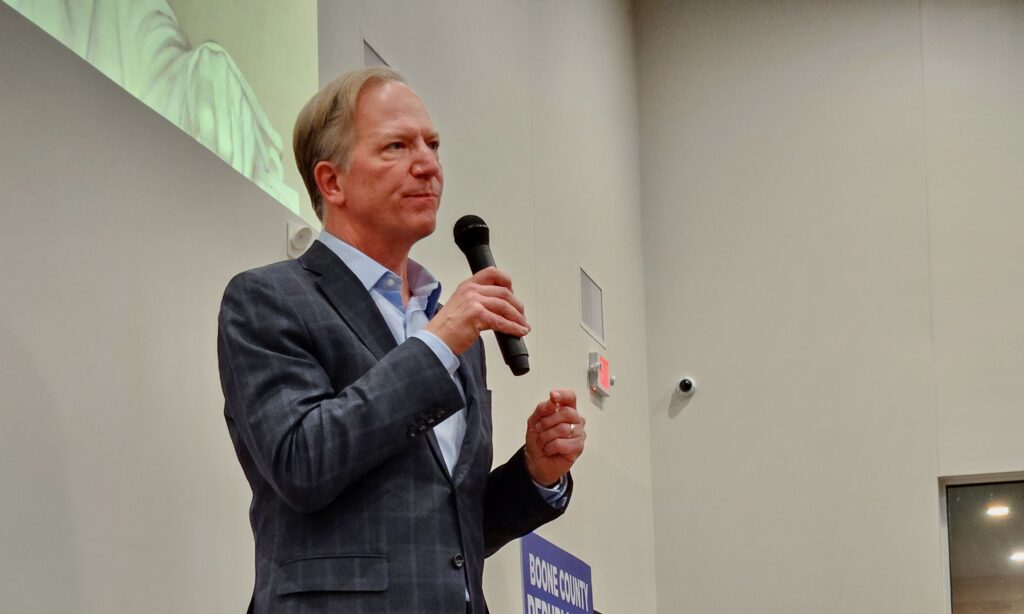
U.S. Rep. Bob Onder speaks at a political event in 2024 (Rudi Keller/Missouri Independent).
A single-engine Piper sits on the ramp at the Jefferson City airport, a few minutes’ drive from the Missouri Capitol.
On paper, it belongs to a limited liability company in Montana, a state with no general sales tax and no property tax on aircraft. The plane is one of at least 16 listed at Missouri airfields but registered to Montana LLCs — an arrangement that can reduce or obscure tax bills that would otherwise come due in the states where aircraft are actually based.
To the county officials in Missouri whose job is to find and value those planes, aircraft like it are becoming harder to see.
Now a Missouri Republican is pushing a change to federal aviation law that tax officials say would make them harder still to tax.
The provision was written by U.S. Rep. Bob Onder, a St. Charles County Republican, and carried into a House aviation safety bill by U.S. Rep. Sam Graves, the northwest Missouri Republican who chairs the committee that produced it. It would bar state and local governments from using aircraft-location data — information many planes are required to broadcast for safety — to identify aircraft “for the purpose of obtaining revenue” from their owners or operators.
Onder calls it a privacy measure aimed at stopping airports from using safety technology to impose “exorbitant” landing fees, and at lawyers who he says use the data to pursue “frivolous lawsuits” against pilots.
But the language is broader than airport fees, and tax officials warned Congress before the House voted that it could block one of the tools they use to enforce property, sales and use taxes on aircraft.
In Missouri, the erosion has already begun.
For years, the State Tax Commission provided county assessors a list, drawn from FAA records and sorted by county, of the aircraft in their jurisdictions. The commission stopped this year, Gregory Allsberry, its chief counsel, said in an email to The Independent.
The reason: the Missouri Department of Revenue no longer supplies the underlying data because of a 2024 federal law — backed by the Aircraft Owners and Pilots Association, the nation’s largest pilots’ lobby — that allows private aircraft owners to keep their names and addresses out of the public registry.
The commission now advises county assessors to search FAA records themselves. But if an owner declines to list a plane on a personal property declaration and has had identifying information redacted from federal records, Allsberry acknowledged, “the assessor may not be able to identify certain aircraft as property which is assessable in that county.”
County assessors in Missouri say that is exactly what is happening.
“With the new regulations and the ability to hide their information, it has made this process very difficult to appropriately determine what aircraft is registered within counties for assessment purposes,” said Chrissy Gillis, the Putnam County assessor and president of the Missouri State Assessors Association. The change, she said, “has and is directly affecting the ability for county assessors to value aircraft for local assessment purposes.”
That privacy law is separate from Onder’s legislation. It shields who owns a plane. His measure would shield where it flies.
How much money is at stake if Onder’s bill becomes law? No one in state government can say. Asked how much Missouri collected last year in sales and use taxes on aircraft purchases, a Department of Revenue spokesman said: “The department does not specifically track this information.”
Graves has long financial ties to the industry seeking the change, and Onder received support from its political arm after introducing the bill.
Political action committees run by the Aircraft Owners and Pilots Association and by the National Business Aviation Association have given Graves’ campaign and leadership committees more than $209,000 since 2000, federal records show. A PAC connected to the Aircraft Owners and Pilots Association gave Onder $5,000 in late September.
A safety bill, and a rider
Onder’s measure began as a standalone bill, the Pilot and Aircraft Privacy Act, and became Section 105 of the ALERT Act, the House’s answer to the January 2025 collision between an Army Black Hawk helicopter and an American Airlines jet near Reagan National Airport that killed 67 people.
The crash produced 50 safety recommendations from the National Transportation Safety Board, and the bill was assembled around them. The House passed the package in April, 396-10. The Senate’s competing measure, the ROTOR Act, contains no provisions comparable to Onder’s language, leaving the tax question to be settled as the two chambers reconcile their bills.
Onder, a physician, former state senator and licensed pilot, introduced his measure last June.
Some third parties, Onder said at the time, have “taken advantage of this data to impose and collect exorbitant third-party landing fees and frivolous lawsuits” against general aviation. He described himself as “a pilot with years of experience” using the broadcast system, known as Automatic Dependent Surveillance-Broadcast, or ADS-B, which continuously transmits an aircraft’s identification, altitude, speed and heading.
But for tax officials, that data has become one of the most useful ways to find aircraft that might otherwise never reach the local rolls.
The Federal Aviation Administration began requiring most aircraft to broadcast the ADS-B signal in 2020. The system tracks planes more precisely than radar. Tax collectors soon found a second use, matching the broadcast identification numbers against the national aircraft registry to attach names and addresses to the planes overhead.
A small industry now packages the data and sells it to revenue agencies.
In Los Angeles County in California, the data has helped the local assessor’s office identify 1,000 aircraft since the start of this year that it had not been taxing, with a combined assessed value of $3.5 billion, the county assessor, Jeff Prang, told a reporter for Politico. At California’s 1% property-tax rate, he said, that is roughly $35 million a year that owners had been avoiding.
“Private aircraft owners go to great lengths to hide their aircraft from us,” Prang told Politico. Without the broadcast data, he said, assessors are reduced to driving to airfields and counting planes by hand — and the owners who know the schedule “might fly their planes out of state.”
Missouri planes, Montana plates
The 16 aircraft in Missouri identified in a review of federal records are likely only a partial picture. They are the planes whose Montana paperwork could still be traced to Missouri airfields using the same kind of tracking data Onder’s legislation would place off-limits.
Together they carry an estimated retail value of more than $7 million.
The Piper at Jefferson City shows the mechanism at work. For years the plane belonged to a partnership in Stuart, Florida. In December 2024 it was sold to a Montana LLC and flown to Missouri the same day. By January it had settled at Jefferson City Memorial, where flight records show it has been based ever since.
There’s also a helicopter based at an airpark in St. Charles County held by a Montana entity, and a turboprop worth an estimated $3.1 million, flown from Spirit of St. Louis Airport in Chesterfield and registered more than 1,000 miles away.
The arrangement is a well-worn one.
A buyer forms a Montana LLC, registers a plane, a boat or a motor home to it, and keeps the asset wherever he likes. Because Montana imposes no general sales tax and no property tax on aircraft, the structure can reduce or eliminate bills that would otherwise come due where the aircraft is actually based.
Missourians pay personal property tax on their cars every year; the county knows where they live. For a plane, the same obligation can turn on paperwork filed 1,200 miles away — and on whether anyone can establish where the aircraft actually sits and how often it flies, the very facts the broadcast data supplies.
Aircraft in Missouri are taxed mainly at the county level, as personal property, with the value set by local assessors and the bill collected for schools, libraries and local government. The state adds sales and use tax on aircraft purchases — the collections the Department of Revenue says it does not track.
‘A clear, nationwide standard’
Whether Onder’s proposal reaches those taxes is the center of the fight, and its supporters have not been shy about its scope.
In their own report on the bill, House Republicans wrote that the provision would “establish a clear, nationwide standard, preempting any future state, local or tribal law” — a reach well beyond the airport landing fees the sponsors describe.
Tax officials had asked Congress to close that gap before the vote. The California Assessors’ Association, a nonpartisan body of county officials, told Graves, Onder and other committee members in March that the bill never defines the “fees” it restricts and could be read to reach property taxes, and asked that the language be narrowed to airport charges.
Alabama’s revenue commissioner estimated the provision could cost his state, its counties and its municipalities more than $18 million a year. During the committee’s work, an amendment to preserve state and local governments’ ability to keep using the data for tax collection was offered by U.S. Rep. Shomari Figures, an Alabama Democrat. It was not adopted.
Supporters say the alarm is overblown, and that the real abuse is the repurposing of safety technology for revenue. Aviation safety equipment “should be used for its intended purpose and not to collect taxes and fees,” Jim Coon, the Aircraft Owners and Pilots Association senior vice president of government affairs and advocacy, said in an email to The Independent.
But objections are not coming only from tax officials. When the Senate aviation subcommittee took up the competing bills at a June 23 hearing, Todd Hauptli, president of the American Association of Airport Executive, told senators that Onder’s proposal “would preclude airports from their ability to use ADS-B for fee collection purposes.”
Airports use the data to collect existing landing fees that help pay for safety projects, Hauptli said, and pilots who switch off their transponders to avoid those fees — as some have threatened to do — make flying less safe, not more.
U.S. Sen. Jerry Moran, the Kansas Republican presiding over the June 23 hearing, noted that the dispute is not over whether the money is owed. The fees, Moran said, are “already required to be paid.”
Hauptli agreed. It is the same thing county assessors say about taxes — the obligation stands either way. Onder’s proposal would remove one of the means of enforcing it.
Onder did not respond to questions from The Independent about his legislation, or about whether he owns or leases a private aircraft. He has said previously that the threat of fees and lawsuits tied to the data discourages pilots from running the transponders the rest of the bill would require.
The dispute now moves to negotiations between the House and Senate, where the tax language is one of the provisions to be reconciled.
This article was originally published by Missouri Independent and is republished by MetroSTL under a Creative Commons license. The reporting is the outlet’s; please support them.