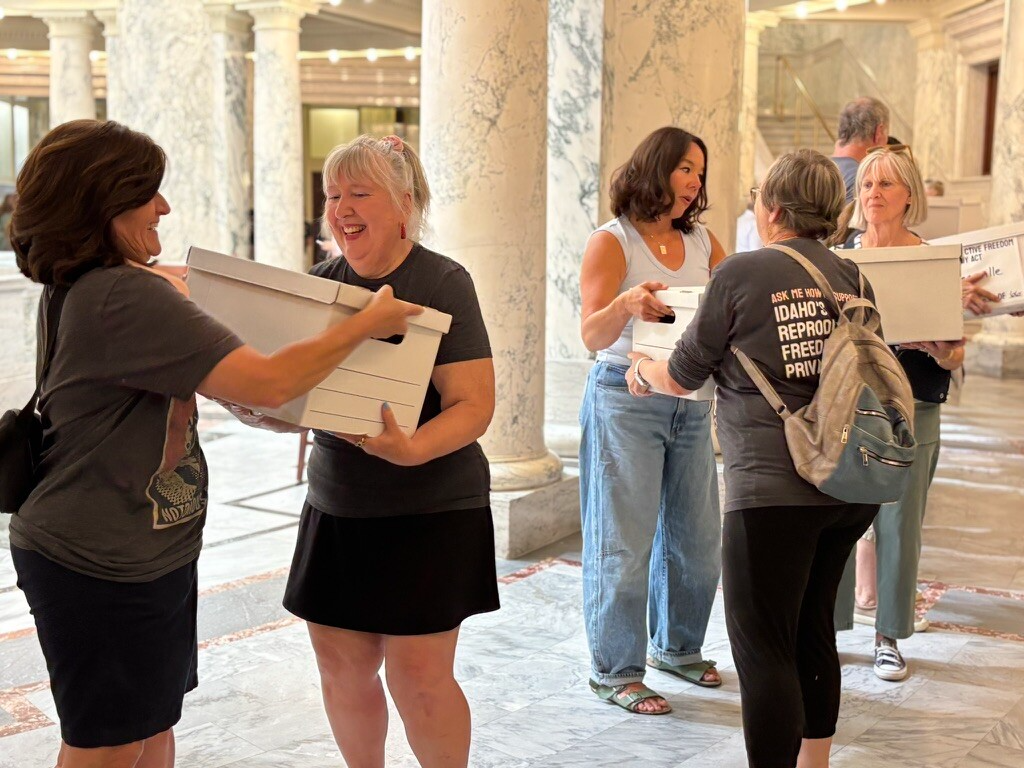
Volunteers pass boxes full of signed ballot initiative petitions through the Idaho Capitol on July 2. If approved for November’s ballot and then by voters, the proposed Reproductive Freedom and Privacy Act would restore abortion access “without government interference” until fetal viability, and would protect fertility treatments and other reproductive care such as contraception. (Photo by Kelcie Moseley-Morris/Stateline)
BOISE, Idaho — Suzanne Gallus is a Catholic woman and mother of seven who has been pregnant 12 times, and she’s spent the past year asking residents to sign a petition to help restore access to abortion in one of the most conservative areas of Idaho.
At an event on July 2 at the Idaho Capitol, Gallus told a crowd of fellow volunteers and supporters that she spoke with about 400 people while knocking on doors in north Idaho, and she had learned that even those who had deeply held personal beliefs against abortion were willing to sign and vote yes.
“People were always very open with a lot of their stories, and their stories may have not even been about them,” Gallus later told Stateline. “It could’ve been about a niece, or a cousin or their grandmother, and they weren’t all abortion stories either. A lot of them were about adoption or infertility.”

Despite Idaho’s status as a deeply conservative state — President Donald Trump won there by nearly 37 percentage points in 2024 — an estimated one-fourth, or 28%, of more than 110,000 signatures collected by the group spearheading the proposed Reproductive Freedom and Privacy Act are from registered Republicans.
According to the campaign’s data, more than 33% of the signers are unaffiliated voters, 37% are Democrats and about 1% are Libertarians. Those shares may be higher or lower once the petitions are certified by the Idaho Secretary of State’s office to put the proposal on the November ballot.
Idaho’s initiative, which would restore abortion access “without government interference” until fetal viability and would protect fertility treatments and other reproductive care such as contraception, is one of three abortion-related measures expected to be on state ballots in November. It needs a simple majority to pass. The state allows residents to propose laws, but not constitutional amendments.
In Nevada, voters will be asked to reaffirm a right-to-abortion initiative that they already passed in 2024, a confirmation required by state law. Virginia voters will be asked to approve a measure referred by the legislature that would add a right to reproductive freedom to the state constitution.
Two other ballot initiatives in Colorado and Missouri would ban abortion rather than restore access. Missouri’s legislature revisited the issue after voters narrowly approved an amendment in 2024 establishing a right to abortion until fetal viability. Lawmakers this year sent a measure to November’s ballot that would once again ban abortion as well as gender-affirming healthcare for minors.
Colorado’s initiative to remove the state constitutional right to abortion has not yet officially qualified for the ballot.
Republican signatures
Gallus, the Idaho volunteer, lives in Rathdrum, a city of fewer than 10,000 people north of the more populous Coeur d’Alene, where the leaders of the local Kootenai County Republican Central Committee have helped move the state party further right over the past decade. North Idaho delegates were among those who in 2022 voted down a proposed amendment to the Idaho Republican Party platform allowing abortions to save a pregnant woman’s life.
At the end of June, a local conservative blogger published a list of the names of more than 4,000 petition signers from Kootenai County, roughly half of whom were Republicans, garnered from a public records request. The blog post accused those Republicans who signed of being “RINOs,” or Republicans in Name Only.
Melanie Folwell, lead organizer of the initiative effort, said many people they came across while canvassing didn’t want to sign the petition in part because it is public record, but said they would vote for it in November.
“They were scared of retribution for signing,” she said.
A statewide poll conducted by Boise State University’s School of Public Service showed nearly 61% of Idaho residents strongly or somewhat supported the proposed Reproductive Freedom and Privacy Act, while about 28% were somewhat or strongly opposed, and nearly 12% remained unsure. Support among Republicans was about 45%, with 66% support from independent voters.
That’s about the same level of support for the right to a legal abortion up to viability that national polls have recorded since 2022, when the U.S. Supreme Court made its decision in Dobbs v. Jackson Women’s Health that allowed states to regulate abortion access for the first time since 1973. Another poll from Boise State in 2025 showed 55% of residents supported legal access to abortion at least through the first trimester, while 20% thought it should be completely prohibited.
Supporters of ballot measure to end Idaho’s strict abortion ban turn in nearly 110K signatures
Idaho’s trigger law banning nearly all abortions took effect in August 2022 after the Dobbs decision. In the years since, the state has been at the center of many stories about the unintended consequences and legal battles that can result after an abortion ban. One study showed 114 out of 268 physicians practicing obstetrics left the state after the ban took effect, and only 20 replaced them, for a net loss of 94 within two years.
The state government has also continued to fight a federal law that mandates stabilizing care for anyone who comes to an emergency room, which many physicians say in some cases includes terminating a pregnancy. Idaho’s abortion law does not have an exception to preserve a pregnant patient’s health, despite past legislative efforts to add that exception.
It will likely take another week or more for signatures to be verified, but Folwell is confident that organizers will meet and exceed the required threshold of about 71,000 qualified signatures. The group turned in more than 110,000 signatures.
David Ripley, executive director of Idaho Chooses Life, concedes that reality as well. He told Stateline in a statement that it appears the measure will be on the ballot in November, and said it represents a fundamental choice for Idaho.
“Idaho Chooses Life will fight this radical proposal with all the means at our disposal. We are confident that Idaho will reject this measure – once they understand the grave harm it would do to our future,” Ripley said in the statement.
Gender split
The signers are split about evenly between registered Democrats and Republicans, but about 65% are women. Close to 20% of those women were above the age of 65, with the second-highest group being women between the ages of 36 and 45, at 11.5%. The largest percentage of men who signed — 10.8% — were also above the age of 65.
“We heard this time and time again of women saying, ‘I can’t believe we’re here,’ because they have that longer view of history, because they were alive during the time before Roe was the law of the land,” Folwell said. “They understand what this loss is.”
John Eckert, regional organizer of southeast Idaho for the initiative, knocked on doors in some of the most rural areas of the state, and some of the most religious. Idaho has the second-largest population of residents who identify as members of the Church of Jesus Christ of Latter-Day Saints, according to the Association of Religion Data Archives, and many of those members are located in the southeast region of the state, which borders Utah.
“I did find quite a few people who were initially very against it,” Eckert told Stateline. But after asking them a few questions and describing some of the problems Idaho has been facing as a result of the ban, he said people would often agree to sign the petition and let voters decide in November.
“To me, that’s very Idaho,” Eckert said.
Back at home in Rathdrum, Gallus said she now thinks of abortion as part of a tower of blocks stacked together. She sees no silos of pregnancy, abortion or fertility, because pulling out any one of those blocks can destabilize the entire tower.
“We’ve been conditioned over the last 50 years to think of abortion as a silo, and that is not the case,” Gallus said. “That polarized discussion about it put it in its own silo, and we’re seeing the fruits of that now.”
Stateline reporter Kelcie Moseley-Morris can be reached at kmoseley@stateline.org.
This article was originally published by Stateline and is republished by MetroSTL under a Creative Commons license. The reporting is the outlet’s; please support them.