February is well known as Black History Month. But the month of March is important in Civil Rights history.
One particularly poignant event happened on March 9, 1965, when the Rev Dr. Martin Luther King Jr. led a march across the Edmund Pettis Bridge, in Selma, Ala., where eventually tens of thousands of people joined in.


In total, we visited 10 sites on the historic National Civil Rights Trail.
The group started at the National Civil Rights Museum at the Lorraine Motel in Memphis, Tenn., the motel made famous when King was assassinated on its balcony in 1968. The museum provided the students with a broad overview of the entire Civil Rights movement, with a tour that allowed us to be within feet of the area on the balcony where he lost his life. Several students noted that this experience was incredible, surreal, and something that would stay with them forever.

Just across the street is the 16th Street Baptist Church where, in September 1963, four young girls lost their lives after a bomb, placed by a member of the KKK, exploded before a church service.
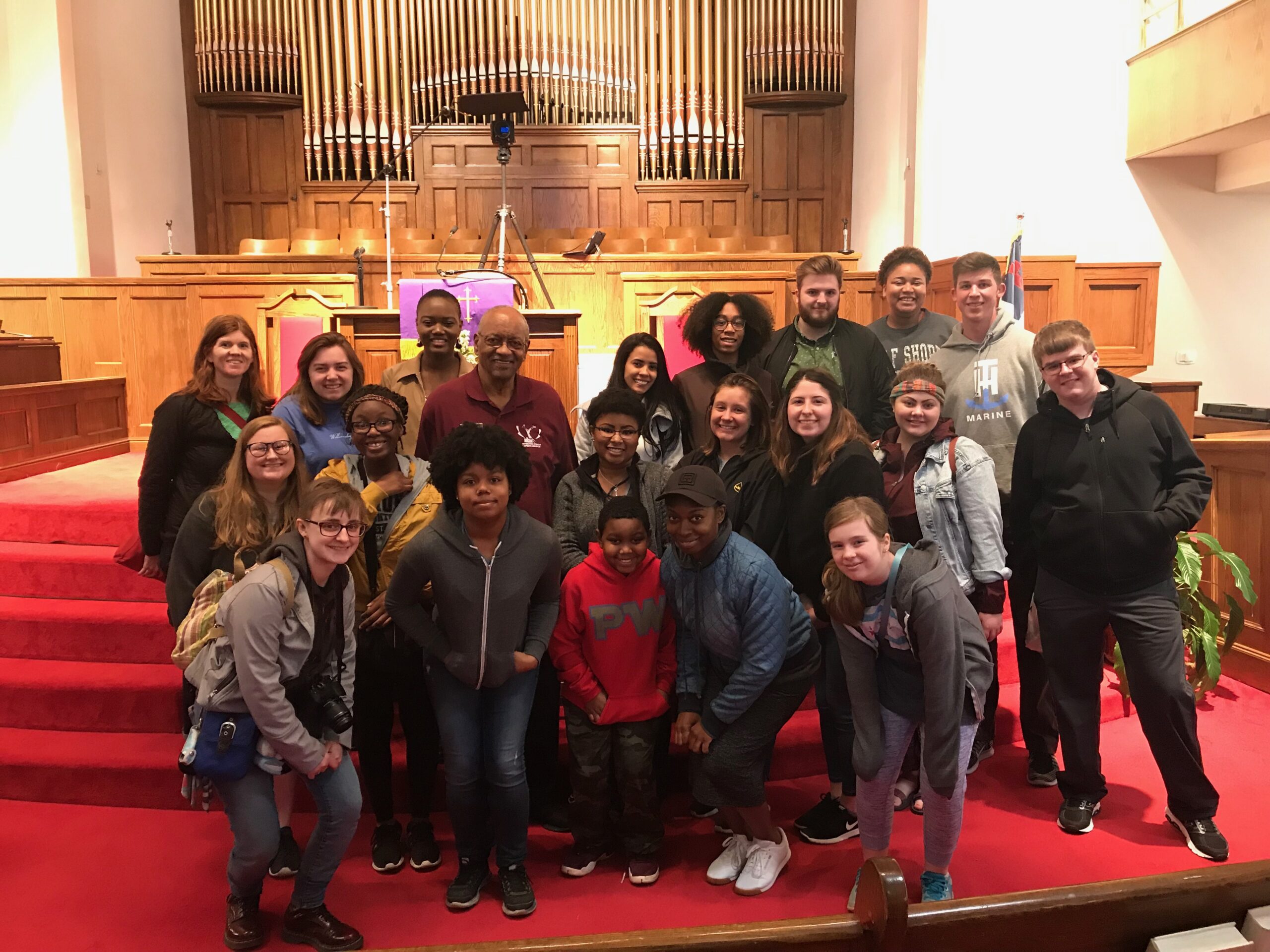
It was there that we met Armond Bragg, whose family have been a part of the church for generations. Bragg explained to students that he’d dropped his younger sister off at church on his way to work on the morning of the explosion. Given that Bragg is in his 70s, it was a reminder that this movement and these events did not happen too long ago.

On our last day, we started in Selma, walking across the Edmund Pettus Bridge, where a young John Lewis (now a Democratic U.S. Representative from Georgia) had his skull broken as he marched in support of voting rights on Bloody Sunday.
We had no idea that journeying to Selma would allow us to come face-to-face with individuals who had actually participated in the Civil Rights Movement.
For example, at the Selma Interpretive Center, we had the incredible opportunity to meet Joanne Bland, one of the youngest people ever arrested in the Civil Rights Movement.
We met Sam Baker at the National Voting Rights Museum. As a young man, Baker volunteered at the march to Montgomery and participated in the last leg of the march.
These individuals demonstrate being ordinary people who took extraordinary measures asking that basic rights be extended to them.

Our final two stops in Montgomery were the Freedom Riders Museum and the Civil Rights Memorial Center.
We are asked all the time if the 21 hours spent on the bus and the nearly 1,500 logged miles was worth it, and the answer is a resounding YES. In fact, on March 25, we embark on our second tour, which will be four days long, with Mississippi being added.
Knowing that UMSL students are very likely to stay in the St. Louis area upon graduation, it is our hope with these trips that students will be inspired and come back ready to engage with and improve their communities.
– Courtney McDermott is an assistant teaching professor and Associate Director of Field Education for the School of Social Work at UMSL. Sha-Lai Williams is an associate professor in UMSL’s School of Social Work and teaches Social Work Practice and Human Behavior courses.